
Picking the wrong telehandler tires leads to constant punctures, costly downtime, and safety risks. This frustration eats into your profits and project timelines, leaving you with an unreliable machine.
The best telehandler tire depends on your jobsite conditions, puncture risks, and downtime costs. Match pneumatic tires for soft ground, solid tires for puncture-prone areas, and foam-filled tires for a balanced, all-around solution to optimize performance and your total cost of ownership.=
As a manufacturer with over 15 years of experience, I’ve seen countless customers grapple with this decision. A telehandler is only as good as the tires it sits on. The wrong choice doesn’t just mean a bumpy ride; it impacts safety, load stability, and your entire operation’s efficiency. The right choice, however, can transform your machine’s performance and save you a significant amount of money in the long run. Let’s break down exactly what you need to know to make the right call.
What are the Main Types of Telehandler Tires?
You see options like pneumatic, foam-filled, and solid, but the differences seem confusing. Choosing without understanding can lead to buying an expensive tire you don’t need or a cheap one that fails.
The three main telehandler tire types are pneumatic (air-filled), foam-filled (a pneumatic casing filled with a polymer), and solid (made entirely of rubber). Pneumatic tires offer comfort, foam-filled tires prevent flats, and solid tires provide maximum durability and stability in harsh environments.
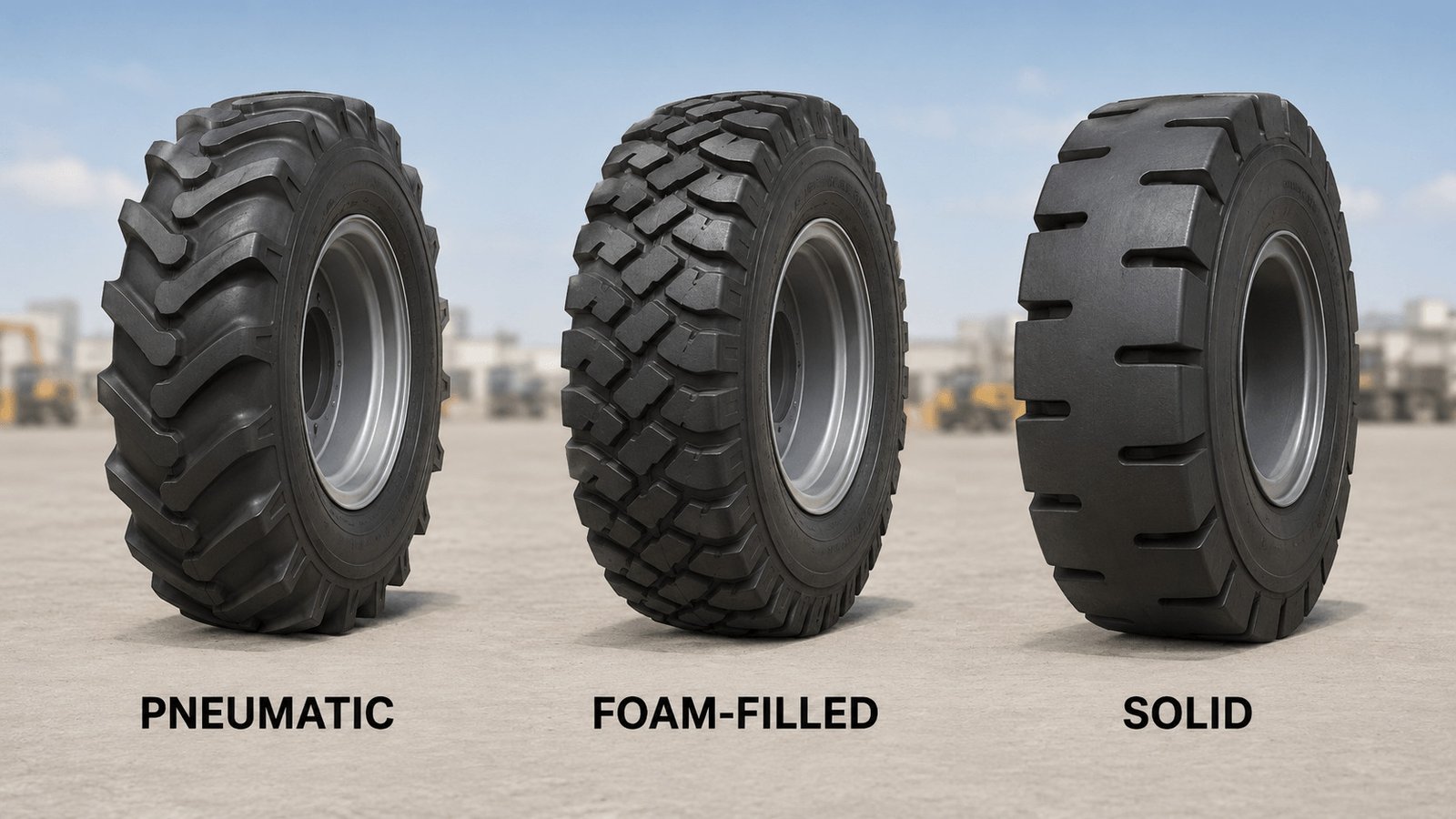
Each tire type was designed to solve a specific problem on the jobsite. Understanding their core strengths and weaknesses is the first step toward making an informed decision. I’ve worked with clients who swore by one type, only to find another was a better fit for a new project. It’s all about matching the tool to the task.
Here’s a breakdown to help you see the differences more clearly:
| ميزة | Pneumatic (Air-Filled) | Foam-Filled | Solid Rubber |
|---|---|---|---|
| Puncture Resistance | Low | High | Puncture-Proof |
| راحة المشغل | High | Medium | Low |
| Soft Ground Traction | Excellent | Good | Fair to Poor |
| Upfront Cost | Low | Medium | High |
| Lifespan | Shortest | Medium | Longest (up to 4-8x) |
| صيانة | High (Air Pressure) | Low | None |
Pneumatic tires are the standard for a reason. Their air-filled design acts as a natural shock absorber, providing the most comfortable ride for the operator and reducing wear on the machine’s components. They also offer excellent “flotation,” meaning they spread the machine’s weight over a wider area, which is perfect for soft ground like mud or sand. Their biggest weakness is their vulnerability to punctures.
Solid tires are the ultimate solution for durability. Made of solid rubber, they are completely immune to flats. This makes them a game-changer on sites littered with nails, rebar, and sharp debris. They also provide incredible stability for high-lifting operations. However, this toughness comes at the cost of comfort and a much higher initial price.
Foam-filled tires offer a middle ground. We take a standard pneumatic tire casing and inject it with a special polymer that cures into a solid, resilient core. You get the puncture-proof reliability of a solid tire but with a bit more give than a solid rubber block, making the ride slightly less harsh. They are heavier and more expensive than pneumatic tires but are often a great compromise for mixed-use environments.
How Do I Match a Tire to My Jobsite?
You know the tire types, but your jobsites change from smooth concrete to muddy fields with construction debris. You worry that one tire type won’t handle all your needs, forcing a compromise that costs you money.
Match your tire to your jobsite by assessing the ground conditions and puncture risks. Use solid tires for demolition sites with rebar and nails. Choose pneumatic tires for agricultural work on soft soil. Opt for foam-filled or solid tires for mixed-use rental fleets where downtime is unacceptable.
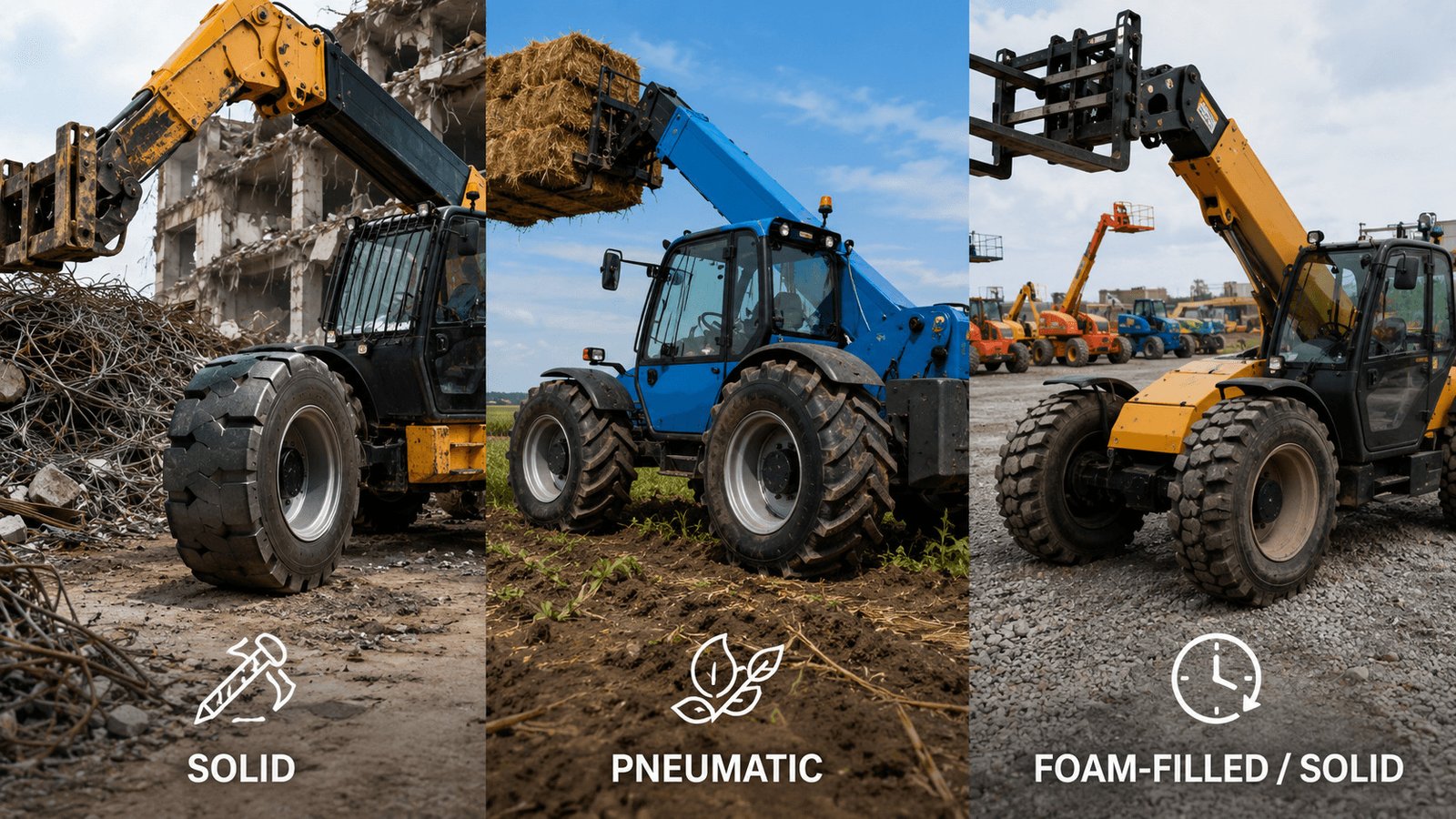
The “best” tire doesn’t exist. The best tire is the one that directly addresses the biggest challenges of your primary workplace. Over the years, I’ve helped my clients analyze their work environments to pinpoint the perfect tire. The goal is always to maximize uptime and safety while managing costs effectively. Here is how I advise them to think about it.
For Debris-Filled Construction and Demolition Sites
If your telehandler operates on sites with scrap metal, broken concrete, rebar, and nails, your biggest enemy is tire punctures. Here, every flat tire means a stopped machine, a paid operator standing by, and potential project delays. For these environments, solid tires are almost always the right answer. Their puncture-proof design eliminates downtime from flats. The stability they offer is also a major plus when lifting heavy materials to height. The trade-off is a rougher ride for the operator and a higher upfront investment. But when you compare that to the cost of one or two service calls and lost work hours, the solid tire often pays for itself quickly.
For Agriculture and Soft, Uneven Ground
On farms, landscaping projects, or any job on soft dirt, mud, or sand, your main challenge is traction and ground disturbance. You need a tire that “floats” on top of the surface rather than digging in. This is where pneumatic tires truly shine. Their flexible sidewalls and ability to run at lower pressures create a larger footprint, providing excellent traction and minimizing damage to the ground. The air cushion also gives a much smoother ride over bumpy fields, reducing operator fatigue and protecting the telehandler itself from excessive vibration and shock. The obvious risk is punctures from rocks or field debris, but in many agricultural settings, this risk is manageable.
For Rental Fleets and Mixed-Use Scenarios
Rental companies face the biggest challenge because their machines go to a different jobsite every week. One day it’s a smooth warehouse floor, the next it’s a messy construction site. Here, the priority is reliability and minimizing service calls. For this reason, many rental fleet managers choose foam-filled or solid tires. Foam-filled tires are a popular compromise, offering puncture protection without the full cost and harshness of solid tires. However, if their service records show frequent tire damage and high downtime costs, making the jump to solid tires becomes a smart financial decision. It protects their investment and ensures their customers get a machine that works without interruption.
How Can I Calculate the True Cost of My Tires?
The high price tag on solid tires looks intimidating, making cheaper pneumatic tires seem like the obvious choice. But you suspect hidden costs like repairs and downtime are eating away at those initial savings.
Calculate the true cost by considering the Total Cost of Ownership (TCO), not just the purchase price. Factor in the tire’s lifespan, potential downtime costs from flats, repair expenses, maintenance needs, and the impact of operator comfort on productivity over the long term.
As a manufacturer, I always encourage my customers to think like a fleet manager. The sticker price is only one part of the story. A cheap tire that needs to be replaced three times and causes a week of downtime is far more expensive than a premium tire that runs flawlessly for years. Let’s dig deeper into the real factors that determine your tire costs.
To find the TCO, you must look beyond the initial purchase. Here’s a simple framework I use with my clients:
1. Purchase Price vs. Lifespan
A pneumatic tire might be the cheapest upfront, but a solid tire can last four to eight times longer in a harsh environment. Let’s say a pneumatic tire costs $500 and a solid tire costs $2,000. If the solid tire lasts five times as long, its “lifespan cost” is actually lower ($2,000 / 5 = $400) than the pneumatic tire ($500 / 1 = $500), not even counting the labor to change the pneumatic tires four extra times.
2. The Cost of Downtime
This is the most important and most overlooked cost. What happens when a telehandler gets a flat tire on a busy jobsite?
- Lost Labor: The operator is paid to wait. A crew might also be waiting for the materials the telehandler was supposed to deliver.
- Lost Revenue: The machine isn’t working and earning money.
- تكاليف الإصلاح: You have to pay for a service truck to come out and either patch or replace the tire.
If your machine is down for just 3 hours and your total cost per hour (labor, rental revenue, etc.) is $100, that’s $300 lost from a single flat tire. If this happens several times a year, the cost skyrockets.
3. Maintenance and Repairs
Pneumatic tires require daily pressure checks. Under-inflation leads to premature wear and increases the risk of sidewall failure. Patching and repairing flats also adds up. In contrast, solid and foam-filled tires require virtually zero maintenance. You install them and forget about them until they wear out. This saves labor time and eliminates the possibility of human error in maintenance. This is a key reason we see so many of our industrial clients opting for solid tires on their custom HIXEN telehandlers.
By adding up the purchase price, repair costs, and downtime costs over the expected life of the tire, you get a much more accurate picture of what you’re actually spending.
خاتمة
Choosing the right telehandler tire isn’t about finding the toughest or cheapest option. It’s about matching the tire to your specific jobsite, operational risks, and overall cost of ownership.

