
Choosing between a telehandler and a boom lift can be confusing. They both have long arms, but picking the wrong one leads to project delays, wasted money, and serious safety risks.
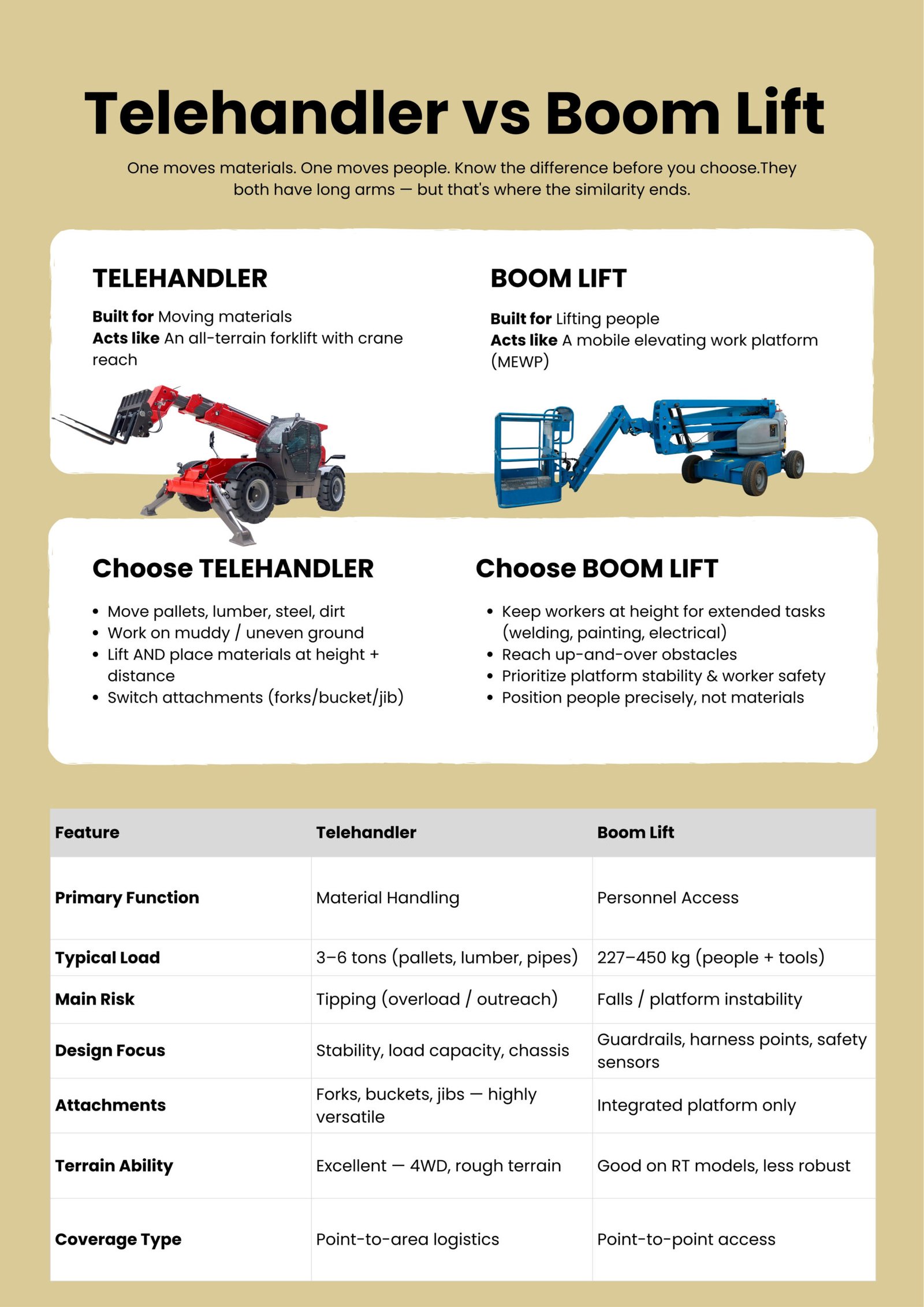
The key difference is simple: a telehandler is built to move materials, acting like an all-terrain forklift with a crane’s reach. A boom lift is a mobile elevating work platform (MEWP) designed specifically to lift people safely to work at height. One moves things, the other moves people.
While they might look similar from a distance, their designs are based on completely different goals. I’ve spent over 15 years in this industry, and the most common mistake I see is confusing these two machines. Let’s break down what each one is really built for. Understanding this will make your next equipment decision much clearer and safer.
What a Telehandler Is Built to Do?
You have heavy pallets of bricks to move across a muddy, unfinished site. A forklift will get stuck, and a crane is too slow. This is where a telehandler becomes your most valuable player.
أ حكاية is a mobile material handling system. Think of it as a super-powered, all-terrain forklift. Its main job is to lift, move, and place heavy loads like lumber, steel, or supplies across challenging job sites, reaching high and far where other machines can’t go.
At our factory, we don’t just see a telehandler as a machine; we see it as a “mobile logistics system.” Its entire design revolves around a physics problem: safely managing a heavy, dynamic load. The load is not just the material’s weight but also its changing center of gravity as the boom extends and retracts. This is why the main risk for a telehandler is tipping over. Our engineering focus is on stability, which is controlled by the relationship between the load moment and the outreach. The further you reach, the less you can lift. This is all detailed in the load chart, the operator’s most important guide. A telehandler’s purpose is to provide “point-to-area” logistics coverage, meaning it can pick up materials from one spot and distribute them over a wide work area.
| Common Telehandler Tasks | Materials Handled | Key Feature Used |
|---|---|---|
| Unloading trucks | Pallets, pipes, equipment | Forks, high lift capacity |
| Framing and roofing | Lumber, trusses, sheeting | Telescopic reach, frame leveling |
| Site cleanup | Debris, soil, gravel | Bucket attachment |
| Moving materials on rough ground | All types | 4WD, large tires, high clearance |
What a Boom Lift Is Built to Do?
Your crew needs to install windows on the fourth floor. Scaffolding takes days to erect, and ladders are out of the question. You need to get your workers up there safely and efficiently right now.
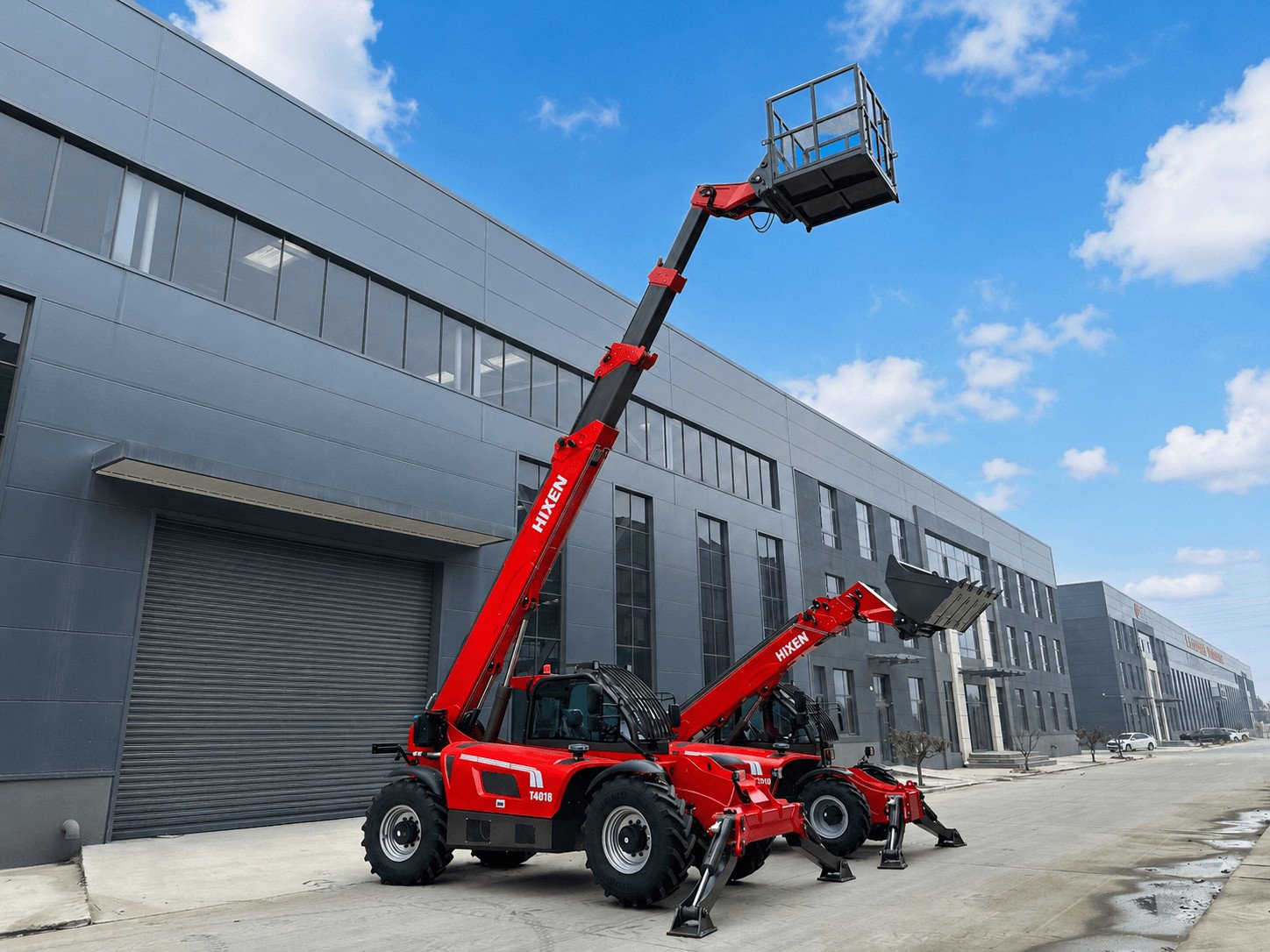
A boom lift is a “personnel safety system.” Its one and only job is to provide a secure, stable platform for people and their tools to work at height. It is not designed for lifting materials; it is designed to protect workers from falls and platform instability.
When you look at a boom lift, you’re looking at a machine designed to solve a “personnel safety system problem.” The load it carries is small and predictable: one or two workers plus their hand tools. The biggest risk isn’t tipping, but a person falling from the platform or the platform becoming unstable. Because of this, the design focus is entirely on safety features. This includes strong guardrails, mandatory harness anchor points, tilt sensors that sound an alarm if the ground is too sloped, and emergency lowering systems. A boom lift excels at “point-to-point access.” It’s designed to get a worker from the ground to a very specific spot, especially when they need to reach up and over obstacles, which is where articulating (knuckle) booms shine.
| Common Boom Lift Tasks | Tools Used on Platform | Key Feature Used |
|---|---|---|
| Electrical work / HVAC | Drills, wiring tools | Precise positioning |
| Painting and finishing | Sprayers, rollers | Stable work platform |
| Building inspection | Cameras, measuring tools | Up-and-over reach |
| Window installation | Glass suction cups, sealants | Smooth controls, safety |
Telehandler vs Boom Lift: Quick Comparison Table?
You’re on the phone with a rental company and need to make a fast decision. Wasting time trying to figure out specs is frustrating. A simple chart can give you the answer you need in seconds.
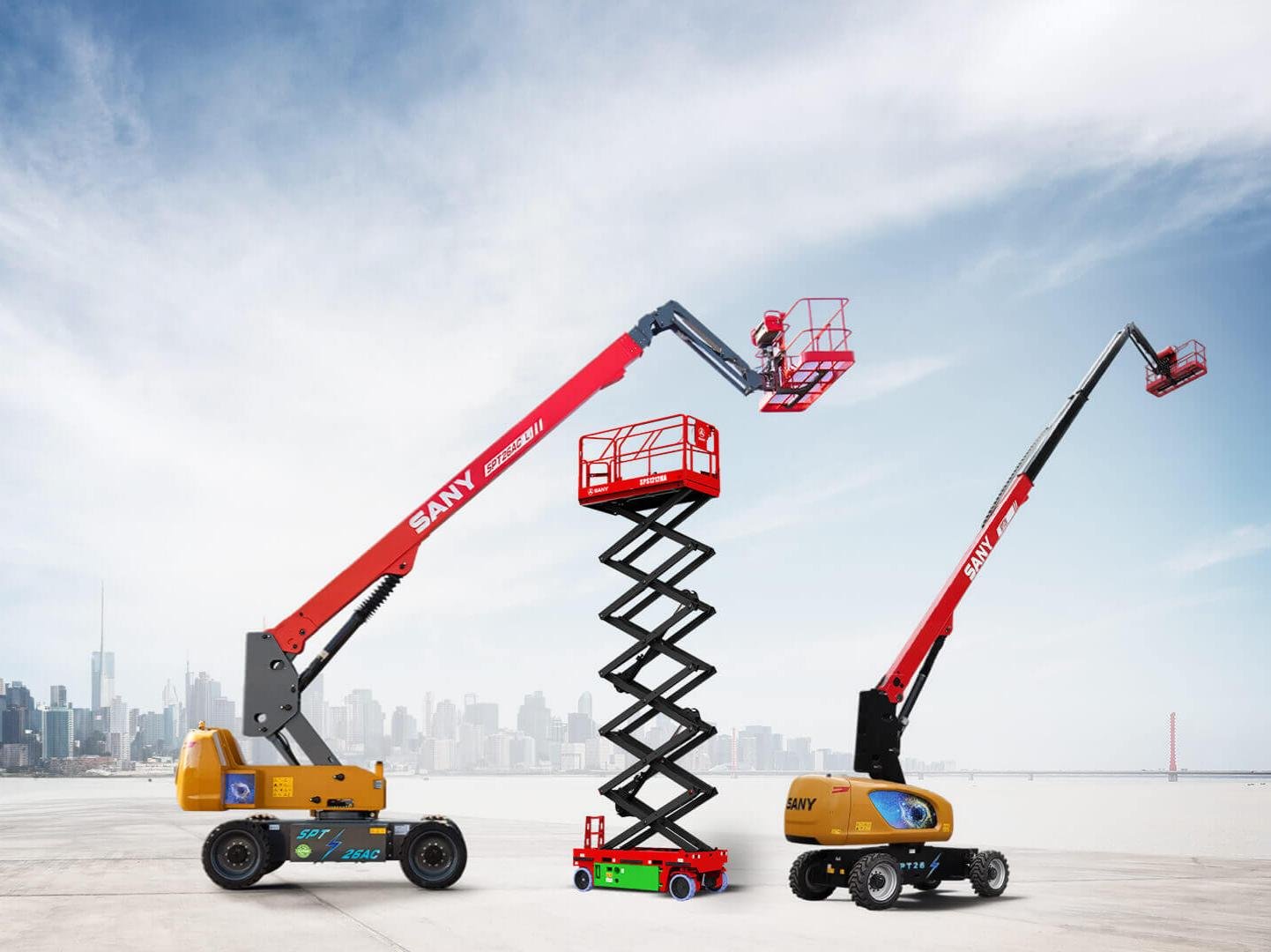
Here is a quick comparison. Telehandlers are workhorses for heavy materials and rough ground. Boom lifts are safety platforms for workers. If you’re moving pallets, choose the telehandler. If you’re lifting a welder to a high beam, choose the boom lift. It’s that simple.
I’ve put this table together based on thousands of conversations with customers. It cuts through the noise and gets right to the point. Pin this up in your office; it will save you headaches. The core functions are completely different, even if both machines have a boom. One is about power and stability with a heavy load, and the other is about precision and safety for a human life. This difference impacts every aspect of their design, from the chassis to the controls. Understanding this table is the first step to running a more efficient and safer job site.
| ميزة | مناولة | رفع بوم |
|---|---|---|
| Primary Function | Move heavy materials (Material Handling) | Lift people to work at height (Personnel Access) |
| Typical Load | Pallets, lumber, pipes (3 to 6 tons) | People and tools (227 to 450 kg) |
| Main Risk | Tipping over due to overload/outreach | Worker falling from platform, platform instability |
| Key Design Focus | Mechanical stability, load capacity, chassis | Personnel safety systems (guardrails, harnesses) |
| المرفقات | Highly versatile (forks, buckets, jibs) | Integrated work platform only |
| Terrain Ability | Excellent; designed for rough terrain (4WD) | Good (on RT models), but less robust than telehandlers |
| الاستخدام الأساسي | Point-to-area logistics coverage | Point-to-point worker access |

The Biggest Difference: Materials vs People?
It’s so easy to see two machines with extending arms and assume they do the same thing. I’ve seen this assumption lead to dangerous situations. The fundamental difference lies in what they are designed to carry.
The single biggest difference is this: telehandlers are engineered to solve the physics problem of lifting heavy, variable materials. Boom lifts are engineered to solve the safety problem of protecting people at height. This core purpose defines every single component, from the engine to the safety sensors.
Let’s go a bit deeper. A telehandler’s design is all about the “mechanical stability problem.” The machine itself acts as a counterweight. The operator constantly thinks about the load chart, the boom angle, and the extension. Our HIXEN telehandlers have advanced sensors to help with this, but the physics is central. The challenge is managing a load whose center of gravity is always changing.
A boom lift, on the other hand, is about the “personnel safety system problem.” The load is light and fixed. The engineering focus shifts entirely to creating a safe bubble for the worker. The platform must stay level, the guardrails must be a specific height, and harness points must be rated to catch a fall. It’s not about lifting power; it’s about creating a safe, unmoving workspace dozens of feet in the air. I once saw a crew try to use a boom lift to nudge a heavy steel beam into place. The overload alarms started screaming, and the machine locked up. They needed a telehandler but didn’t understand this fundamental difference.
Can a Telehandler Replace a Boom Lift?
You’ve got a telehandler on-site, but your crew needs to do a quick repair 40 feet up. Renting a boom lift for a 30-minute job feels like a huge waste. Can your telehandler step in?
Yes, a telehandler can sometimes replace a boom lift, but only if you use a certified man basket attachment. This setup is ideal for temporary or occasional high-access tasks, especially on rough terrain where a standard boom lift might not be able to travel.
While possible, this isn’t a perfect one-for-one replacement. It’s a solution that works under specific conditions. First and foremost, you must use a properly engineered and certified work platform that is compatible with your telehandler model. Never use forks with a simple pallet as a platform—that is incredibly dangerous. Second, this is best for low-frequency use. Think of a quick inspection or a minor repair, not a full day of painting where a dedicated boom lift would be far more efficient. The biggest advantage of using a telehandler with a basket is on very challenging terrain. If the site is extremely muddy or uneven, a telehandler’s superior chassis and 4WD system might be the only way to get a work platform to the required location. Remember, even with the right attachment, all safety rules for elevating personnel still apply.
.jpg)
Terrain Performance: Which Machine Handles Rough Ground Better?
Your new construction site looks more like a mud pit than a work area. Getting the wrong machine means it will get stuck within the first hour. You need a machine that can power through the worst conditions.
The telehandler is the undisputed champion of rough terrain. It is designed from the ground up with a heavy-duty chassis, large off-road tires, and advanced drivetrains like four-wheel drive and four-wheel steering. It’s built to navigate undeveloped sites with ease.
The difference in off-road capability is huge. A telehandler is built like a rugged off-road vehicle. Its heavy-duty frame provides a low center of gravity for stability during transport. Most of our models at HIXEN come with 4WD and three steering modes: front-wheel, crab steer for moving sideways, and circle steer for tight turns. This makes them incredibly agile on cluttered and uneven sites. In contrast, while rough-terrain boom lifts exist, their main focus is stability once parked, not traveling across difficult ground. They can handle moderate terrain, but their chassis is not as robust, and they can become top-heavy and unstable when trying to navigate the same soft mud or steep inclines that a telehandler handles easily. I’ve been on many sites where our telehandlers were the only machines moving, delivering materials to boom lifts that were stuck waiting for the ground to dry.
Telehandler vs Boom Lift: Which One Should You Choose?
It’s decision time, and the wrong choice will impact your budget and timeline. You need to get this right the first time. How do you make the final call with confidence?
The choice comes down to one question: what are you lifting? If the primary task is moving materials, get a telehandler. If the primary task is lifting people to work, get a boom lift. Don’t get distracted by reach or height; focus on the load.
Let’s make this really simple. Use this checklist for your next project.
Choose a TELEHANDLER if you need to:
- Move heavy loads like pallets, lumber, steel, or dirt.
- Work on undeveloped, muddy, or very uneven ground.
- Lift AND place materials at both height and distance.
- Use a versatile machine that can switch between forks, a bucket, or a jib crane.
- Handle the logistics for the entire site.
Choose a BOOM LIFT if you need to:
- Have workers perform tasks at height for long periods (e.g., welding, painting, electrical installation).
- Reach up and over obstacles to access a specific work point.
- Prioritize worker safety and a stable platform above all else.
- Complete tasks that require precise positioning of people, not materials.
From my 15+ years of experience, I can tell you that job site efficiency and safety skyrocket when the right machine is used for the right job. It’s not about which machine is “better,” but which machine is “correct” for the work you have to do today.
خاتمة
Ultimately, telehandlers are for materials, and boom lifts are for people. Understanding this core difference is the key to choosing the safest, most efficient, and most cost-effective machine for your job.

