
Struggling to manage material handling on uneven, challenging job sites with multiple, single-purpose machines? You might be using a forklift for lifting, a wheel loader for loading, and a crane for reaching, creating logistical headaches and driving up operational costs. It’s a common problem that leads to lower efficiency and a crowded, less safe work environment. This guide introduces the chariot télescopique tout terrain, a single, versatile solution designed to streamline your operations and boost productivity.
An all terrain telehandler, also known as a rough terrain telescopic handler, is a highly versatile machine designed to lift, move, and place materials on challenging, uneven surfaces. It combines the capabilities of a forklift, wheel loader, and crane, featuring a telescopic boom that can extend forward and upward, equipped with four-wheel drive and rugged tires for superior off-road performance.
Now that we’ve established what this powerful machine is, let’s explore what makes it such an indispensable asset. The true value lies not just in its lifting power but in its incredible adaptability. We’ll break down its key features, diverse applications, and how it stacks up against other equipment, giving you the knowledge to make an informed decision for your fleet.
What Is an All Terrain Telehandler?
Trying to understand how a single piece of equipment can replace several others on your site? It can be confusing to see one machine performing tasks typically done by a forklift, a loader, and a small crane. The key lies in its unique design. An chariot télescopique tout terrain is engineered specifically for this kind of multi-functionality.
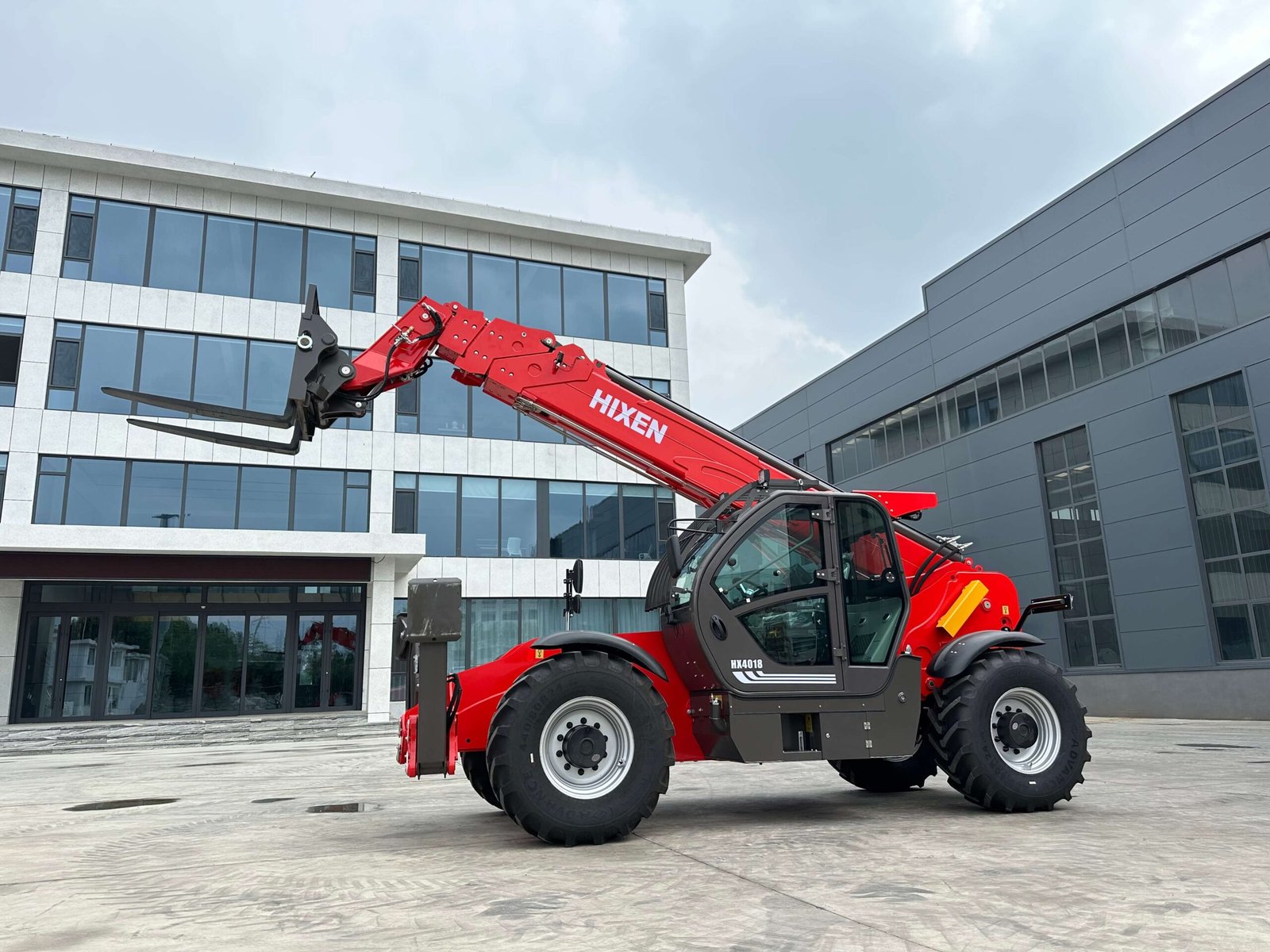
At its core, an chariot télescopique tout terrain is a Class 7 telescopic handler built for rugged environments. Unlike standard forklifts that require smooth, level ground, this machine thrives on mud, gravel, and uneven landscapes. Its defining feature is the telescopic boom, which allows it to place loads at height and reach, something a vertical-mast forklift simply cannot do.
The Evolution from Forklift to Multi-Tool
The concept of the telehandler originated from the need to improve upon the traditional forklift, especially in agricultural and construction settings. Early machines were essentially beefed-up forklifts, but the addition of the telescopic boom was a revolutionary step. This boom can be fitted with a wide array of attachments, transforming the machine’s function in minutes.
The “all terrain” designation is crucial. It signifies a specific build quality and feature set:
- Robust Chassis: A heavy-duty frame designed to withstand the torsional stresses of lifting heavy loads on uneven ground.
- Four-Wheel Drive (4WD): Provides the necessary traction to navigate through mud, sand, and steep inclines without getting stuck.
- High Ground Clearance: Allows the machine to travel over obstacles and rough terrain that would stop a conventional vehicle.
- Large, Rugged Tires: Often filled with foam or solid rubber to prevent punctures, these tires offer stability and grip.
A True Multi-Functional Asset
The real advantage of an chariot télescopique tout terrain is not just its lifting capacity, but its operational flexibility. With the right attachment, it can seamlessly switch between tasks. For example, on a single construction project, it can:
- Unload pallets of bricks from a truck using a fork attachment.
- Transport those bricks across a muddy site to the building perimeter.
- Lift the bricks up to the second or third story for the masons.
- Switch to a bucket attachment to move gravel or soil.
- Use a truss jib or hook to lift and place roof trusses.
This ability to consolidate tasks into one machine is its greatest strength. It reduces the total number of machines needed on-site, which in turn lowers costs related to fuel, maintenance, operators, and transportation. A true chariot télescopique tout terrain is not only designed to move on rough ground but also to maintain lifting performance in these challenging environments.
Key Features of an All Terrain Telehandler?
Wondering what specific components give this machine its “all terrain” capabilities? It’s easy to see the big tires and long boom, but the real magic is in the engineering that combines these elements for safe and efficient operation. Without these integrated features, it would just be another forklift.
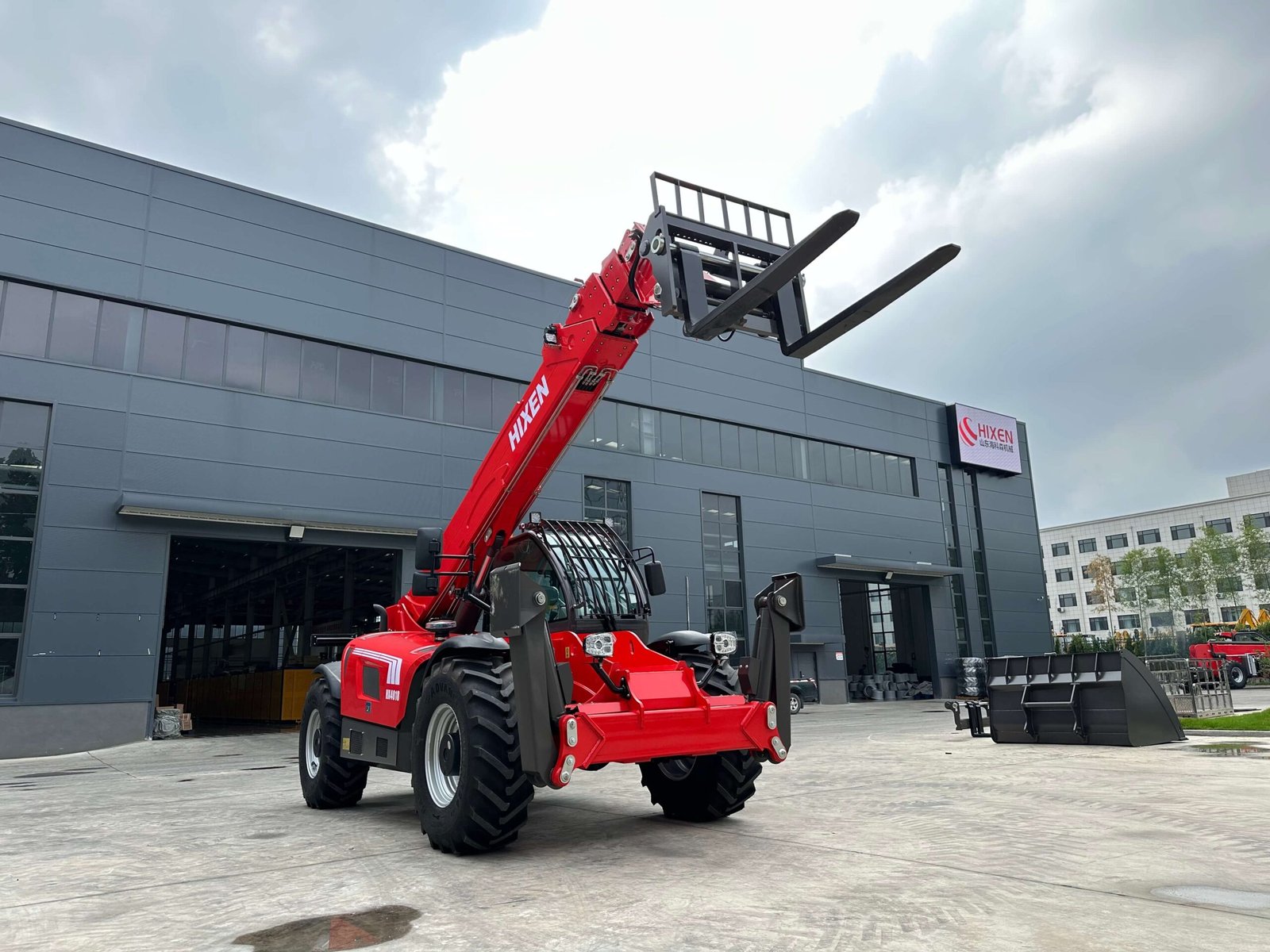
The defining features of an chariot télescopique tout terrain include a powerful engine, a robust 4×4 drivetrain, high ground clearance, multiple steering modes, and a load management system. These elements work together to provide stability, mobility, and safety when lifting heavy loads on unstable surfaces where other machines would fail.
Breaking Down the Core Components
Let’s dive deeper into the specific features that make an chariot télescopique tout terrain an indispensable tool for challenging environments. Understanding these components is critical when evaluating different models for procurement.
The Telescopic Boom
This is the machine’s most prominent feature. Unlike a forklift mast that only moves vertically, the boom can extend telescopically (straight out) and elevate, allowing for both reach and height. The boom’s strength, maximum reach, and lifting capacity are primary specifications to consider. High-quality booms are made from high-tensile steel to handle immense stress. When I was visiting a manufacturing facility recently, I saw the intricate welding process that goes into a single boom section—it’s a testament to the engineering required.
Drivetrain and Steering
Mobility on rough terrain is non-negotiable. Key drivetrain and steering features include:
- Four-Wheel Drive (4WD): Essential for traction. Most models offer permanent 4WD or selectable 2WD/4WD to balance fuel efficiency with performance.
- Multiple Steering Modes: This is a game-changer for maneuverability in tight spaces.
- Front-Wheel Steer: For normal on-road or hard-surface travel.
- Four-Wheel Steer: For a tighter turning radius, ideal for navigating crowded job sites.
- Crab Steer: Allows the machine to move diagonally, perfect for positioning alongside a wall or trench.
Chassis and Stability
UN rough terrain telehandler needs a solid foundation.
- Frame-Leveling: Many models offer hydraulic chassis leveling. This allows the operator to level the machine’s frame (often by +/- 10 degrees) before lifting on a side slope, ensuring a stable and safe lift.
- Outriggers: For models with very high lift capacities or long reaches, outriggers (stabilizers) can be deployed to create a wider, more stable base. This significantly increases the lifting capacity when the boom is extended.
Attachments and Versatility
The quick-coupler system allows operators to change attachments quickly and safely. This is where the machine’s versatility truly shines. Common attachments include:
| Attachement pour chariot télescopique | Utilisation principale | Industries |
|---|---|---|
| Fourchettes | Lifting and moving pallets of material (bricks, seed, etc.) | Construction, Agriculture |
| Seau | Moving loose materials like dirt, sand, gravel, or snow | All Industries |
| Lifting Jib | Suspending loads from a hook, like a small crane | Construction, Industrial |
| Plateforme de travail | Lifting personnel to work at height | Maintenance, Construction |
| Grappin | Handling irregularly shaped objects like logs or scrap | Forestry, Recycling |
Choosing the right attachments is as important as choosing the telehandler itself. A telehandler with multiple attachments can significantly improve equipment utilization and reduce the need for additional machines.
Applications of All Terrain Telehandlers
Where exactly does an chariot télescopique tout terrain fit into your operations? You might see it as just a construction machine, but its capabilities extend far beyond a single industry. Its adaptability makes it a valuable asset in any environment where materials need to be moved across challenging ground.
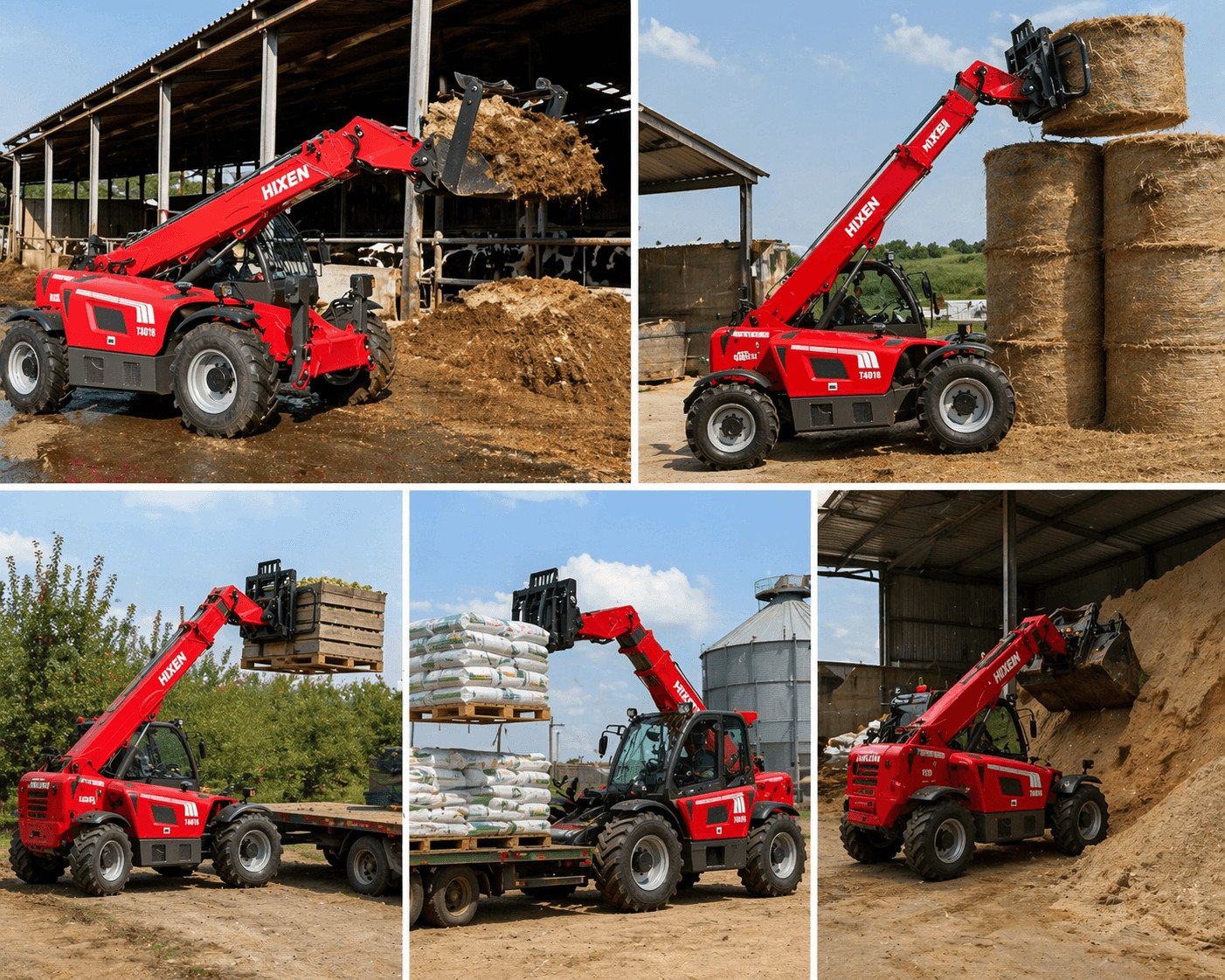
The primary applications for an chariot télescopique tout terrain are in construction, agriculture, mining, and industrial logistics. In construction, it’s used for lifting materials to height. In agriculture, for stacking hay bales and loading feed. In mining and industrial sites, for heavy-duty material handling and maintenance tasks.
A Closer Look at Industry Use Cases
The versatility of the all terrain telehandler machine means its applications are incredibly broad. Let’s explore how different sectors leverage its unique strengths.
Chantiers de construction
This is the most common environment for a telehandler. Its ability to navigate muddy, debris-strewn sites is invaluable.
- Material Placement: Lifting pallets of drywall, roofing materials, and bricks directly to the floor where they are needed. This eliminates double-handling and speeds up the building process. I’ve seen a single telehandler service a multi-story building frame, delivering materials to each level far faster than a traditional crane and ground crew could manage.
- Site Cleanup: Using a bucket attachment, it can quickly clear waste and debris, maintaining a safer work environment.
- Structural Support: With a jib attachment, it can assist in placing steel beams, roof trusses, and other structural components.
Agriculture and Farming
On the farm, efficiency is key. An chariot télescopique tout terrain replaces multiple pieces of equipment.
- Bale Handling: Stacking and transporting large hay or straw bales with grapple or spike attachments. Its reach allows for higher and more stable stacks.
- Feed and Silage Management: Using a large bucket to load feed into mixers or transfer silage. The powerful 4WD is perfect for navigating slippery barn floors and muddy fields.
- General Maintenance: Lifting heavy equipment for repairs or using a work platform to maintain buildings and silos.
Mining and Quarries
These are some of the harshest work environments, demanding extremely durable equipment.
- Tire Handling: Large mining trucks have massive tires that weigh several tons. A telehandler with a specialized tire-handling attachment can safely remove, transport, and install these tires.
- Maintenance Support: Lifting and positioning heavy components like hydraulic cylinders, engine blocks, and conveyor belts during routine maintenance.
- Material Transport: Moving heavy tools, drill bits, and other supplies around the site.
Industrial and Logistics
Even in more structured industrial settings, the chariot télescopique tout terrain finds a role, especially in yards with unpaved surfaces.
- Pipe and Lumber Yards: Handling long, heavy, and awkward loads that would challenge a standard forklift.
- Configuration de l'événement : Moving stages, lighting trusses, and barriers for large outdoor events and concerts.
- Waste and Recycling: Using grapple buckets to sort and load scrap metal, paper, and other recyclable materials.
In each application, the core benefit remains the same: one machine, one operator, multiple tasks. This consolidation is the driving force behind its growing popularity across global markets.
All Terrain Telehandler vs Forklift: Which One Do You Need?
Is a standard forklift “good enough,” or do you need the advanced capabilities of a telehandler? Many procurement managers face this decision, often defaulting to the familiar forklift without considering the hidden costs of its limitations. Making the wrong choice can lead to project delays, safety risks, and operational inefficiencies.
The choice between an chariot télescopique tout terrain and a forklift depends entirely on your work environment and tasks. A forklift is ideal for lifting pallets on smooth, level surfaces, like in a warehouse. An chariot télescopique tout terrain is necessary for lifting and placing loads at height and distance on uneven, rough terrain.

A Detailed Feature-by-Feature Comparison
To make the right decision, you must analyze your specific needs against the capabilities of each machine. The forklift is a specialist; the chariot télescopique tout terrain is a versatile generalist.
The best way to understand the difference is through a direct comparison:
| Fonctionnalité | Standard Warehouse Forklift | All Terrain Telehandler |
|---|---|---|
| Fonction principale | Vertical lifting and short transport | Forward/upward reach, lifting, and transport |
| Terrain Capability | Smooth, paved, level surfaces only | Rough, uneven, unpaved surfaces (mud, gravel) |
| Reach Capability | Vertical only (mast) | Vertical and horizontal (telescopic boom) |
| Versatilité | Limited to forks | Highly versatile with many attachments (buckets, jibs) |
| Maniabilité | Excellent in tight indoor aisles | Good; enhanced by multiple steering modes |
| Stabilité | High on level ground; low on slopes | High, especially with frame leveling/outriggers |
| Typical Cost | Lower initial investment | Higher initial investment |
| Operational Value | High efficiency in repetitive tasks | High flexibility across multiple tasks |
When to Choose a Forklift
A standard forklift is the undisputed king of the warehouse, distribution center, and factory floor. If your daily tasks involve:
- Moving pallets from a delivery truck to warehouse racking.
- Operating exclusively on concrete or asphalt surfaces.
- Lifting loads straight up and down.
- Working within tight, confined indoor spaces.
…then a forklift is likely the more cost-effective and efficient choice. Its lower purchase price and simpler maintenance make it perfect for this specialized role.
When to Choose an All Terrain Telehandler
You need to step up to an chariot télescopique tout terrain when your operational environment becomes more complex. Consider a telehandler if your tasks involve:
- Working on outdoor construction sites, farms, or unpaved yards.
- Needing to place materials on upper floors, across obstacles, or into the center of a truck bed.
- Requiring multiple functions from a single machine, such as loading dirt, lifting pallets, and acting as a personnel platform.
- Operating on slopes or uneven ground where a forklift would be unstable and unsafe.
While the initial cost is higher, the ROI for an chariot télescopique tout terrain comes from its ability to replace two or three other machines, reduce labor hours, and improve project timelines. The best telehandler is not always the one with the highest lifting capacity, but the one that matches your actual working conditions.
How to Choose the Right All Terrain Telehandler
Ready to invest, but overwhelmed by the options? Choosing the wrong model can be a costly mistake, leaving you with a machine that’s either underpowered for your needs or over-specified and overpriced. A systematic evaluation is essential to ensure you get the best value and performance.
To choose the right chariot télescopique tout terrain, you must evaluate your project’s specific requirements, including maximum lift height, maximum reach, and lift capacity. You also need to consider the work environment, necessary attachments, and the reliability of the supplier. This balanced approach ensures you select the most effective machine for your needs.
A Step-by-Step Guide to Your Selection Process
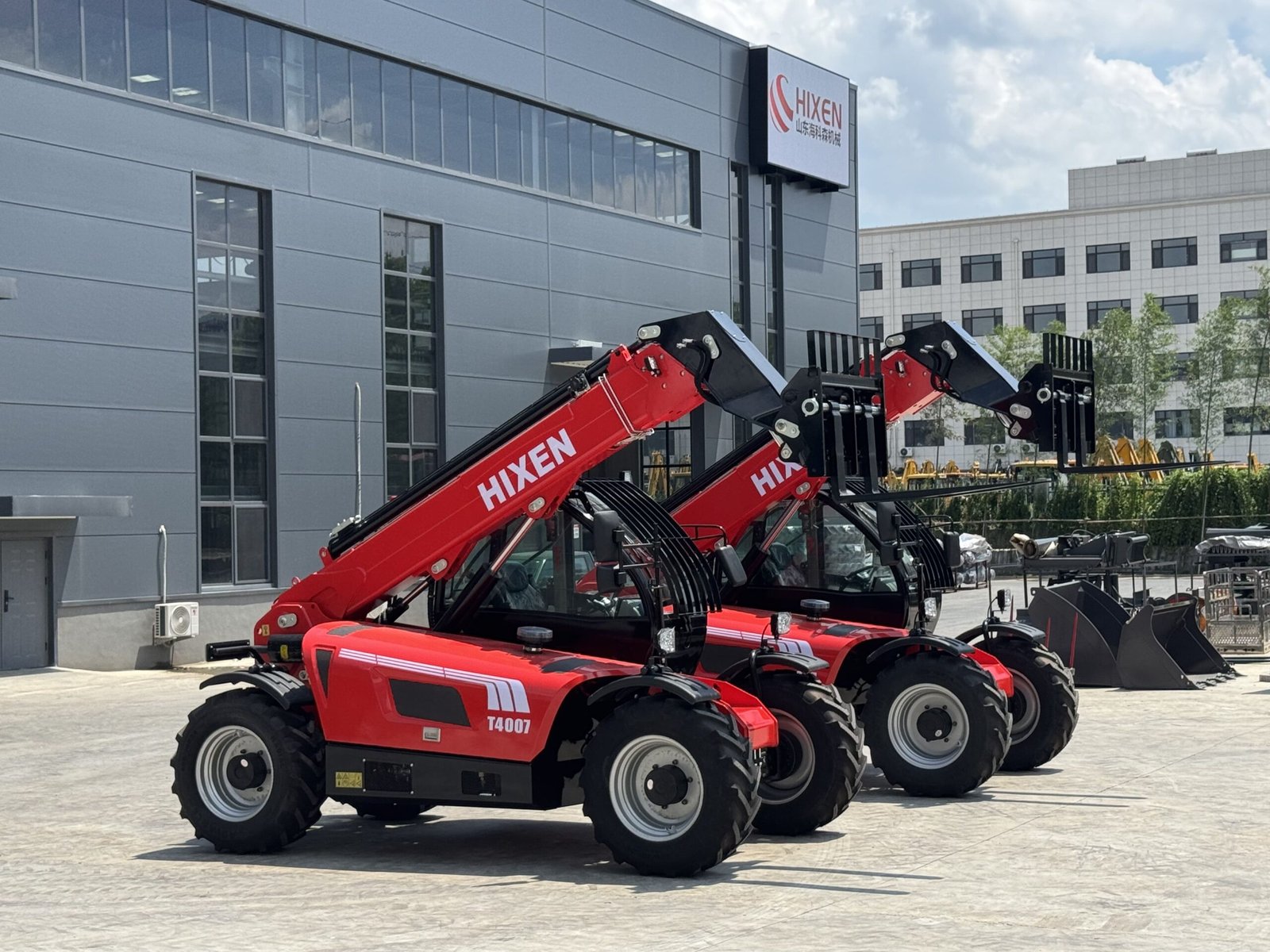
Making a major equipment purchase requires due diligence. I always recommend my clients follow a structured process to clarify their needs and compare options objectively. Choosing the right all terrain telehandler requires balancing lifting capacity, working environment, attachments, maintenance requirements, and supplier reliability.
Here is a practical checklist to guide your decision:
1. Define Your Lifting Requirements
This is the most critical step. Be precise.
- Maximum Lift Height: What is the highest point you need to place materials? Measure it. Don’t guess. Add a small buffer for safety.
- Maximum Forward Reach: What is the furthest horizontal distance you need to reach? For example, placing a pallet on the far side of a flatbed truck or through a second-story window.
- Maximum Lift Capacity: What is the heaviest single load you will lift? Remember to check the telehandler’s load chart. The capacity decreases significantly as the boom extends. A machine rated for 10,000 lbs might only lift 2,000 lbs at full reach.
2. Analyze Your Work Environment
Where will the machine operate?
- Ground Conditions: Is it mostly mud, gravel, sand, or a mix? This influences tire selection (pneumatic, foam-filled, or solid).
- Space Constraints: How much room do you have to maneuver? Measure the width of gates and the turning areas. A model with multiple steering modes might be essential.
- Slopes and Grades: Will you be working on inclines? If so, a model with frame-leveling capabilities is a must-have for safety.
3. Select the Necessary Attachments
The machine is only as versatile as its attachments.
- List Primary Tasks: What will the machine do 80% of the time? Make sure you have the right attachments for these core tasks (e.g., forks, bucket).
- List Secondary Tasks: What other jobs could it do? Consider future needs. Investing in a jib or work platform now could save you from renting a crane or boom lift later.
- Check Compatibility: Ensure the telehandler’s hydraulic system and coupler are compatible with the attachments you need.
4. Evaluate Total Cost of Ownership (TCO)
Don’t just look at the purchase price.
- Maintenance and Service: How accessible are service points? Are spare parts readily available from the supplier? What are the recommended service intervals?
- Fuel Consumption: Compare the fuel efficiency of different engine models (e.g., Tier 4 Final vs. older tiers).
- Operator Training: A complex machine requires a skilled operator. Factor in the cost of training to ensure safe and efficient use.
5. Verify Supplier Reliability
Your relationship with the supplier is a long-term partnership.
- Assistance après-vente : Do they offer technical support and on-site service?
- Parts Availability: How quickly can they supply critical replacement parts to minimize downtime?
- Reputation and Certifications: Look for established suppliers with a track record of quality and reliability. Ask for references and verify any claimed certifications.
By methodically working through these steps, you can confidently select an chariot télescopique tout terrain that will be a productive and profitable asset for years to come.
Conclusion
Choosing the right material handling equipment is a critical decision that directly impacts job site efficiency, safety, and profitability. Throughout this guide, we’ve explored the immense versatility of the chariot télescopique tout terrain. We’ve seen how its unique combination of reach, power, and adaptability allows it to replace multiple machines, streamlining operations in construction, agriculture, and beyond. From its key features like 4WD and multiple steering modes to its wide array of attachments, this machine is a true multi-tool for any challenging environment.
Remember that selecting the perfect chariot télescopique tout terrain requires a careful balance of lifting capacity, reach, your specific working conditions, and supplier reliability. By systematically evaluating your needs, you can ensure you invest in a machine that delivers maximum value.
If you are looking for a reliable, high-performance chariot télescopique tout terrain customized for your unique application, our team at Hixen Machinery is here to help. Contact us today to discuss your project requirements and discover how our engineered solutions can support your business.

