
Struggling to move materials on a complex, multi-story job site? Standard forklifts can’t provide the necessary vertical lift, leading to costly delays and logistical headaches. You need a solution that offers both power and reach, but choosing the wrong machine can compromise safety and efficiency. A high reach telehandler is engineered to solve this exact problem, providing the versatility to lift loads high and far.
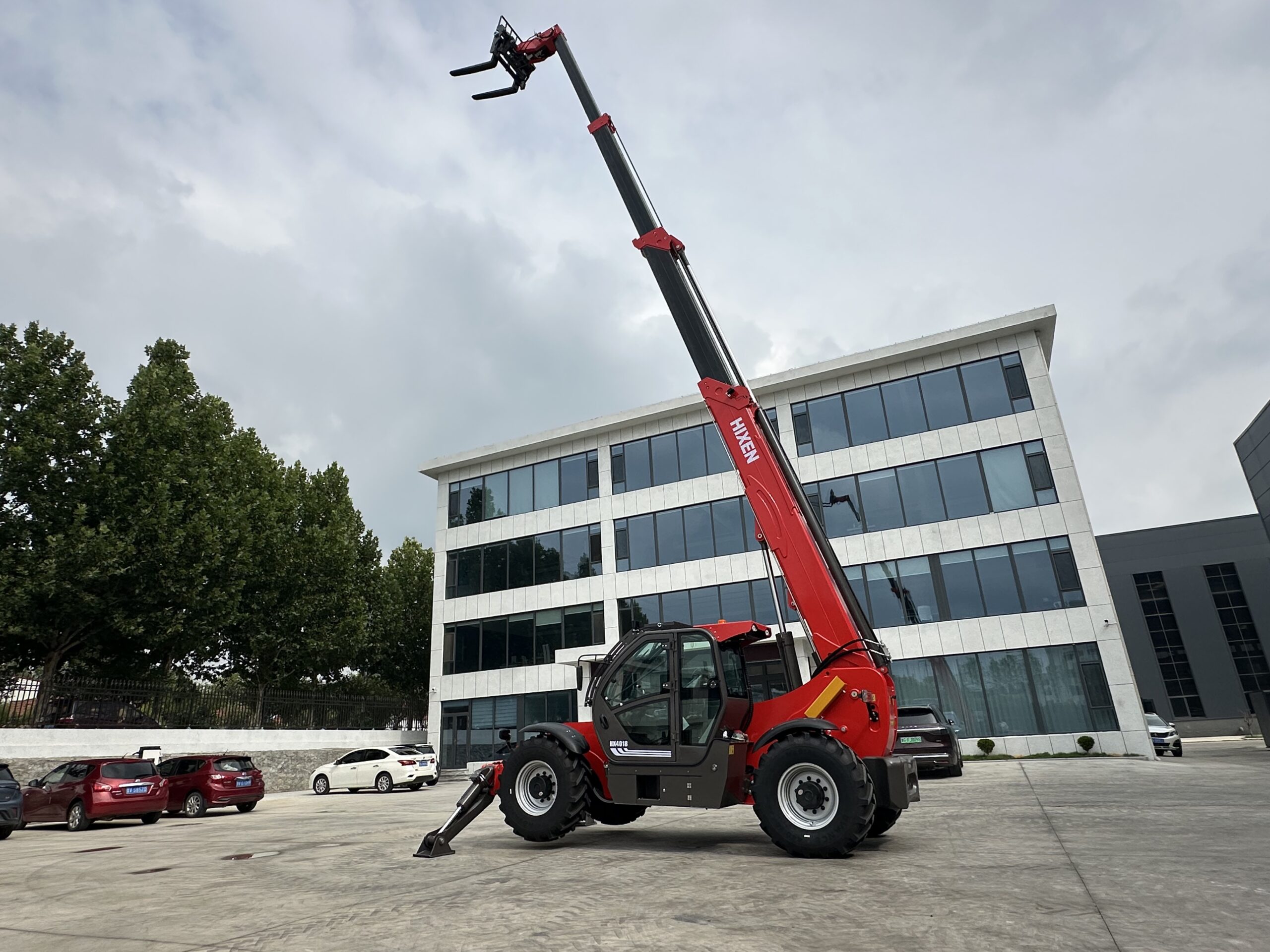
A high reach telehandler is a type of telescopic handler specifically designed for applications requiring significant vertical and forward reach, typically starting from 10 meters (33 feet) and extending up to 18 meters (59 feet) or more. Unlike standard models, they feature enhanced stability systems to safely manage heavy loads at full boom extension.
Now that we have a basic definition, let’s explore what truly sets these powerful machines apart. The value of a high reach telehandler isn’t just in its maximum height but in its practical, real-world performance. Understanding the details is key to making a smart investment for your fleet.
What Defines a High Reach Telehandler, and How High Can It Go?
You see the term “high reach” in brochures, but what does it actually mean in practice? It’s easy to get lost in specifications, wondering if a 10-meter machine is enough or if you need to step up to a much larger model.
А high reach telehandler is defined by its ability to perform safely and efficiently at significant heights, generally beyond the 7-meter range of more compact models. While their name emphasizes height, their true capability is a combination of vertical lift, forward reach, and lifting capacity.
Beyond the Maximum Height Spec
When we, as manufacturers, talk about a telehandler’s class—like a 10m, 14m, or 18m model—we are referring to its maximum vertical lift height under ideal conditions. However, the most critical factor is not just how high but what it can carry to that height.
The defining characteristic of a high reach telehandler is its entire system working in concert to handle the immense forces at play. This includes:
- A multi-stage telescopic boom: These are engineered for strength and rigidity even when fully extended.
- A robust chassis and counterweight: This provides the fundamental balance needed to prevent tipping.
- Advanced stability systems: Features like outriggers and frame leveling are non-negotiable for high-reach work.
A common application I’ve seen with our clients in the construction industry involves lifting materials over an obstacle. For example, they might need to place a pallet of roofing shingles not just onto a three-story roof, but 5 meters inward from the edge of the building. This is where forward reach, or boom span, becomes just as important as the lift height. A machine might be able to lift to 14 meters vertically, but can it still hold a meaningful load when the boom is also extended 8 meters forward? The answer to that question is found in the load chart.
How Do You Read a Load Chart for a High Reach Telehandler?
Have you ever been impressed by a telehandler’s “5-ton” rated capacity, only to find it can’t lift anywhere near that at the required height? This common frustration stems from misunderstanding the single most important document for any telehandler.
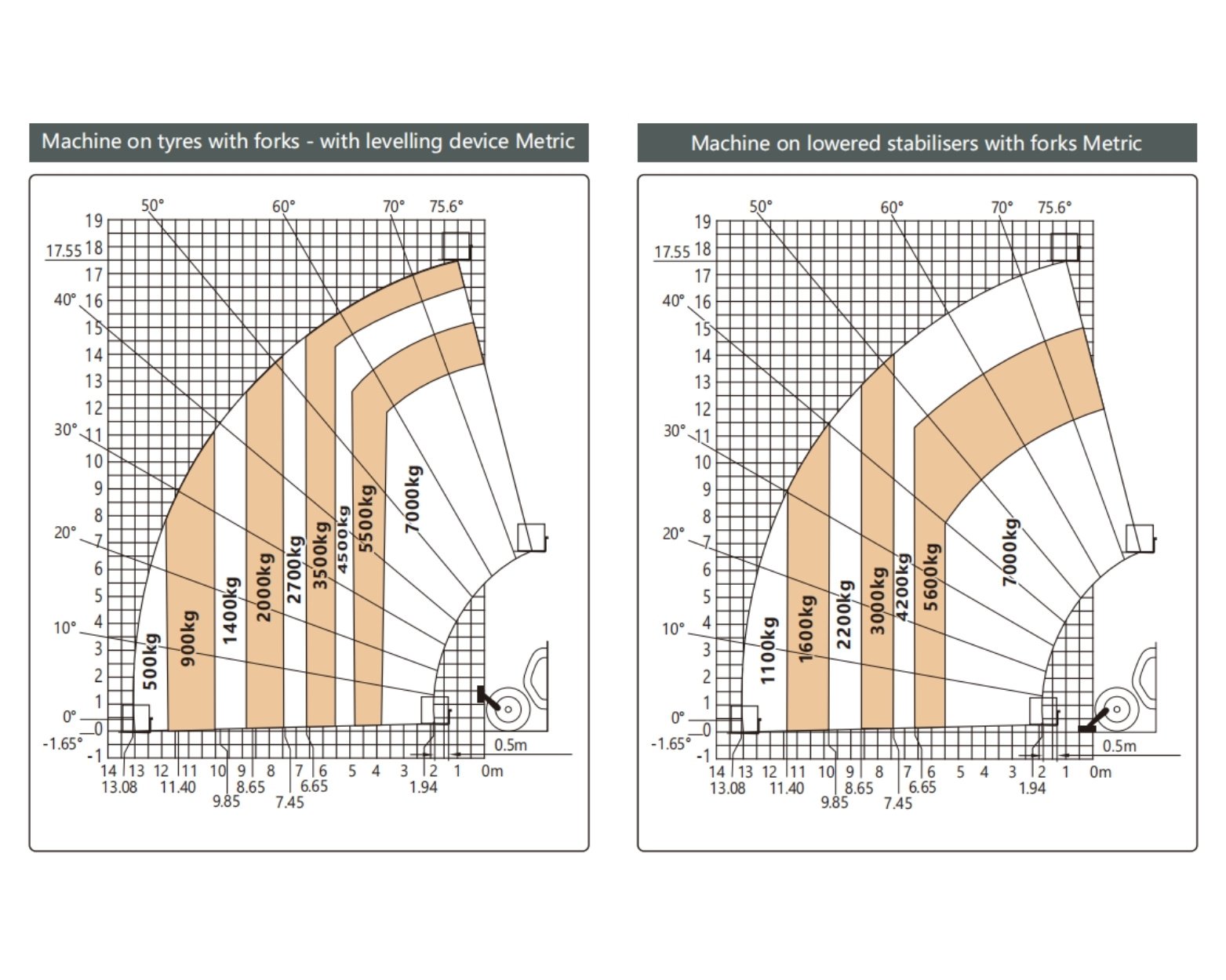
А Таблица загрузки телескопического погрузчика is a diagram, unique to each machine model, that clearly illustrates its safe lifting capacity at various combinations of boom height and forward reach. It is the definitive guide to the machine’s true operational limits, far more important than any single marketing number.
Your Guide to True Lifting Capacity
The load chart, sometimes called a capacity chart, is your key to ensuring both safety and efficiency. Ignoring it is one of the biggest mistakes a buyer or operator can make.
Rated Capacity vs. Capacity at Full Extension
A telehandler’s “rated capacity” (e.g., 4 tons, 5 tons) almost always refers to its maximum lifting ability when the boom is retracted to its shortest length and at a low angle. It’s a measure of pure hydraulic strength close to the machine’s body.
As soon as you begin to raise and extend the boom, the laws of physics take over. The load moves further from the machine’s center of gravity, and its safe lifting capacity decreases dramatically. For instance, a high reach telehandler rated for 5 tons might only be ableto safely lift 500 kilograms at its maximum height and reach. The load chart provides this critical information.
Understanding the Chart’s Axes and Curves
A load chart typically has two main axes:
- The vertical axis shows the height from the ground to the bottom of the forks.
- The horizontal axis shows the forward reach from the front of the tires to the load’s center.
The chart is overlaid with curved lines or shaded zones. Each line represents the maximum load that can be handled anywhere along its path. To use it, you find the intersection of your required height and reach and then check which capacity curve you fall under. If your target point is outside the approved operating range, the lift is unsafe and should not be attempted.
A Practical Example
Imagine you need to lift a 1,200 kg pallet of materials to a height of 12 meters and place it 7 meters forward onto a building’s third floor.
- Locate the Height: Find 12 meters on the vertical axis.
- Locate the Reach: Find 7 meters on the horizontal axis.
- Find the Intersection: Trace lines from these two points until they meet.
- Check the Capacity: Look at the capacity curve just outside of this intersection point. If it’s labeled “1,500 kg,” your 1,200 kg lift is safe. If it’s labeled “1,000 kg,” the machine cannot perform this specific lift, and you either need a larger machine or must find a way to reduce the forward reach.
How Do High Reach Telehandler Classes like 7m, 10m, 14m, and 18m Compare?
Choosing the right lift height seems straightforward, but each class of telehandler is more than just a number. Selecting a machine that is too small limits your capabilities, while one that is too large brings unnecessary costs and logistical challenges.
The primary classes—often grouped around 7m, 10m, 14m, and 18m—are designed for different scales of work. They vary significantly in chassis size, stability features, maneuverability, and cost, making the choice a strategic one based on your primary business needs.
Matching the Machine Class to Your Application
As a manufacturer serving diverse global markets, we design different classes to meet specific operational demands. A contractor in a dense European city has different needs than a mining operator in South America. Here’s a breakdown to help you compare.
| Особенность | 7m – 10m Class | 14m Class | 18m+ Class |
|---|---|---|---|
| Typical Application | General construction, agriculture, large warehouses | Multi-story building projects, industrial yards | High-rise construction, infrastructure, bridge work |
| Max Lift Height | Approx. 7 to 10 meters | Approx. 14 meters | 18 meters or more |
| Chassis & Footprint | Compact to Mid-size | Mid-size to Large | Large and heavy-duty |
| Stability System | Stabilizers often optional on smaller models | Stabilizers and frame leveling are standard | Advanced, wide-stance stabilizers and heavy-duty leveling are required |
| Маневренность | High; better for confined spaces | Moderate; requires more operational space | Lower; best suited for open, prepared sites |
| Primary Advantage | Versatility and agility | The “sweet spot” of reach and capacity | Maximum vertical and horizontal reach |
| Consideration | Limited for structures over 2-3 stories | The most popular choice for rental fleets | Requires highly skilled operators and careful site planning |
From my experience talking with distributors, the 14-meter high reach telehandler is often the workhorse of rental fleets. It offers a fantastic balance, capable of handling the majority of three-to-four-story construction projects without the larger footprint and higher transport cost of an 18-meter machine. However, for specialized contractors working on high-rise buildings or major infrastructure, the 18-meter class is indispensable. The key is to analyze your most common projects, not just the most extreme ones.

What Stability and Safety Features Matter for a High Reach Telehandler?
When a boom is extended 15 meters in the air carrying a heavy load, there is no room for error. The slightest instability can lead to catastrophic failure. This is why the machine’s stability and safety systems are its most critical components.
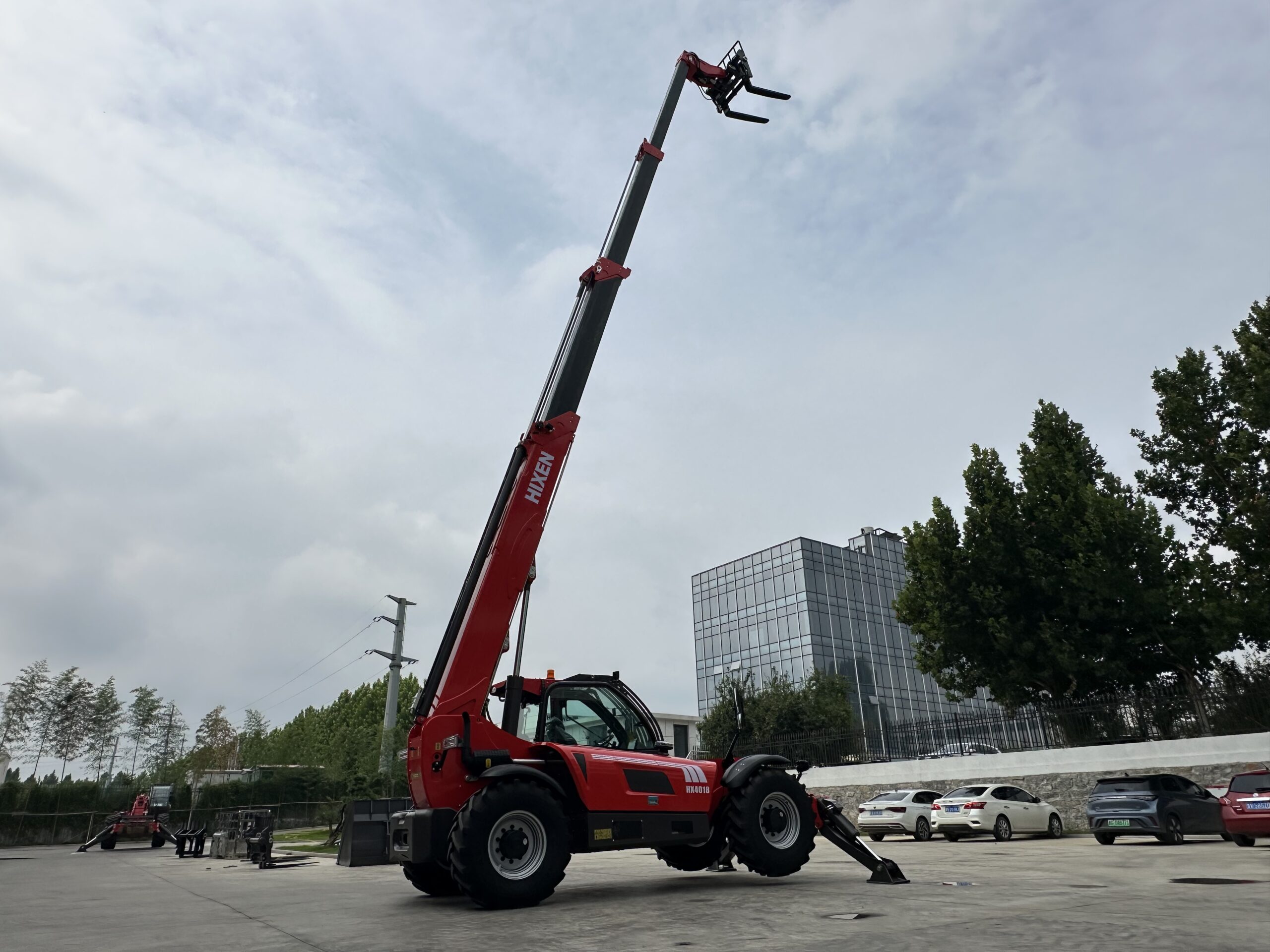
For any high reach telehandler, the essential stability features are outriggers (stabilizers) and a frame-leveling system to create a solid base. These are complemented by intelligent safety systems, like a Load Moment Indicator (LMI), which acts as the brain of the operation, preventing overloads.
The Systems That Keep You Safe at Height
Safety is not just about operator skill; it’s engineered into the machine. When evaluating a high reach telehandler, you must scrutinize these systems.
The Foundation: Outriggers and Frame Leveling
Outriggers, also known as stabilizers, are hydraulic legs that extend from the chassis to the ground. They dramatically widen the machine’s base, creating the stability needed to lift heavy loads high into the air. For high reach work, they are not optional—they are essential.
Frame leveling (or chassis leveling) is equally important. Construction sites are rarely perfectly flat. This system allows the operator to tilt the telehandler’s frame by several degrees to create a level and stable lifting platform, even when the ground is sloped. I’ve seen operators on muddy farm sites and uneven construction projects rely on this feature daily; without it, many lifts would be impossible to perform safely.
The Brains: Load Management Systems
Modern telehandlers are equipped with a Load Moment Indicator (LMI) or a Rated Capacity Indicator (RCI). This is a sophisticated computer system that uses sensors to monitor:
- The boom’s extension length
- The boom’s angle
- The load weight on the forks
It constantly calculates whether the current lift is within the safe limits defined by the load chart. If the operator approaches an unsafe condition, the system will provide audible and visual warnings. In many models, it will automatically lock out functions that would make the situation worse (like booming out further), while still allowing safe movements (like retracting the boom). This system is a final, critical line of defense against human error.
What are the Best Attachments and Applications for High Reach Work?
A telehandler’s greatest strength is its versatility, which comes from its ability to use a wide range of attachments. However, using these attachments at height introduces new considerations that every owner and operator must understand.
The best attachments for high reach work directly support the job at hand, such as pallet forks for materials, work platforms for personnel, and jibs for suspended loads. Each attachment has its own weight and changes the machine’s center of gravity, which must be accounted for.
Matching the Tool to the Tall Task
The right attachment turns your high reach telehandler into a specialized tool. However, it’s crucial to remember one rule: every attachment reduces the machine’s net lifting capacity. The weight of the attachment itself must be subtracted from the capacity shown on the load chart. Always use the specific load chart provided for that machine-attachment combination.
Here are some of the most common attachments and their high-reach applications:
- Pallet Forks: This is the standard attachment. For high reach work, they are used to lift pallets of bricks, blocks, roofing materials, and tools to upper floors or rooftops.
- Work Platform (Man Basket): This attachment transforms the telehandler into a Mobile Elevating Work Platform (MEWP). It’s ideal for lifting workers to perform tasks like installing windows, repairing facades, or doing electrical work at height. Safety is paramount, and these platforms come with their own strict regulations.
- Lifting Jib or Winch: This attachment allows the telehandler to function more like a small crane, lifting loads that are suspended from a hook. It’s perfect for precisely placing roof trusses, steel beams, or large pipes.
- Ведра: While more common for ground-level work, a bucket can be used to lift loose materials like sand or gravel to height, though it’s often less efficient for high reach applications than using a crane and skip.
Choosing the right attachment involves analyzing the specific task. Don’t assume the standard fork carriage is always the best tool. For our clients in equipment rental, we always recommend they stock a variety of attachments to maximize the utility and rental income from each high reach telehandler in their fleet.
.jpg)
How Do You Choose the Right High Reach Telehandler for Your Business?
You’ve analyzed the technology and the safety features, but how do you make the final purchasing decision? With so many models and brands on the market, it’s easy to focus on the wrong details and end up with a machine that doesn’t fit your business.
Выбор правильного high reach telehandler requires a holistic evaluation. You must move beyond the brochure’s maximum specs and analyze your true application needs, scrutinize the load chart for those scenarios, and carefully consider the total cost of ownership, including after-sales support and parts availability.
A Strategic Approach to Procurement
As a manufacturer, we want our partners—whether they are distributors, rental companies, or end-users—to be successful with our equipment. That success starts with choosing the right machine.
Step 1: Define Your Core Applications
First, look at your business. What are the most common lifts you will perform?
- Height & Reach: What are the typical heights of the buildings you work on? How far forward do you need to place materials?
- Load Weight: What is the average and maximum weight of the loads you lift?
- Site Conditions: Are your sites typically spacious and flat, or are they confined and uneven?
Answering these questions will narrow your search from a dozen models to just two or three.
Step 2: Live by the Load Chart
Once you have your core lifting scenario (e.g., “lift 1,500 kg to 12 meters with 6 meters of forward reach”), take this requirement and compare it against the load charts of the machines you are considering. This is a non-negotiable step. A machine that looks good on paper might not be able to perform your most common task.
Step 3: Evaluate Total Cost of Ownership (TCO)
For distributors and large fleet owners, the initial purchase price is only part of the equation. Downtime is the real cost.
- Engine & Components: Look for reliable, well-known engine brands like Cummins, Perkins, or Yanmar. This ensures that service and parts are available globally.
- Spare Parts Supply: Ask about the manufacturer’s spare parts availability and logistics. Can you get critical parts quickly to keep your machine running?
- Warranty & Support: A strong warranty and responsive technical support from the manufacturer are invaluable. They are your safety net when issues arise.
Our advice is always to prioritize long-term reliability over a small short-term price difference. A machine that is constantly down for repairs is a liability, not an asset.
Frequently Asked Questions
How much does a high reach telehandler cost?
The cost varies widely based on brand, lifting height, capacity, and included features. A new high reach telehandler can range from under $100,000 USD to well over $200,000 USD. It’s more important to evaluate the Total Cost of Ownership (TCO), including maintenance and reliability, than the initial purchase price alone.
Can a telehandler be used as a crane?
While a telehandler with a jib or winch attachment can lift suspended loads, it is not a crane and is governed by different safety standards. They are designed for different purposes. Always follow the manufacturer’s specific load charts and operating guidelines for suspended loads to ensure safety.
What training is required to operate a high reach telehandler?
In most countries, operating a high reach telehandler requires specialized training and certification. Operators must be proficient in reading load charts, understanding stability principles, conducting pre-operation inspections, and safely handling the machine with various attachments. Regulations vary by region, so always verify local requirements.
What is the difference between a telehandler and a boom lift?
A telehandler is a versatile material handler designed to lift and place loads with attachments like forks or buckets. A boom lift, or Mobile Elevating Work Platform (MEWP), is specifically designed to safely lift personnel in a work platform to perform tasks at height.
Заключение
Выбор правильного high reach telehandler is a critical decision that directly impacts your job site’s safety, efficiency, and profitability. The key is to look beyond the maximum lift height advertised in a brochure. True value is found by mastering the load chart to understand a machine’s real-world capabilities. Prioritize essential stability systems like outriggers and frame leveling, and always account for the reduced capacity when using attachments. Finally, for long-term success, especially for fleet owners and distributors, evaluate the total cost of ownership, focusing on reliable components and strong after-sales support.
If you are evaluating a high reach telehandler for your fleet or next project, our team is here to help you analyze your requirements and understand the specifications that truly matter. Contact us to discuss a solution tailored to your operational needs and to ensure you get the right machine for the job.

