
Sourcing a telehandler for challenging job sites brings a unique set of concerns. You’re worried about machines getting bogged down in mud or losing traction on a slope with a fully loaded boom. Choosing a 4×4 telehandler seems like the obvious solution, but this specification alone doesn’t guarantee the all-terrain performance your operations demand.
A 4×4 telehandler, also known as a 4WD or four-wheel drive telehandler, is a machine where engine power is delivered to all four wheels for maximum traction. While this is a critical feature for off-road work, it is standard on most modern telehandlers. True rough terrain capability depends more on the complete system: axles, steering modes, tires, and differential lock.
Now that we have a clear definition, let’s explore why simply having four-wheel drive is just the starting point.
What Is a 4×4 Telehandler and How Does Four-Wheel Drive Work?
Trying to decipher drivetrain specifications can feel overwhelming, especially with the technical jargon used in brochures. You see “4WD,” “4×4,” and “all-wheel drive,” but getting this right is crucial for ensuring the machine you purchase can handle your customers’ job sites without costly downtime.
A 4×4 telehandler is a machine where the engine’s power is mechanically routed to both the front and rear axles. This allows all four wheels to push and pull the machine forward simultaneously, providing significantly more grip than a two-wheel drive (4×2) system, especially on loose or slippery surfaces.
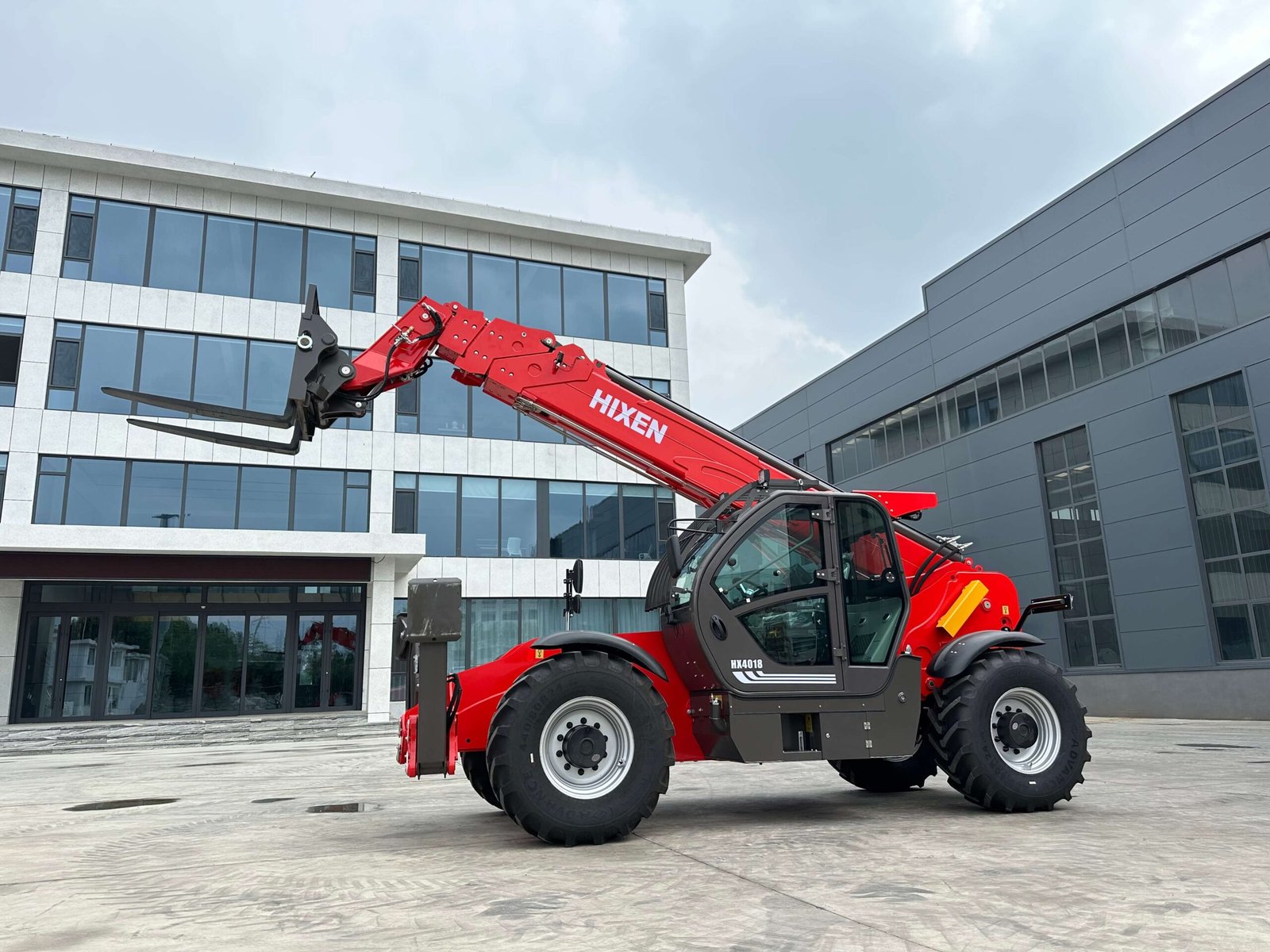
In our factory, nearly every telehandler we manufacture above the compact class is a 4×4 telehandler by default. For B2B buyers, it’s important to see this not as a premium add-on, but as a baseline requirement for any serious agricultural or construction machine.
The mechanics are straightforward:
- El engine generates power.
- El transmission manages the speed and torque.
- A transfer case splits the power between two driveshafts.
- One driveshaft goes to the front axle, and the other goes to the rear axle.
- Differentials on each axle allow the left and right wheels to turn at slightly different speeds when cornering.
This setup ensures that even if one axle loses some traction, the other can still provide driving force. This is the fundamental difference from a 4×2 machine, where only one axle (usually the front) is powered. When a 4×2 machine’s drive wheels slip in mud, the non-powered wheels can’t help, and the machine gets stuck.
From my experience visiting customer sites in over 30 countries, I’ve seen firsthand that the question isn’t whether you need four-wheel drive—you almost certainly do. The real question is what type of 4WD system and supporting features you need for your specific terrain, a topic we’ll explore in the sections below.
4×4 vs 4×2 Telehandlers Compared
The primary difference is capability: a 4×4 telehandler delivers superior traction for unpaved, soft, or sloped surfaces, while a 4×2 model is a more economical choice strictly for hard, level ground like concrete yards or inside large warehouses.
While 4×4 is the dominant configuration in the market, 4×2 models still exist for niche applications. For fleet managers and equipment dealers, understanding the specific pros and cons is key to guiding customers to the right investment.
Here is a direct comparison:
| Característica | 4×4 Telehandler | 4×2 Telehandler |
|---|---|---|
| Tracción | Excellent on mud, snow, gravel, slopes | Poor on unpaved or slippery surfaces |
| Ideal Terrain | Construction sites, farms, quarries | Paved lots, warehouses, factories |
| Maniobrabilidad | Superior with 4-wheel steering modes | Limited to front-wheel steering |
| Eficiencia de combustible | Lower due to more drivetrain components | Higher due to simpler, lighter drivetrain |
| Acquisition Cost | Más alto | Más bajo |
| Mantenimiento | More complex (transfer case, extra axle) | Simpler and less costly to maintain |
| Tire Wear | Can be higher, especially on hard surfaces | Generally lower |
A 4×4 system is heavier and has more moving parts (a transfer case, a second driveshaft, a steerable drive axle), which leads to slightly higher fuel consumption and maintenance requirements. However, this cost is easily justified by the immense gains in productivity and safety. A single instance of a 4×2 machine getting stuck can cost hours of labor and potential project delays, immediately erasing any initial cost savings.
In contrast, a 4×2 telehandler is perfectly suited for tasks like moving pallets in a large distribution center or working on a road paving project where the ground is always firm. For these buyers, a 4×4 telehandler would be an unnecessary expense.
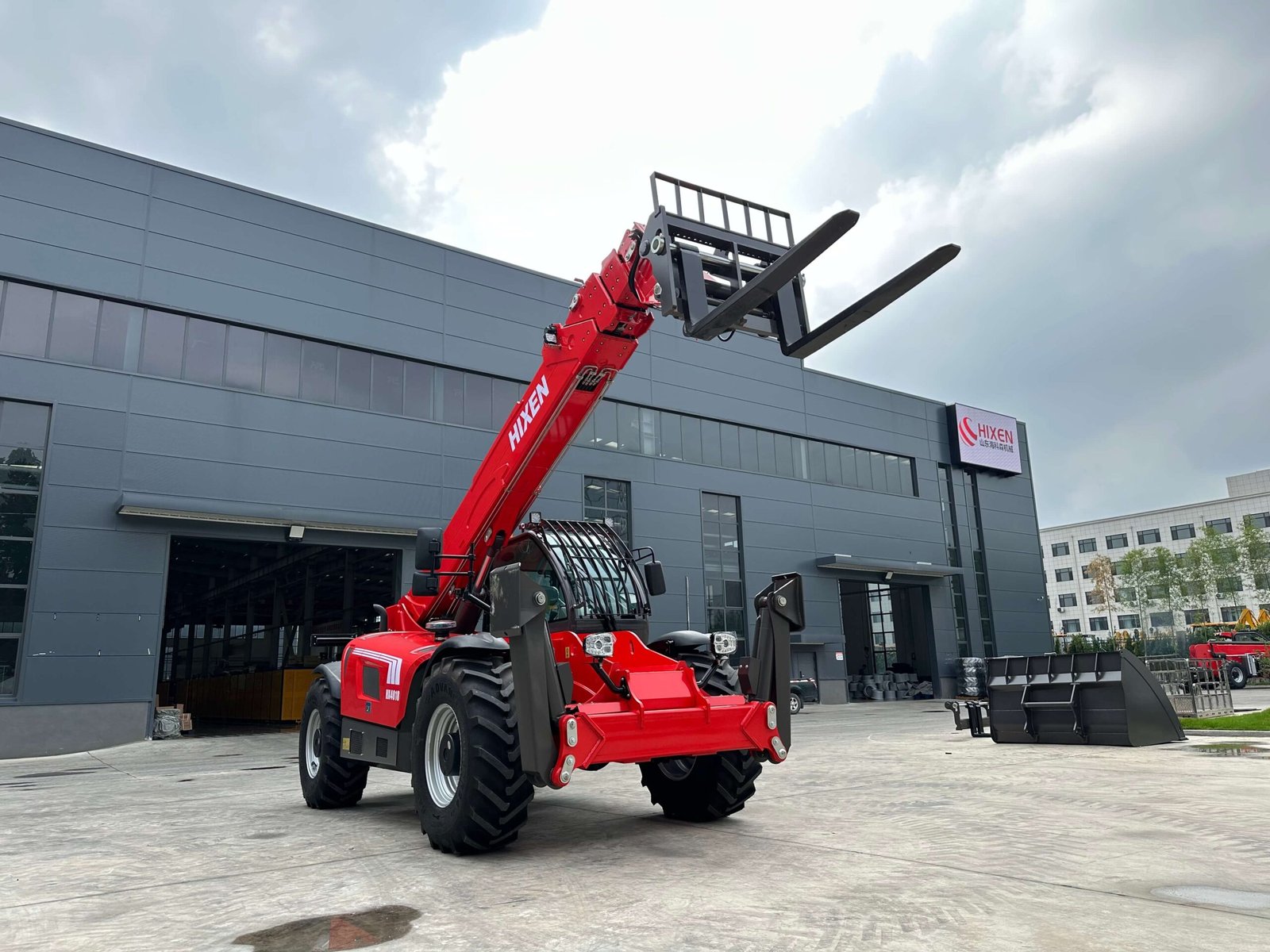
Steering Modes That Matter: Why 4WD Alone Is Not Enough on a 4×4 Telehandler
You’ve invested in a powerful 4×4 machine, but your operators are complaining it feels clumsy in tight quarters and tears up the ground making tight turns. The problem isn’t the drive system; it’s the lack of advanced steering capabilities.
While four-wheel drive provides essential forward traction, it’s the selectable steering modes that give a modern 4×4 telehandler the agility to work efficiently. Four-wheel steer and crab steer are critical for navigating confined job sites without constant, time-wasting repositioning.
A 4×4 telehandler with only standard front-wheel steering is severely limited. It may have the power to cross a muddy field, but it will struggle to maneuver inside a barn, between buildings on a farm, or on a crowded construction site. True operational flexibility comes from the ability to change how the wheels steer.
Here are the three essential modes:
Two-Wheel Steer (Front Steer)
This is the standard mode for driving on roads or across open ground. Only the front wheels turn, providing stability at higher speeds, much like a car or truck. It’s simple and safe for transit, but offers the largest turning radius.
Four-Wheel Steer (Circle Steer)
In this mode, the rear wheels turn in the opposite direction of the front wheels. This dramatically reduces the machine’s turning radius, often allowing it to turn in a circle that is tighter than its own length. This is indispensable for:
- Navigating tight corners in farmyards or warehouses.
- Repositioning in confined spaces on a construction site.
- Minimizing ground disturbance compared to making a wide, three-point turn.
Crab Steer
Here, all four wheels turn in the same direction, allowing the entire machine to move diagonally without changing its heading. I once watched an operator use crab steer to perfectly position a telehandler alongside a wall to place pallets on scaffolding. Without it, he would have had to perform a dozen forward-and-back maneuvers. Crab steer is essential for:
- Sidling up next to buildings or trenches.
- Moving away from an obstacle in a straight line.
- Making fine adjustments to a load’s position without turning the entire machine.
For any buyer evaluating a rough terrain telehandler, the inclusion of these three steering modes is a non-negotiable feature. It’s the combination of 4WD y 4-wheel steering that unlocks a machine’s full potential.
Best Applications for a 4×4 Telehandler: Farms, Construction Sites and Uneven Ground
Will a standard telehandler configuration be sufficient for your market, or do you need a more specialized setup? Guessing wrong means buying equipment that is either under-powered for the job or over-priced for the need, both of which hurt your return on investment.
A properly specified 4×4 telehandler is the machine of choice for any application involving unpaved, uneven, or low-traction surfaces. Its strengths are most apparent in agriculture, construction, mining, and landscaping, where ground conditions are unpredictable.
The versatility of a 4×4 telehandler is one of its greatest assets, but its configuration must be matched to the environment. As a manufacturer, we advise buyers to define the primary application first.
Agriculture and Farming
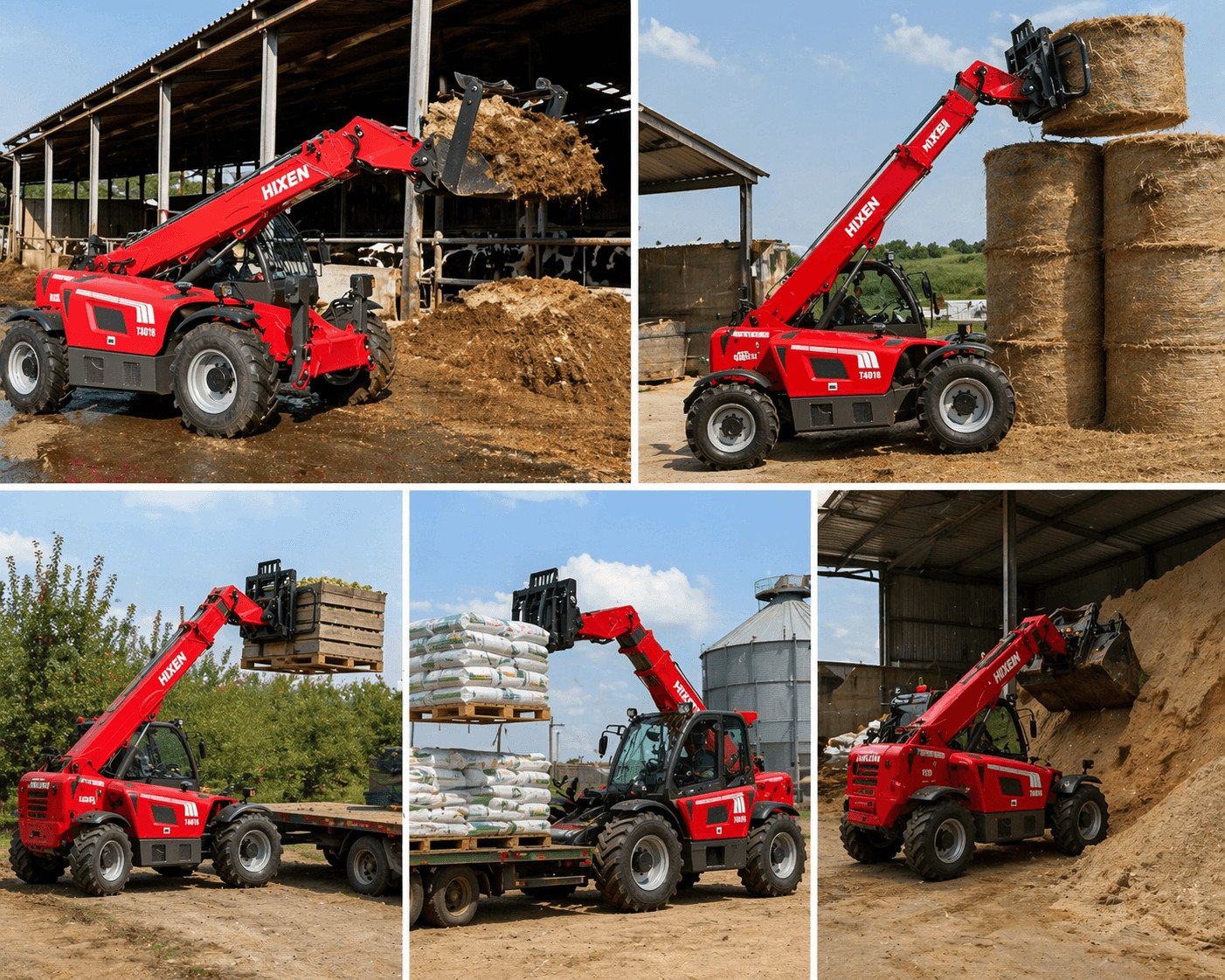
On farms, a telehandler must perform on a wide variety of surfaces, from concrete yards to muddy fields. A 4×4 system is essential for moving heavy loads of hay, silage, or manure in wet conditions. Coupled with four-wheel steer, it can easily navigate tight barns and gated areas. Our customers often pair models like the HIXEN HX3507 with specific Adjuntos de mano tela like bale grabs and grain buckets for maximum efficiency.
Construction and Building Sites
Construction sites are the natural habitat of the rough terrain telehandler. Before a site is graded and paved, it’s a landscape of mud, debris, slopes, and trenches. A 4×4 telehandler is required to safely transport materials like bricks, lumber, and steel beams across the site and lift them to height. High-reach models like our HX4014 and HX5018 are popular here, as their stability and traction are critical when the boom is extended.
Mining, Quarries, and Landscaping
These applications involve constant work on loose gravel, steep grades, and rough terrain. The robust traction of a 4×4 system, combined with heavy-duty axles and specialized tires, is necessary to handle the demanding duty cycles. Whether it’s loading aggregate into a hopper or moving large rocks for a landscaping project, the machine’s ability to maintain grip is paramount for both productivity and safety.
Key Specs to Check Before Buying: Axles, Tires, Differential Lock and Engine Options
You’re comparing technical sheets, and every machine is listed as “4WD.” How do you differentiate the truly capable models from the basic ones? The answer lies in the specifications that support the four-wheel drive system.
Beyond the 4×4 badge, discerning buyers must evaluate the axle type (planetary hubs are superior), tire options (agricultural vs. industrial tread), differential functionality (locking or limited-slip), and engine power to ensure the 4×4 telehandler is built for their terrain.
In our experience as a fabricante de mano tela, these are the components that separate a standard machine from a true rough terrain workhorse.
Axles and Ground Clearance
Look for machines with heavy-duty planetary axles. Planetary hub reduction multiplies torque at the wheel, providing superior pushing power and reducing stress on the rest of the drivetrain. This design also typically allows for greater ground clearance, which is critical for avoiding obstacles and damage on uneven sites. Always verify the axle load ratings to ensure they can handle the machine’s rated capacity under dynamic conditions.
Llantas
The tires are the machine’s only point of contact with the ground. No 4×4 system can work without proper grip.
- Agricultural Tires (R-1): Feature deep, widely spaced lugs designed to bite into mud and soft soil.
- Industrial Tires (L-2/G-2): Have a tougher compound and a tread pattern designed for durability on mixed surfaces like gravel, dirt, and occasional pavement.
- Flotation Tires: Offer a wider footprint to distribute weight over a larger area, ideal for very soft or sensitive ground like turf.
Differential Lock or Limited-Slip Differential (LSD)
This is perhaps the most misunderstood—and most critical—feature for traction. A standard “open” differential will send power to the wheel with the least resistance. This means if one wheel is on ice or in the mud, it will spin uselessly while the wheel with good grip gets no power.
- Differential Lock: When activated, it forces both wheels on an axle to rotate at the exact same speed, ensuring power goes to the wheel with traction. This can be the difference between driving out of a mud pit and needing a tow.
- Limited-Slip Differential (LSD): Automatically works to prevent excessive wheelspin by diverting some torque to the wheel with more grip. It’s a great, operator-friendly compromise.
Engine and Cooling Options
A powerful engine is needed to drive a fully loaded 4×4 system over difficult terrain. More importantly, for our global clients, the engine must meet local emissions standards and have service support available. That’s why we offer configurations with engines from trusted brands like Cummins, Perkins, Yanmar, and Kohler. Furthermore, operating in hot climates like the Middle East or Africa requires an oversized cooling package to prevent overheating during demanding work cycles.
Conclusión
To summarize, while the 4×4 telehandler is the industry standard for any work outside of paved surfaces, the “4×4” designation is only the beginning of the story. True all-terrain performance and operational flexibility are delivered by a complete package: robust planetary axles, terrain-appropriate tires, a locking or limited-slip differential, and versatile steering modes. By looking past the simple 4WD label and evaluating these critical subsystems, you can select a machine that delivers consistent reliability, safety, and a strong return on investment. The key is to first define your operating environment, then match the machine’s capabilities to that reality.
If you are sourcing telehandlers for your dealership, rental fleet, or business, our engineering team can help you configure the ideal machine for your market’s unique demands. We invite you to explore our range of modelos de manipuladores telescópicos, from the versatile HIXEN HX3507 to the high-reach HX6018, or browse our comprehensive catalog of Adjuntos de mano tela to build the perfect solution. Contact us today for a detailed consultation and quote.
Frequently Asked Questions
Is a 4×4 telehandler the same as a rough terrain telehandler?
Mostly, yes, but the term “rough terrain” implies more than just four-wheel drive. A true rough terrain telehandler also has features like high ground clearance, heavy-duty axles, appropriate tires, and multiple steering modes to be effective on challenging job sites.
Does a 4×4 telehandler use more fuel?
Yes, a 4WD system has more mechanical components than a 2WD system, leading to slightly higher fuel consumption. However, the gains in productivity, uptime, and safety on unpaved surfaces far outweigh the marginal increase in fuel cost.
What is the turning radius of a 4×4 telehandler?
This varies significantly based on its steering modes. With standard two-wheel steering, the turning radius is large. With four-wheel steering engaged, the turning radius can be extremely tight, often smaller than the machine’s overall length, providing excellent maneuverability.
Can I get a 4×4 telehandler with different engine options for my country?
Yes, reputable international manufacturers can configure machines to meet regional needs. We frequently equip our telehandlers with engines from Cummins, Perkins, Yanmar, or other brands to comply with local emissions regulations (like Euro V or Tier 4) and ensure parts and service are readily available.

