
Investing in a powerful telehandler is a significant step, but its true potential remains untapped without the right tools. You might find yourself struggling with inefficiency or even causing damage by using a generic or poorly-fitting implement for a specialized job. The solution lies in understanding the world of Adjuntos de mano tela and how to source high-quality, perfectly compatible options directly from an expert manufacturer.
The most popular telehandler attachments are those that provide the greatest versatility across common industries. These typically include general-purpose buckets for material handling, fork carriages for lifting pallets, grapple buckets for securing irregular loads, and lifting jibs for crane-like functionality. These core tools cover the majority of tasks in construction, agriculture, and logistics.
Now that you have a high-level overview, you are likely wondering which specific attachments are right for your operation. In this guide, we will break down the options by category, discuss critical selection factors, and explain how to verify quality when sourcing directly from a factory like ours.
What Are Telehandler Attachments and Why Do They Matter?
A telehandler without an attachment is essentially a vehicle with a boom that can extend and lift, but it can’t perform any actual work. You’re not moving aggregate, lifting roofing materials, or clearing debris. Understanding that telehandler attachments are the specialized tools that unlock your machine’s true, multi-functional potential is the first step toward maximizing your return on investment.
They are interchangeable work tools engineered to mount securely to the end of a telehandler’s boom. Each one is designed to perform a specific function—from digging and scooping to gripping and lifting—transforming your single machine into a versatile fleet.
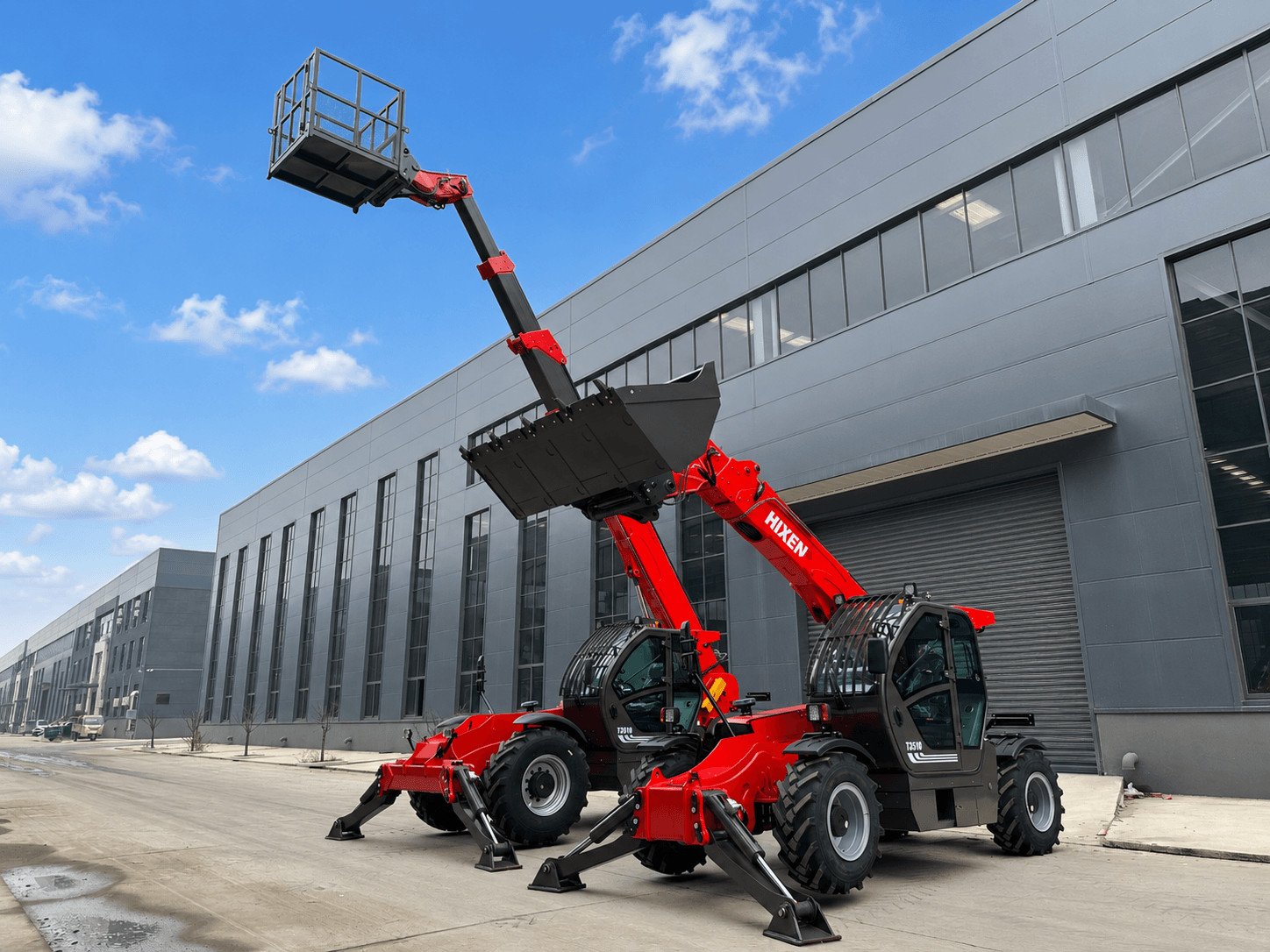
As a manufacturer of both telehandlers and the attachments themselves, we see the complete picture. The true value isn’t just in the attachment’s function but in its integration with the base machine. Here’s a deeper look at why this matters:
Engineered for Perfect Integration
When you source attachments from a third-party supplier, they are often designed as a “one-size-fits-most” solution. This can lead to subtle but significant performance issues. At HIXEN, we manufacture our attachments in-house, alongside our telehandlers. This means the fit, balance, and hydraulic compatibility are engineered together from the very beginning. There is no guesswork. The attachment for a HIXEN 7M telehandler is designed specifically for its load chart and hydraulic output.
Hydraulic System Synergy
An attachment is only as good as the hydraulic power that drives it. Incompatibility in hydraulic flow (gallons per minute) or pressure (PSI) can lead to several problems:
- Slow or weak performance: An attachment may operate sluggishly if the telehandler’s hydraulic output doesn’t match its requirements.
- Overheating: A mismatch can cause the hydraulic system to overwork, leading to increased fluid temperature and potential damage to seals and components.
- Premature wear: Incorrect pressure settings can strain cylinders, hoses, and fittings on both the machine and the attachment.
Because we control the manufacturing of both, we ensure our hydraulic hoses, fittings, and internal components meet the exact specifications required for seamless operation. This eliminates a common point of failure that I’ve seen frustrate many equipment owners.
What Are the Most Popular Telehandler Attachments by Category?
With dozens of specialized tools available, the sheer number of options can be overwhelming. You might feel pressured to choose, only to find you’ve acquired a tool that isn’t optimized for your primary tasks. The best approach is to categorize the most popular telehandler attachments to simplify your decision-making process.
The most common attachment categories include buckets for handling loose materials, forks and carriages for palletized goods, grapples for irregular objects, jibs and booms for crane-like lifting, and various specialty tools designed for specific jobs like snow removal or concrete placement.
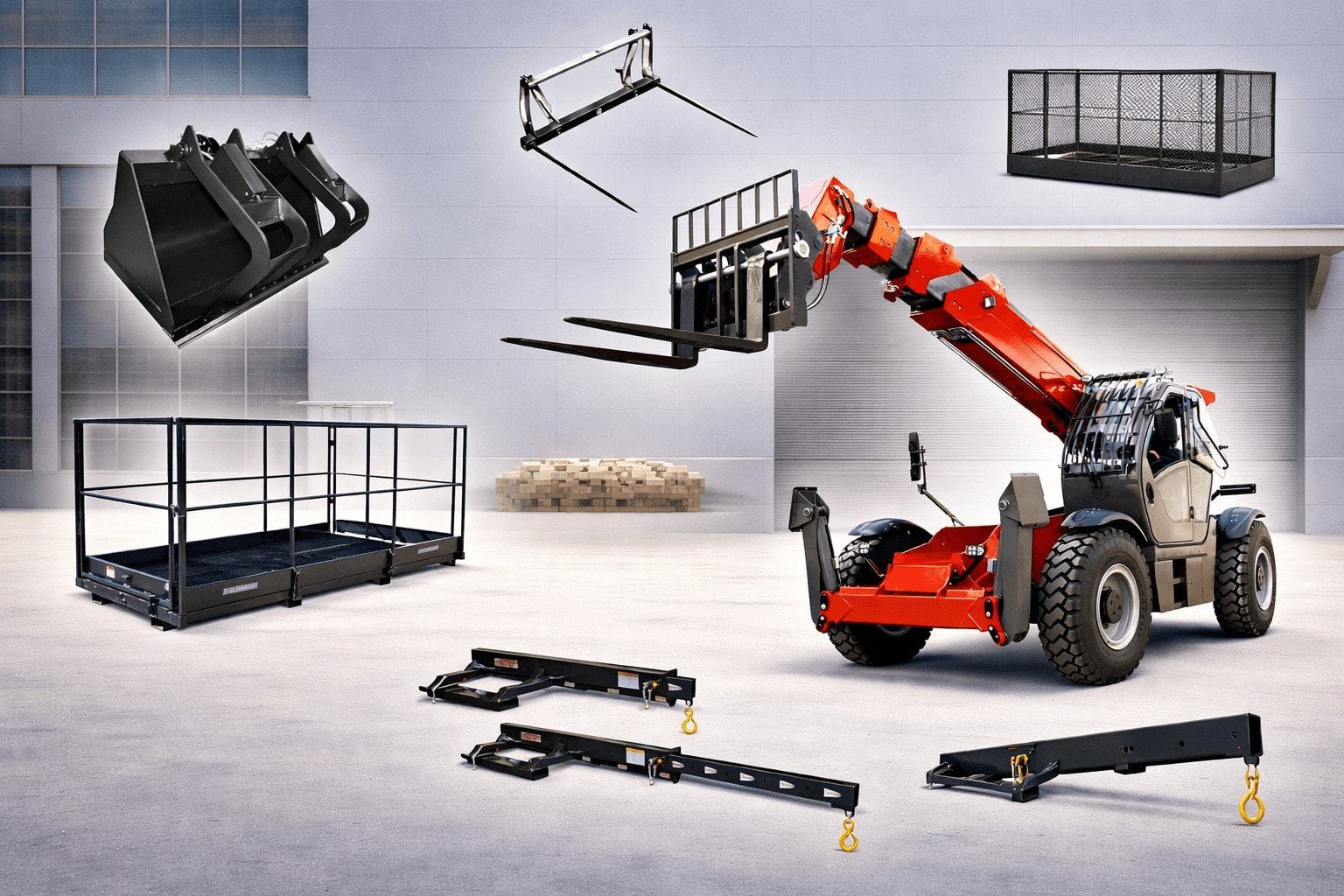
To help you identify the best fit for your needs, I’ve organized them into this scannable table. This is the same way we help our distributor partners and direct-buy customers narrow down their choices.
| Attachment Category | Typical Use Case | Best-Fit Industry |
|---|---|---|
| Cubos | Moving soil, sand, gravel, grain, debris | Construction, Agriculture, Landscaping |
| Forks & Carriages | Lifting pallets, lumber, building materials | Logistics, Construction, Warehousing |
| Grapples & Clamps | Handling logs, scrap metal, hay bales, silage | Forestry, Recycling, Agriculture |
| Lifting & Crane Tools | Hoisting trusses, engines, general materials | Construction, Industrial Maintenance |
| Snow & Cleaning | Clearing snow from lots, sweeping debris | Facility Management, Municipal |
| Specialty Tools | Lifting personnel, pouring concrete | Construction, Maintenance, Agriculture |
Let’s dive deeper into a few of these key categories.
- Cubos: The most fundamental attachment. A General-Purpose Bucket is your workhorse for moving loose material. However, a 4-in-1 Bucket offers much more functionality: it can operate as a standard bucket, a grapple, a dozer blade, and a leveling tool. It’s an excellent choice for construction and landscaping contractors who need maximum versatility from a single tool.
- Forks & Carriages: While standard forks are essential, a Side-Shifting Carriage is one of the most valuable upgrades you can invest in. It allows the operator to laterally adjust the forks without repositioning the entire telehandler. I’ve seen this feature save countless hours in crowded warehouses and tight construction sites.
- Garfios: This category is highly specialized. A Log Grapple has a shape designed to securely grip multiple logs, while a Bale Grapple is built to handle wrapped hay bales without puncturing the plastic. Choosing the right grapple is critical for both efficiency and preventing material damage.
What key factors should you consider when choosing a telehandler attachment?
You have identified the type of tool you need, which is a great first step. However, purchasing an attachment that is incompatible with your machine or underrated for your typical workload is a costly and dangerous mistake. Before you finalize any purchase, you must review a few critical technical factors when selecting telehandler attachments.
The most important factors to consider are the telehandler’s rated load capacity, the weight of the attachment itself, the mounting system compatibility (such as a quick-attach coupler), and the hydraulic system requirements, including flow rate and pressure.
As a manufacturer, these are the questions our engineering team discusses with every customer to ensure a perfect match.
Load Capacity and Center of Gravity
Every telehandler has a load chart, which is the single most important document for safe operation. This chart shows how much weight the machine can safely lift at different boom extensions and angles. Crucially, the weight of the attachment itself must be subtracted from the machine’s lift capacity. For example, if our HIXEN 18M telehandler has a capacity of 3,000 kg at a certain reach, and you mount a 500 kg work platform, your net capacity for personnel and tools is reduced to 2,500 kg. Always verify that the combined weight is within the limits defined by the load chart.
Mounting Systems and Compatibility
Incompatibility is a major headache for equipment owners. Many manufacturers use proprietary mounting systems. This is a key area where we differentiate ourselves. Our standard telehandler attachments are designed with quick-attach plates compatible with major global brands, including JCB, Manitou, and CAT.
Furthermore, a core part of our business is OEM/ODM customization. If you have a fleet of mixed brands or a machine with a unique coupler, you don’t have to settle for off-the-shelf options. We can manufacture an attachment with the exact mounting configuration you require. This flexibility is a significant advantage for international distributors and end-users sourcing from China.
Lead Time and Customization
When sourcing from a factory, lead time is a practical concern.
- Standard Attachments: For our regular inventory of buckets, forks, and grapples, the typical lead time is 7-15 days.
- Custom Attachments: For orders requiring custom sizing, capacity, color, or mounting configurations, the lead time is generally 15-30 days.
This ability to request specific dimensions or capacities means you get a tool perfectly suited to your job, rather than making do with a standard size.
What Are the Best Telehandler Attachments by Industry Application?
You know your industry inside and out, but you might not be aware of which specific tool could unlock a new level of efficiency for your telehandler. Using a generic attachment for a specialized task can leave your team struggling, while the right tool would handle the job with ease. Let’s explore the most effective Adjuntos de mano tela for key industries.
For construction, heavy-duty buckets, lifting jibs, and work platforms are essential. Agriculture relies heavily on bale grabs, silage defacers, and specialized forks. Meanwhile, port and logistics operations maximize efficiency with side-shifting carriages and container handlers.
Matching the attachment to the industry application is the final step in making a smart investment.
Construction and Demolition
Construction sites are dynamic environments that demand versatility.
- 4-in-1 Buckets: The ultimate multi-tool for site prep, cleanup, and material handling.
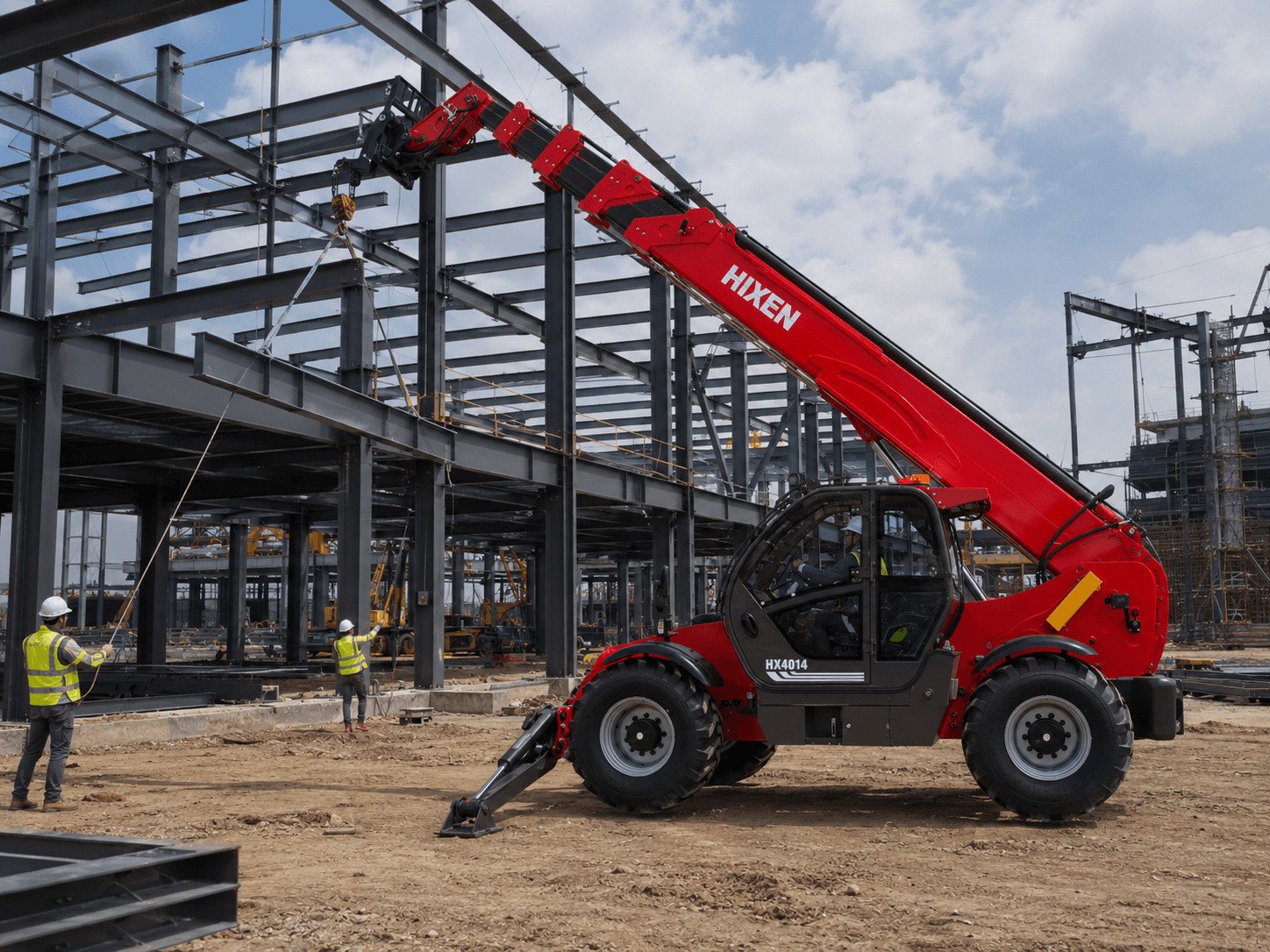
- Truss Booms & Lifting Jibs: Essential for lifting and placing roofing materials, steel beams, and other components with crane-like precision. Our high-reach models like the HIXEN 18M telehandler are frequently paired with these attachments.
- Personnel Work Platforms: A safe and efficient way to lift workers for tasks like inspections, repairs, or installations at height.
Agriculture and Farming
In agriculture, speed and gentle handling are often paramount.
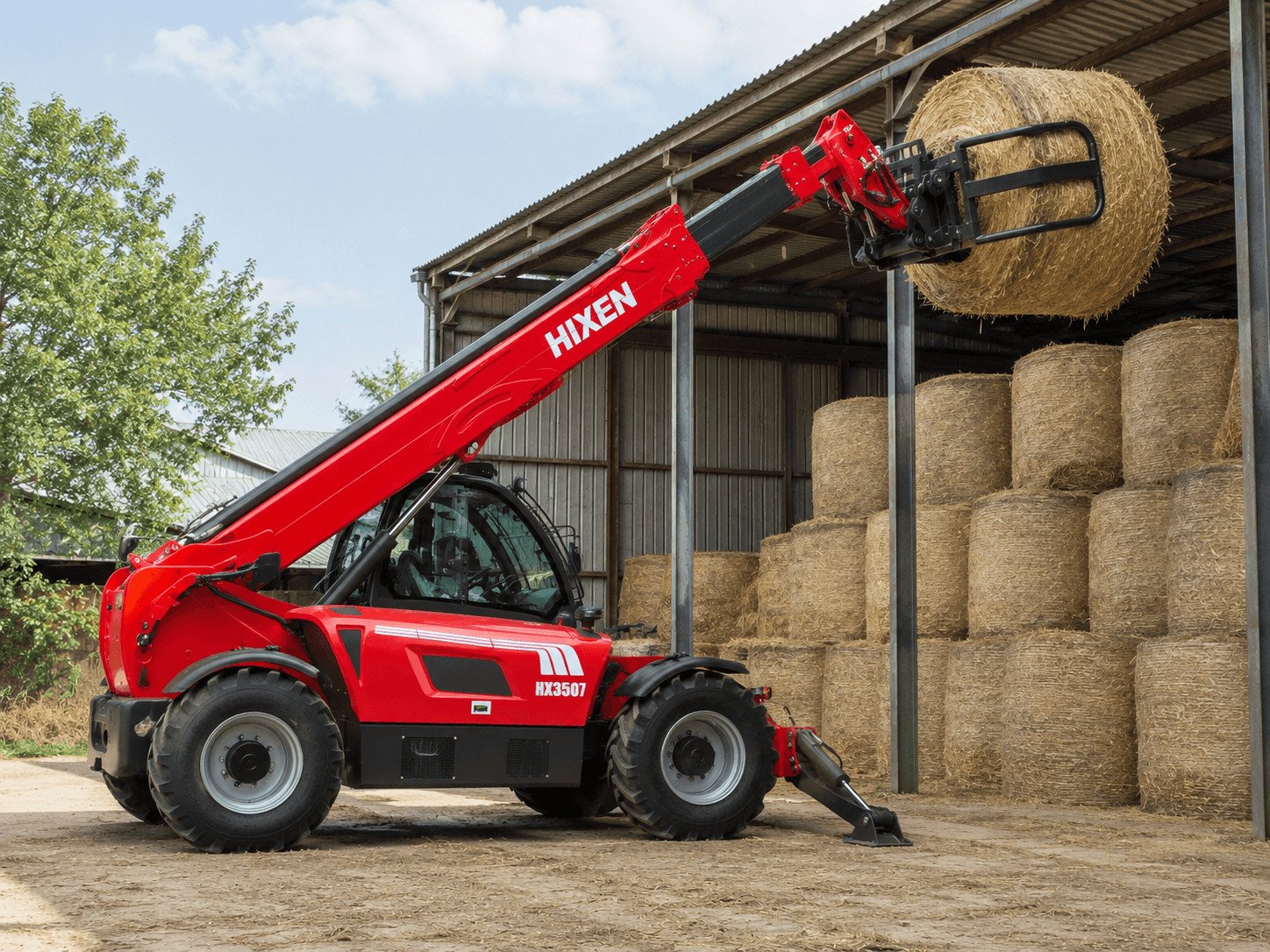
- Bale Grabs: Designed to lift and stack round or square bales without damaging the wrapping, which is critical for preserving silage quality.
- Grain/Light Material Buckets: Larger in volume than standard construction buckets to move more light material (like grain or feed) in fewer trips.
- Manure Forks/Grapples: A robust tool designed specifically for handling loose manure and bedding with a grapple to secure the load. Our mid-range HIXEN 10M telehandler is an agricultural workhorse, compatible with our full range of farm attachments.
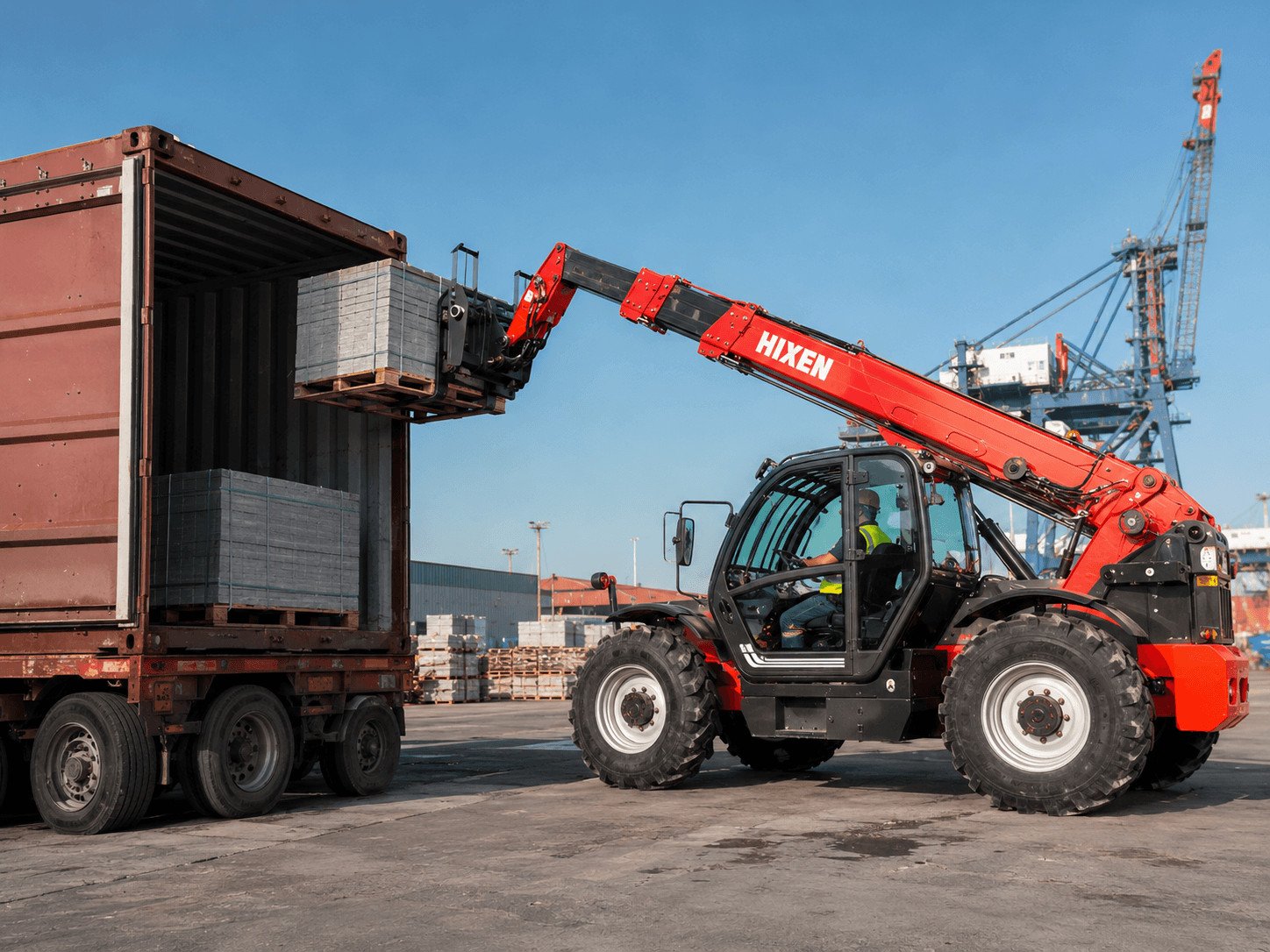
Ports, Logistics, and Warehousing
This sector is all about precision and throughput.
- Side-Shifting Fork Carriages: This is arguably the most important attachment for logistics. The ability to make fine lateral adjustments without moving the telehandler is critical for quickly loading trucks and organizing warehouses.
- Custom Fork Configurations: We frequently manufacture forks with custom lengths, thicknesses, or spacing for clients who handle non-standard pallets or materials.
- Container Handlers: For smaller ports or yards, a specialized telehandler attachment can be a cost-effective solution for stacking and moving shipping containers.
Conclusión
The right telehandler attachments are not just accessories; they are force multipliers that transform a single machine into a highly specialized, multi-functional workhorse. By understanding the different categories and focusing on key quality indicators like steel grade, weld quality, and manufacturer certifications, you can make an informed purchasing decision. As a factory that engineers both the telehandler and the attachment, we provide a unique advantage: guaranteed compatibility, robust construction, and the flexibility of full customization. Investing in a quality set of telehandler attachments is just as critical as choosing the machine itself.
Ready to equip your telehandler for maximum productivity and ROI? Contact our engineering team today to discuss your specific operational needs and receive a no-obligation quote for your next attachment.

