
Al comparar un manipulador telescópico vs grúa, la pregunta clave no es qué máquina es mejor, sino cuál es mejor para su lugar de trabajo específico.
Un manipulador telescópico ofrece excelente movilidad, versatilidad y opciones de accesorios, lo que lo convierte en una opción práctica para mover y levantar materiales en obras de construcción, granjas, almacenes y proyectos industriales. Una grúa está diseñada para levantamiento de cargas pesadas, aplicaciones de alto alcance y colocación precisa de carga, especialmente en grandes proyectos estructurales o de construcción.
Para los contratistas, empresas de alquiler y gerentes de proyectos, comprender la diferencia entre un manipulador telescópico y una grúa puede ayudar a reducir costos, mejorar la seguridad y aumentar la eficiencia en el lugar de trabajo. Esta guía lo guiará a través de sus principales diferencias, aplicaciones ideales, consideraciones de costos y cómo elegir el equipo adecuado para su proyecto.
¿Qué es un manipulador telescópico?
¿Confundido acerca de lo que realmente hace un manipulador telescópico? Parece una carretilla elevadora, pero sus capacidades van mucho más allá, provocando confusión en los lugares de trabajo.
Un manipulador telescópico, o manipulador telescópico, es una máquina versátil con un brazo telescópico que puede extenderse hacia adelante y hacia arriba. Combina características de una carretilla elevadora y una grúa, capaz de levantar, mover y colocar materiales mediante varios accesorios.
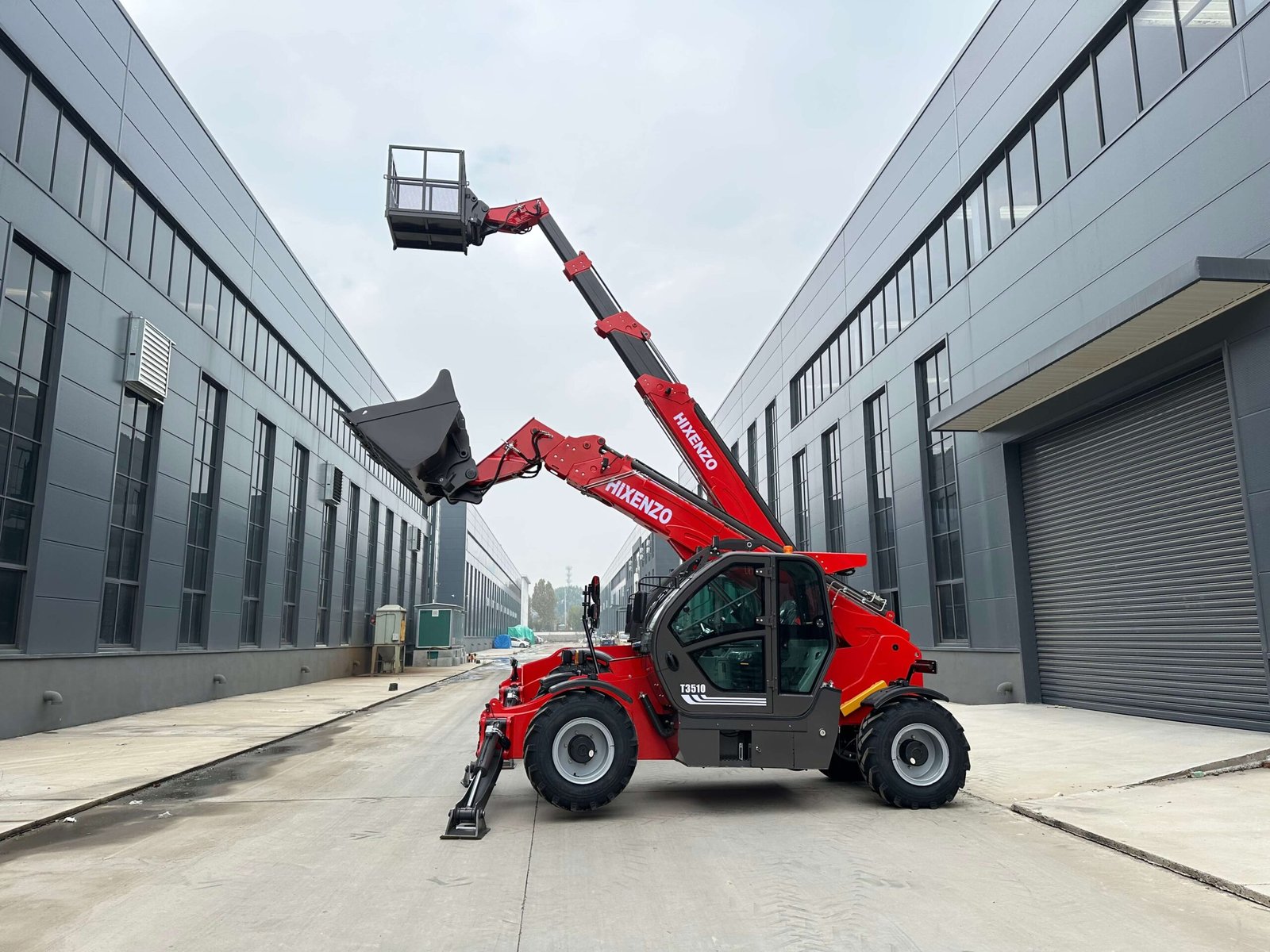
Cuando comencé en esta industria, la llamé "súper carretilla elevadora". Tiene las conocidas horquillas para levantar palets, pero su verdadera potencia proviene del brazo telescópico. Esta pluma le permite no solo levantar cosas hacia arriba sino también superar obstáculos. Piense en intentar colocar una plataforma de ladrillos en un andamio dos pisos más arriba; una carretilla elevadora no puede hacer eso, pero un manipulador telescópico puede hacerlo fácilmente.
La verdadera magia está en los apegos. En nuestra fábrica, combinamos nuestros Manipuladores telescópicos con una variedad de herramientas.:
- Horquillas: Para elevación estándar de palés y materiales.
- Cubos: Para mover materiales sueltos como tierra, arena o grava, como una cargadora de ruedas.
- Foques y cabrestantes: Para suspender cargas y operar más como una pequeña grúa.
- Plataformas de Trabajo: Levantar con seguridad a los trabajadores para tareas en altura.
Esta capacidad de cambiar de tarea lo convierte en un multiuso en obras, granjas y almacenes logísticos. Es una sola máquina que puede hacer el trabajo de otras tres o cuatro.
¿Qué es una grúa?
Cuando piensas en “levantar objetos pesados”, probablemente te imaginas una grúa. ¿Pero conoces los diferentes tipos y qué los hace únicos para un trabajo?
Una grúa es una máquina diseñada para levantar y mover objetos extremadamente pesados, principalmente verticalmente. Utiliza cables, poleas y un mecanismo de elevación. Las grúas vienen en muchas formas, desde grúas móviles sobre camiones hasta imponentes grúas torre estáticas.
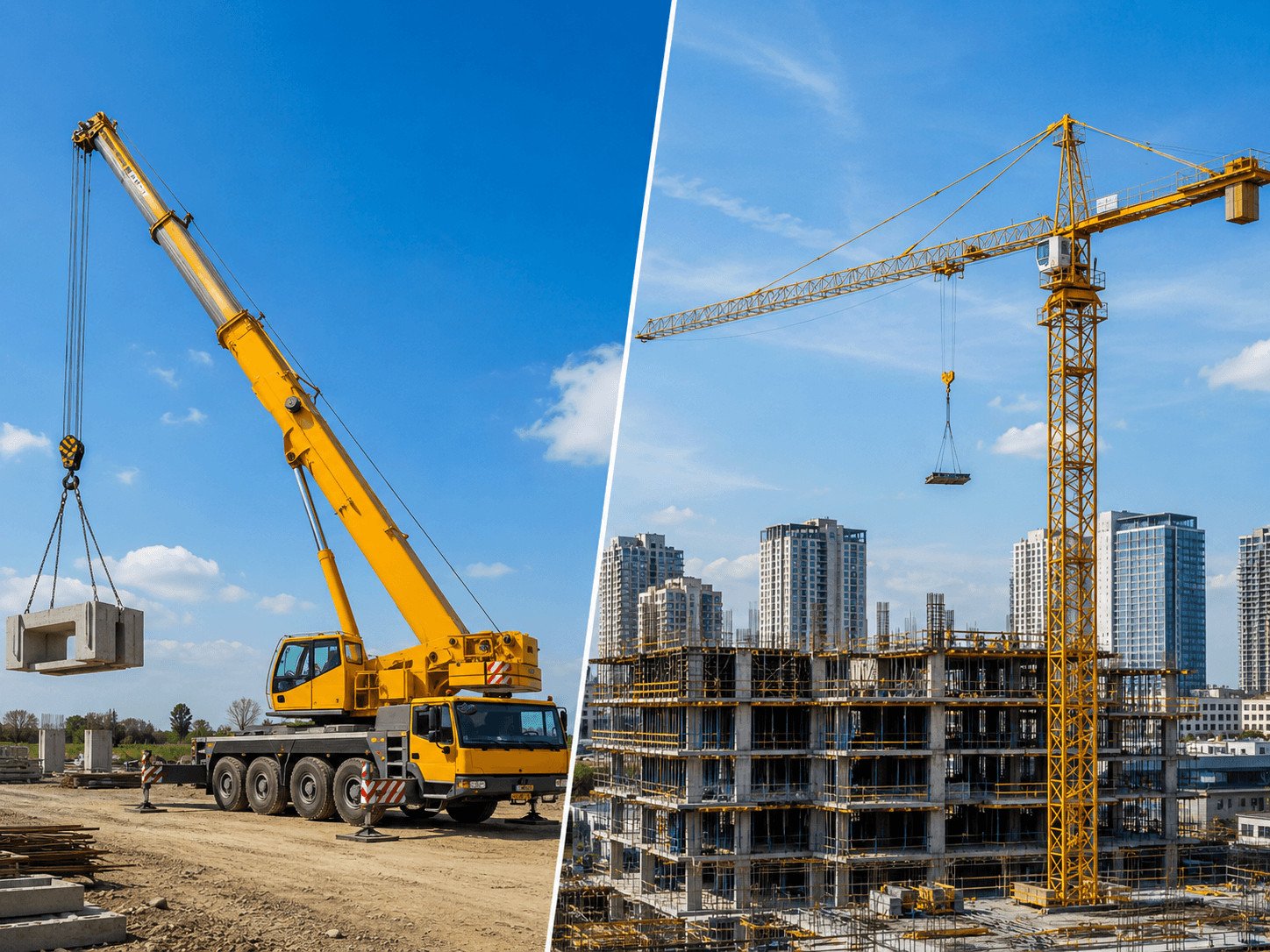
A diferencia de un manipulador telescópico, una grúa es un especialista. Su trabajo principal, y a menudo único, es levantar y colocar objetos de inmenso peso a alturas significativas. Una vez vi a un equipo utilizar una enorme grúa móvil para colocar una unidad HVAC de 30 toneladas en lo alto de un edificio de diez pisos. La precisión fue increíble. El operador podía mover la unidad pulgadas a la vez, cientos de pies en el aire.
Hay muchos tipos de grúas, pero en la mayoría de los lugares de trabajo verá:
- Grúas Móviles: Montados en un camión o sobre orugas, pueden ser conducidos hasta el sitio, pero requieren una configuración importante con estabilizadores para mayor estabilidad.
- Grúas Torre: Las grúas gigantes que ves construyendo rascacielos. Se ensamblan en el sitio y permanecen allí durante la duración del proyecto.
La fuerza de una grúa es su poder puro y concentrado. No circula por el sitio cargando materiales; permanece en un lugar y realiza el trabajo pesado que ninguna otra máquina puede hacer.
Telehandler vs Crane: ¿Diferencias clave de un vistazo?
Intentar comparar un manipulador telescópico y una grúa puede resultar confuso. Pongamos sus características clave una al lado de la otra para obtener una vista clara y sencilla.
La principal diferencia es la función. Un manipulador telescópico se destaca en el movimiento de materiales por un sitio con su alcance hacia adelante y sus múltiples accesorios. Una grúa se especializa en levantamiento pesado vertical con altura y capacidad superiores pero menos movilidad.
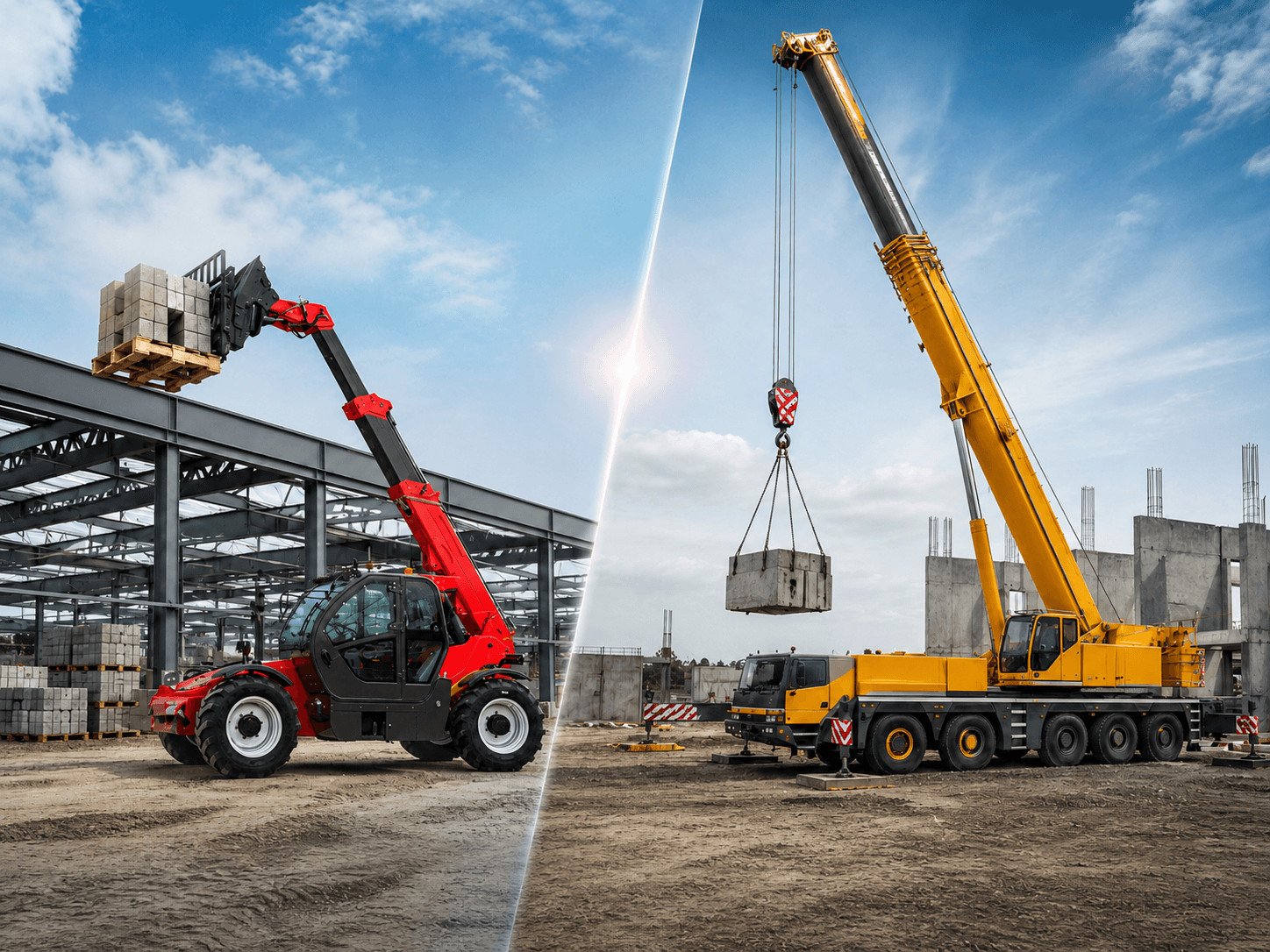
Siempre les digo a mis clientes que lo piensen de esta manera: un manipulador telescópico es un corredor de maratón que también puede correr, mientras que una grúa es un levantador de pesas de clase mundial. Uno está diseñado para ofrecer resistencia y versatilidad en muchos eventos, el otro para un único esfuerzo masivo. Para que quede aún más claro, he desglosado sus diferencias principales en esta tabla. Este es exactamente el gráfico que dibujo en mi pizarra cuando un cliente me hace esta pregunta. Mirarlo de esta manera ayuda a aclarar qué herramienta es adecuada para cada trabajo.
| Característica | Manipulador telescópico | Grúa |
|---|---|---|
| Función principal | Manipulación y transporte de materiales | Levantamiento y colocación de objetos pesados |
| Movimiento | Alcance hacia adelante y hacia arriba (telescópico) | Elevación principalmente vertical (elevación) |
| Movilidad | Alto (se conduce como un vehículo, 4x4) | Limitado (requiere una configuración compleja) |
| Accesorios | Muchos (horquillas, cucharones, foques, plataformas) | Pocos (ganchos, aparejos de elevación) |
| Tiempo de configuración | Mínimo (conducir y trabajar) | Importante (estabilizadores, contrapesos) |
| Mejor para | Tareas versátiles, sitios de trabajo en terrenos difíciles | Elevadores de gran altura, extremadamente pesados y de un solo punto |
Capacidad y alcance de elevación: ¿Cuándo se hace necesaria una grúa?
Su manipulador telescópico es potente, pero cada máquina tiene sus límites. Llevarlo demasiado lejos puede ser desastroso, entonces, ¿cómo saber cuándo cambiar?
Una grúa se vuelve necesaria cuando el peso de la carga o la altura de elevación requerida excede la capacidad de un manipulador telescópico. Si necesita levantar más de 10 toneladas o alcanzar alturas superiores a 20 metros de manera constante, una grúa es la opción más segura y capaz.
Recuerdo a un contratista que intentó utilizar un manipulador telescópico grande para levantar una estructura de acero que era demasiado pesada para su alcance máximo. Las ruedas traseras de la máquina comenzaron a levantarse del suelo. Afortunadamente, el operador tenía experiencia e inmediatamente bajó la carga. Este es exactamente el escenario que desea evitar.
Los manipuladores telescópicos son increíblemente capaces. Nuestros modelos HIXEN, por ejemplo, pueden levantar hasta 6 toneladas y alcanzar hasta 18 metros de altura. Esto cubre una amplia gama de tareas en la mayoría de los lugares de trabajo. Sin embargo, la clave es la tabla de carga. La capacidad de un manipulador telescópico disminuye drásticamente cuanto más se extiende la pluma. Es posible que esa máquina de 6 toneladas solo pueda levantar 1 tonelada con todo su alcance hacia adelante.
Una grúa está diseñada de manera diferente. Toda su estructura está construida para soportar un peso inmenso a grandes alturas. Cuando su proyecto requiere levantar componentes de más de 10 a 15 toneladas, o necesita colocarlos en edificios de más de cinco o seis pisos, es hora de llamar al especialista en grúas.
¿Movilidad y flexibilidad en el lugar de trabajo?
Su lugar de trabajo es una mezcla de barro, esquinas estrechas y materiales dispersos. Necesita una máquina que pueda navegar por él, no quedarse atrapada en él.
Los manipuladores telescópicos son los claros ganadores en movilidad. Pueden conducir por carreteras, navegar por terrenos accidentados con 4x4 y maniobrar en espacios reducidos. Las grúas, especialmente las más grandes, requieren instalación, terreno estable y espacio significativo, lo que limita la flexibilidad.
En cualquier proyecto de construcción nueva, el terreno rara vez es perfecto. A menudo es desigual, embarrado y desordenado. Aquí es donde realmente brilla un manipulador telescópico. He visto nuestras máquinas navegar por terrenos que detendrían en seco a un montacargas o un camión normal. Con potentes sistemas de tracción en las cuatro ruedas y múltiples modos de dirección (dos ruedas para carreteras, cuatro ruedas para giros cerrados y dirección de cangrejo para movimientos de lado a lado), pueden llegar a casi cualquier lugar. Puedes sacarlo del camión de reparto y ponerlo a funcionar en minutos.
Una grúa es todo lo contrario. Una grúa móvil necesita un camino amplio y despejado para llegar a su posición. Luego, se necesita una cantidad significativa de tiempo para su instalación. La tripulación tiene que extender los estabilizadores sobre un terreno sólido y nivelado, agregar contrapesos y realizar controles de seguridad. Este proceso puede llevar horas. Si necesita hacer otro levantamiento al otro lado del sitio, deberá empacarlo todo y comenzar de nuevo. Para un proyecto con muchas tareas en diferentes ubicaciones, el tiempo perdido se acumula rápidamente.
Precisión y levantamiento pesado: ¿Dónde funcionan mejor las grúas?
Debes colocar una viga de acero de 20 toneladas en el décimo piso. Intentar esto con la máquina equivocada no sólo es ineficiente; es extremadamente peligroso.
Las grúas sobresalen en el levantamiento pesado y preciso. Su sistema de polipasto y cable permite movimientos verticales muy finos y controlados, lo cual es fundamental para colocar componentes pesados como unidades HVAC o estructuras de acero. El movimiento del brazo de un manipulador telescópico es menos preciso para este tipo de tareas.
La clave aquí es cómo se levantan las máquinas. Una grúa utiliza un sistema de cabrestante y cable. El operador puede elevar la carga hacia arriba o hacia abajo con un control increíble, sin que la carga se balancee mucho de lado a lado. Esto es esencial cuando intentas alinear los orificios de los pernos en dos enormes vigas de acero a 100 pies en el aire. El movimiento es suave y aislado del resto de la máquina.
Un manipulador telescópico levanta cambiando el ángulo y la longitud de su brazo hidráulico. Cuando “subes”, la carga se mueve hacia arriba y hacia atrás hacia la máquina. Cuando extiendes el brazo, se aleja. Esto está perfectamente bien para colocar un palet sobre una superficie plana, pero hace que la colocación milimétricamente perfecta de una carga pesada suspendida sea mucho más desafiante. El operador tiene que coordinar varias funciones a la vez. Para los trabajos de colocación más pesados y delicados, el diseño especializado de la grúa simplemente funciona mejor. Es la herramienta adecuada para ese trabajo específico y de alto riesgo.
Consideraciones de seguridad: ¿Tablas de carga, condiciones del terreno y capacitación del operador?
Un accidente con equipo pesado puede ser catastrófico. Ignorar las reglas de seguridad relacionadas con las tablas de carga, el terreno y el entrenamiento no es un riesgo, es una certeza de desastre.
Ambas máquinas requieren operadores certificados y un estricto cumplimiento de los protocolos de seguridad. Las consideraciones clave incluyen entender la tabla de carga, asegurando condiciones estables del suelo y teniendo en cuenta el viento. Juzgar mal cualquiera de estos puede provocar propinas.
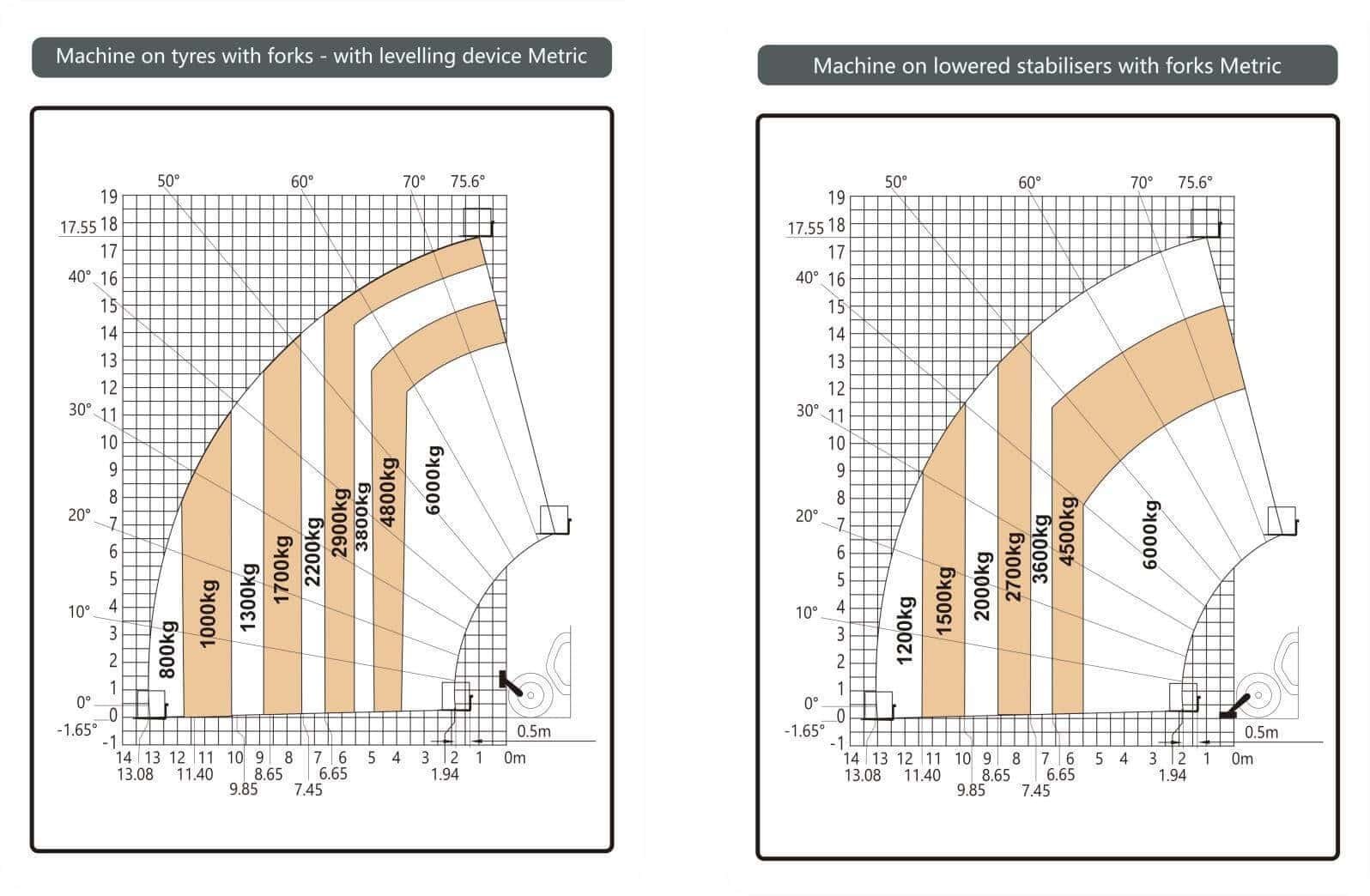
No puedo enfatizar esto lo suficiente: la seguridad lo es todo. El accidente más común y peligroso tanto para los manipuladores telescópicos como para las grúas es el vuelco. Esto casi siempre sucede por una de tres razones.
En primer lugar, el operador no entiende tabla de carga. Este gráfico es la biblia de la máquina. Le indica exactamente cuánto puede levantar en cada ángulo y extensión de la pluma. No es un solo número. Un operador debe saber leerlo correctamente en cada elevación.
Segundo, condiciones del terreno. Una grúa necesita un terreno firme y perfectamente nivelado para sus estabilizadores. Un manipulador telescópico es más indulgente, pero aún puede volcarse en una pendiente pronunciada o si una rueda se hunde en un terreno blando. Antes de cualquier levantamiento pesado, se debe inspeccionar el suelo.
Tercero, entrenamiento del operador. Operar una grúa es una habilidad altamente especializada que requiere una certificación extensa. El funcionamiento del manipulador telescópico también requiere formación y certificación específicas. Un operador no sólo debe saber conducir la máquina sino también comprender los principios de estabilidad y dinámica de carga. Nunca permita que una persona no capacitada opere ninguna de estas poderosas máquinas.
Costo y eficiencia: ¿cuál ahorra más en su proyecto?
Su presupuesto es ajustado y cada dólar cuenta. Elegir la máquina con la tarifa de alquiler más baja puede parecer inteligente, pero en general podría costarle más.
Un manipulador telescópico suele ser más rentable para proyectos que requieren versatilidad. Puede reemplazar varias máquinas, ahorrando costos de alquiler y mano de obra. Una grúa es eficiente para tareas dedicadas a levantar objetos pesados, pero de lo contrario es costosa tenerla en el sitio.
Cuando los clientes me preguntan qué máquina es "más barata", siempre replanteo la pregunta: "¿Qué máquina proporciona el mayor valor para su proyecto?" Una grúa tiene una tarifa por hora muy alta, además de costos de movilización para llevarla y traerla al sitio. Si solo lo necesita para un levantamiento de cuatro horas, es increíblemente eficiente. Pero si permanece inactivo durante dos días esperando ese ascenso, estás pagando mucho por nada.
A telehandler has a lower daily rental cost. More importantly, its value comes from its efficiency. On Monday, it can unload trucks. On Tuesday, it can lift framing materials to the second floor. On Wednesday, it can move gravel with a bucket attachment. It does the work of a forklift, a small crane, and a loader. You rent one machine instead of three. You pay one operator instead of three. The setup time is zero—just start the engine and go. For most general construction work, this multi-tasking ability is what truly saves money on the project.
¿Puede un manipulador telescópico reemplazar una grúa?
You want one machine to do it all. Can a versatile telehandler really take the place of a powerful crane on your job site?
A telehandler can replace a small crane for some tasks. If you are lifting a few tons a moderate distance, a telehandler with a winch or jib attachment can often do the job more efficiently. It cannot replace a crane for heavy, high-reach lifts.
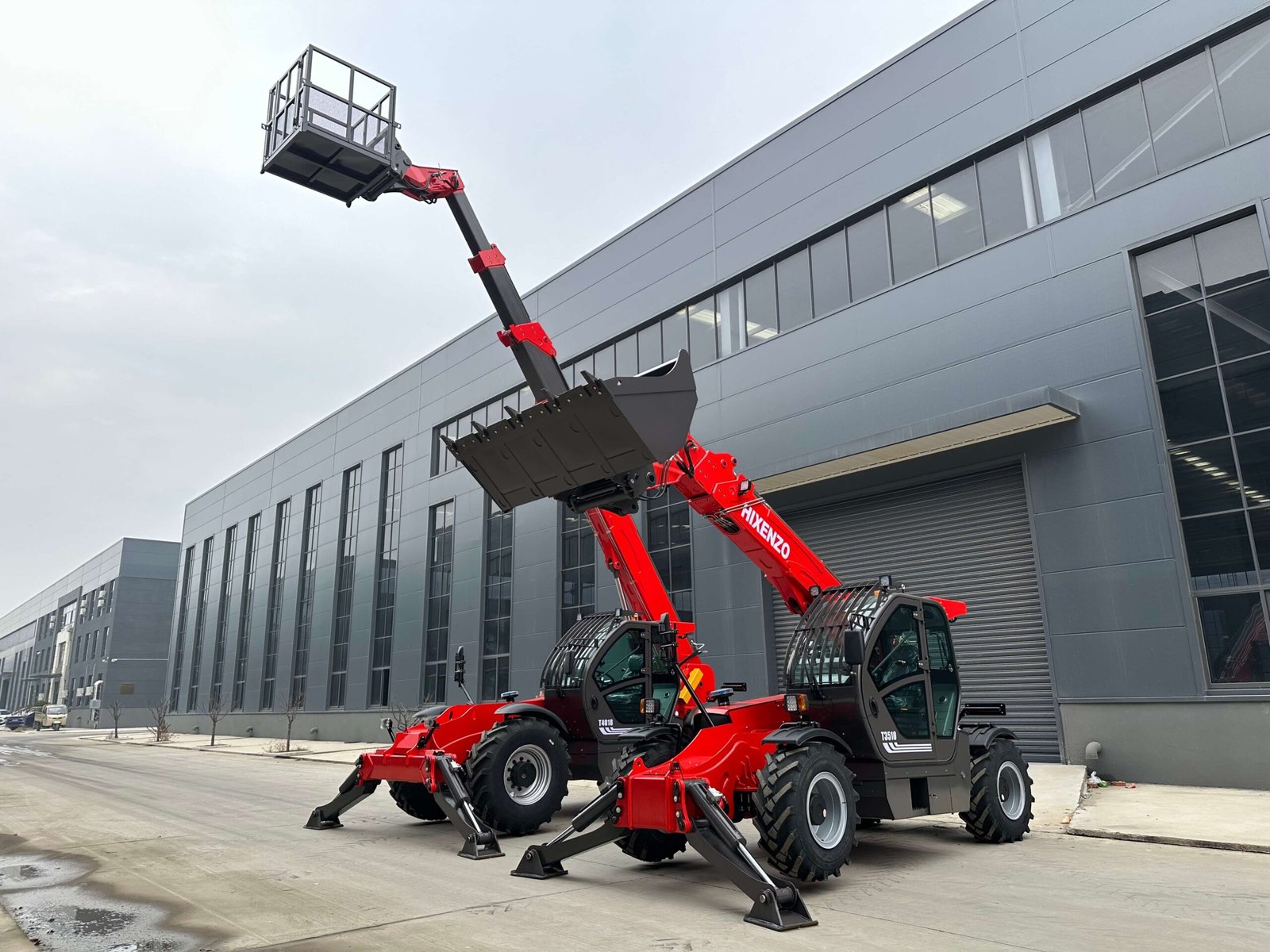
This is the golden question for many of my customers. And the answer is a definite “sometimes.” A few years ago, a customer was building a two-story commercial building. They planned to rent a small mobile crane for a few days to lift roof trusses into place. The trusses weighed about 1.5 tons each. I showed them how one of our 4-ton telehandlers, fitted with a lifting jib, could easily handle the task.
¿El resultado? Usaron el manipulador telescópico. No sólo levantó las vigas, sino que también trasladó los paquetes de vigas desde el camión de reparto hasta la zona de montaje. El trabajo se realizó más rápido y sin el costo de alquilar una grúa y un operador por separado.
Sin embargo, los límites son claros. Si esas vigas hubieran pesado 10 toneladas o hubieran tenido que ser elevadas a un edificio de diez pisos, el manipulador telescópico no habría sido una opción. Un manipulador telescópico es un sustituto de un small grua en específico situaciones, no es un reemplazo de la función principal de elevación de objetos pesados de una grúa.
¿Cuándo debería elegir un manipulador telescópico?
Su proyecto implica mover mucho material, trabajar en terrenos irregulares y llegar a lugares difíciles. Necesitas un todoterreno, pero ¿cuál es?
Choose a telehandler when your project demands versatility and mobility. It’s ideal for moving materials around a rough-terrain site, lifting loads to moderate heights, and using various attachments for different tasks, effectively acting as multiple machines.
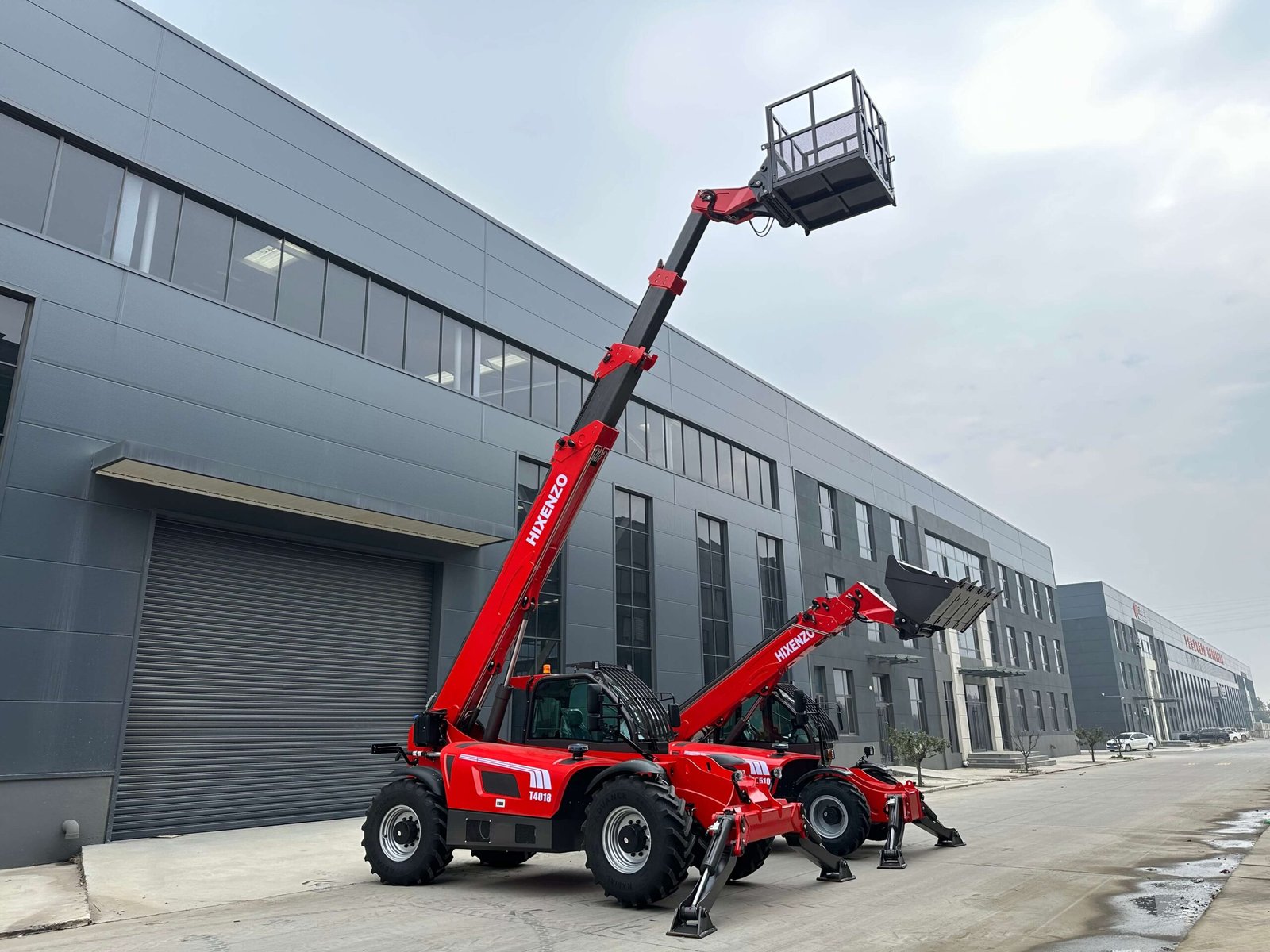
Over my years of visiting job sites, I’ve developed a simple mental checklist. If a project manager answers “yes” to most of these questions, a telehandler is almost always the right choice.
Your Telehandler Checklist
- Do you need to work on rough, muddy, or uneven ground? A telehandler’s 4WD and high ground clearance are perfect for this.
- Do you need to move materials horizontally as well as vertically? (e.g., from a storage yard to the building foundation).
- Are your lifts generally under 6 tons and below 18 meters (about 5 stories)? This is the sweet spot for most telehandlers.
- Do you have multiple different jobs for one machine? (e.g., lifting pallets, moving dirt, lifting workers in a platform).
- Is your job site compact and requires a machine that can maneuver in tight spaces? The multiple steering modes of a telehandler are a huge advantage here.
If this sounds like your project, a telehandler will be your most valuable player.
¿Cuándo debería elegir una grúa?
The task is simple but massive: lift something very heavy, very high. Using an underpowered machine is not an option. What’s the only right tool?
Choose a crane for jobs that involve lifting extremely heavy loads (typically over 10 tons) or require placement at significant heights and distances. It’s the specialist for when lifting power and precision are the top priorities.
Just as there’s a checklist for telehandlers, there’s one for cranes. The questions are different because the machine’s purpose is different. If you find yourself saying “yes” to these, you need to budget for a crane.
Your Crane Checklist
- Is your primary task to lift one or more objects that weigh over 10 tons? This is crane territory.
- Do you need to lift materials higher than 20 meters (above 6 stories)?
- Does the placement of the object require millimeter-level precision? (e.g., setting large glass panels, aligning steel beams, placing an HVAC unit).
- Do you have a single, stable, and prepared area where the machine will work from? A crane is stationary during operation.
- Is the machine’s primary job for the day just one or two major lifts? If so, the specialized power of a crane is what you need.
A crane is a specialist. When you need that specialty, nothing else will do.
¿El manipulador telescópico y la grúa pueden trabajar juntos en grandes proyectos?
Why see it as an “either/or” choice? On large, complex projects, the smartest managers don’t choose one machine; they leverage the strengths of both.
On large construction sites, telehandlers and cranes are a powerful team. The telehandler acts as the logistical support, efficiently moving materials to the crane’s drop zone. The crane then performs the heavy, high-altitude lifting.
I love visiting large-scale industrial or high-rise construction sites because you see this teamwork in action. It’s like watching a perfectly choreographed dance. The scene is always the same and it’s incredibly efficient.
A flatbed truck arrives with a load of steel I-beams. A massive tower crane sits in the middle of the site, its hook too high to reach the truck. This is where the telehandler comes in. It quickly drives over, unloads the heavy beams from the truck, and shuttles them across the messy site to a designated laydown area directly beneath the tower crane.
As soon as the telehandler moves away, the crane’s hook descends, picks up a beam, and lifts it 20 stories into the air for the ironworkers. While the crane is doing its slow, precise work, the telehandler is already on its next mission: unloading pallets of concrete blocks or moving scaffolding for another crew. It’s a perfect partnership. The telehandler handles the ground game, and the crane handles the air game.
¿Cómo elegir la máquina adecuada para su proyecto?
You’ve learned the differences, but now it’s time to decide. How do you translate this knowledge into a confident choice for your specific project?
To choose correctly, analyze your project’s key factors. Evaluate the maximum weight and height of your lifts, the site conditions (terrain and space), the need for versatility versus specialized lifting, and your overall budget.
Making the right choice comes down to asking the right questions about your job. Don’t start by asking “Do I need a telehandler or a crane?”. Instead, start by analyzing your project needs. I walk all my clients through this five-question process. Grab a piece of paper and write down the answers for your next project.
- What is the ABSOLUTE heaviest single item I need to lift? (This determines your required load capacity.)
- What is the HIGHEST point I need to place materials? (This determines your required lifting height/reach.)
- What is the job site like? (Is it a wide-open, level pad or a cramped, muddy, and uneven site? This determines your mobility needs.)
- How many DIFFERENT types of tasks do I need to accomplish? (Is it just lifting, or also moving materials, loading dirt, etc.? This determines your need for versatility and attachments.)
- What is my budget for equipment? (Consider not just the rental cost, but the total cost including operators and efficiency gains or losses.)
Once you have the answers to these questions, the right machine will become obvious.
Recomendación final: ¿Manejador telescópico para mayor versatilidad, grúa para levantamiento pesado?
After all this analysis, the choice can feel overwhelming. Let’s simplify it down to one final, clear recommendation to guide your decision.
Our final recommendation is simple: If your project involves a variety of tasks on a dynamic job site, choose a telehandler. If your main challenge is a single, heavy, high lift, a crane is your answer. Know your primary need.
At the end of the day, it’s not about which machine is “better.” It’s about which machine is the right tool for your job. The telehandler is your mobile, multi-tool workhorse that boosts overall site productivity. The crane is your specialized, heavy-lifting champion for the tasks no other machine can handle.
As a manufacturer with over 15 years of experience, we’ve seen how the right telehandler can transform a job site’s efficiency. If your needs align with versatility, mobility, and robust performance for the majority of your tasks, then investing in a quality telehandler is one of the smartest business decisions you can make. It becomes the heart of your operation. We encourage you to explore the specifications of factory-direct models to see if it fits your needs. You can see our full range of telehandlers to match your project’s specific load and height requirements.

