
If you have taken the time to compare telehandlers and skid steers, you have likely discovered that the choice hinges on a core capability: the telehandler is the ideal choice if you need to lift materials to great heights or extend your reach over a distance, whereas the skid steer is better suited for ground-level operations in confined spaces.
This guide breaks down the real mechanical differences, answers the questions buyers actually ask before committing budget, and ends with a checklist you can use on your next equipment decision.

Telehandler vs Skid Steer: Key Differences Explained?
You see a machine with a boom and a machine with arms. They both lift things, right? This thinking leads to costly mistakes. The core difference isn’t what they lift, but how they lift.
A telehandler’s primary feature is its telescopic boom, designed for height and forward reach. A skid steer uses two lift arms, designed for ground-level power and agility with a zero-turn radius. They are fundamentally different tools for different tasks.
Let’s dive deeper into what makes these machines so different. It all comes down to their basic design and intended purpose. I’ve seen countless job sites, and the difference is obvious once you know what to look for.
A telehandler is built around its boom. Think of it as a crane and a forklift combined. The operator sits high up, with a clear view of the load as it goes up and away from the machine. This design is all about stability at height and distance.
A skid steer is the opposite. It’s built low to the ground for maximum stability during pushing, digging, and turning. Its power is concentrated at ground level. The operator sits in a compact cage, protected and right in the middle of the action. The magic of a skid steer is its ability to turn in its own footprint, which is something a telehandler can’t do.
Here’s a simple table to make it clear:
| Característica | Manipulador telescópico | Minicargador |
|---|---|---|
| Core Design | Telescopic Boom | Vertical or Radial Lift Arms |
| Primary Motion | Up and Forward (Lifting & Reaching) | Up and Down (Lifting & Digging) |
| Mejor para | Placing materials at height, long-distance | Ground-level work, digging, grading, clearing |
| Turning | Wider turning radius (2 or 4-wheel steer) | Zero-turn radius (skid steering) |
| Operator View | Excellent for elevated loads | Good for ground-level & attachment work |
Understanding this fundamental difference is the first step. You’re not choosing a machine; you’re choosing a core capability: reach or agility.

Lifting Height, Reach & Capacity Compared?
Your project involves lifting, but how high and how far? Answering this question often makes the decision for you. It’s where the real power of a telehandler becomes impossible to ignore.
A telehandler can lift materials multiple stories high and reach over obstacles. A skid steer’s lift is mostly vertical, limited to just a few meters, with almost no forward reach. The difference isn’t inches; it’s entire floors of a building.
In my experience manufacturing telehandlers, the boom is everything. It’s not just a piece of steel; it’s a complex engineering system designed for one thing: safely moving weight away from the chassis. A skid steer’s arms are designed for brute force directly in front of the machine. They are not meant to handle the physics of a load that is 10 meters away and 15 meters in the air.
The most important concept to understand with a telehandler is the tabla de carga. This chart tells you exactly how much weight you can lift at a specific height and reach. As the boom extends, the safe lifting capacity decreases. This is a critical safety feature. Our HIXEN telehandlers, for example, have robust boom designs and precise load management systems because we know our customers are counting on that stability when a load is far from the cab. A skid steer doesn’t really have a complex load chart because its lifting envelope is so small and close to the machine.
Let’s look at some typical numbers.
| Métrico | Typical Skid Steer | Typical Telehandler | Why It Matters |
|---|---|---|---|
| Altura máxima de elevación | 3-4 meters | 7-18 meters | Reaching second floors, stacking high, roofing work. |
| Max Forward Reach | Less than 1 meter | 4-13 meters | Placing loads over trenches, fences, or onto the center of a truck bed. |
| Max Lift Capacity | 1-2 tons | 2-7 tons | Handling heavier pallets, large building materials, or bigger attachments. |
As you can see, they aren’t even in the same category. If your job requires placing a pallet of bricks on the third story or setting a truss on a roof, the skid steer is not an option. The telehandler is the only tool for that job.
Can a telehandler replace a skid steer?
This is a question I get a lot, especially from businesses trying to minimize their fleet. People see a telehandler with a bucket and think it can do a skid steer’s job. This is a misunderstanding.
No, a telehandler cannot fully replace a skid steer, and a skid steer cannot replace a telehandler. They are complementary tools. A telehandler is for reach and height; a skid steer is for ground-level power and agility.
Thinking of them as a team is the right approach. On many of the large construction sites and farms we supply, they own both. The skid steer does the dirty work on the ground, and the telehandler handles all the lifting and placing. One machine prepares the work, and the other finishes it. Trying to make one machine do both jobs is inefficient and often unsafe. You wouldn’t use a screwdriver to hammer a nail, even though you could technically try.
Let’s look at specific industries to see how this plays out.
For Construction Jobsites
On a typical building site, the skid steer is the first machine to arrive. It’s used for site prep: clearing debris, grading the ground, and digging small trenches. Its compact size and zero-turn radius are perfect for navigating a chaotic, evolving site. Then, as the structure goes up, the telehandler becomes the star. It’s used to lift pallets of blocks, drywall, and roofing materials to upper floors. It can reach over scaffolding and place loads exactly where they are needed, saving hours of manual labor.
For Farming and Agriculture
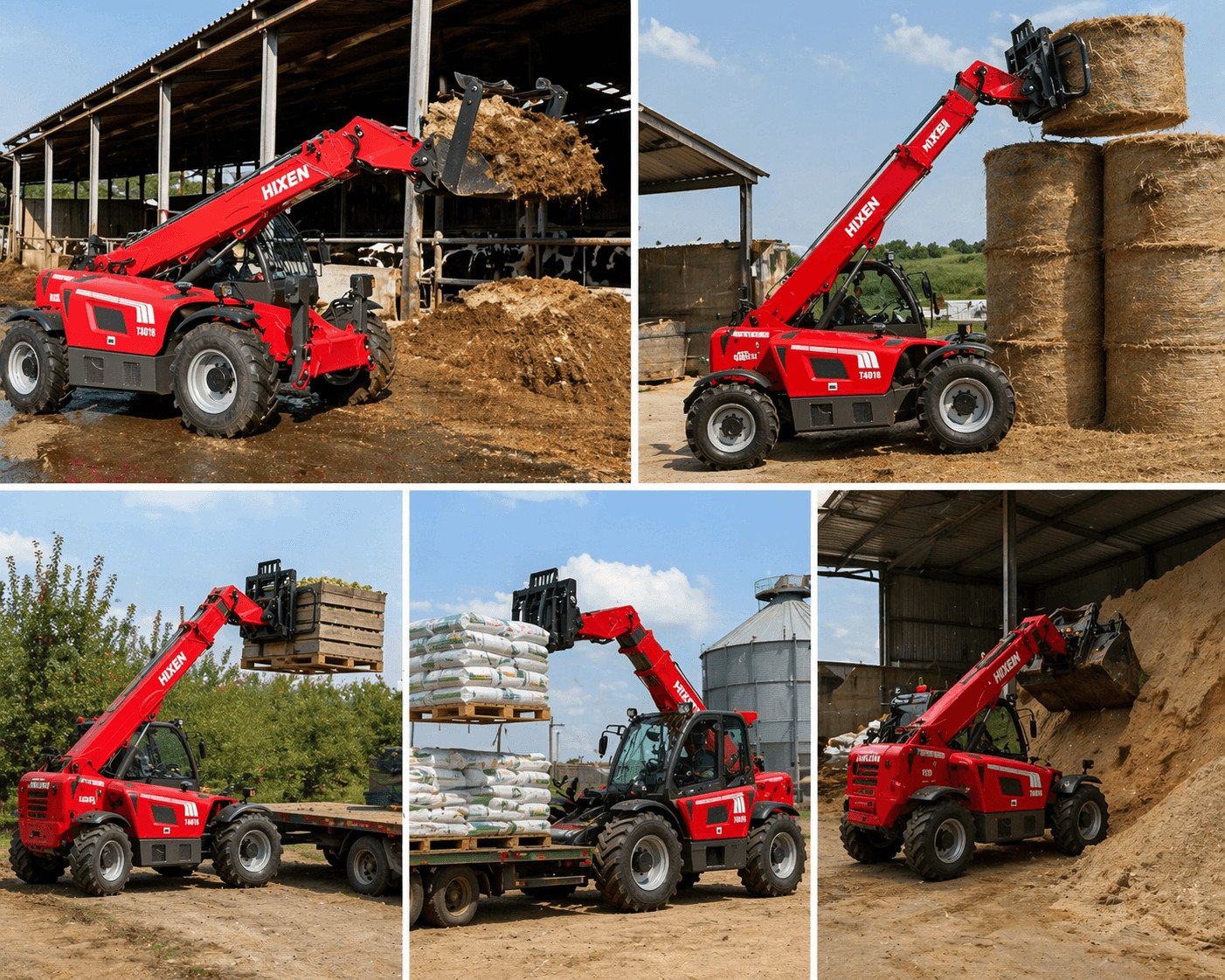
I see this combination all the time in agriculture. A farmer will use a skid steer with a grapple attachment to clean out barns and move feed in tight quarters. Its agility is unmatched. Then, they’ll switch to their telehandler to stack large, heavy hay bales into massive stacks, something the skid steer could never do. Or they’ll use it to load bulk bags of seed or fertilizer into a tall spreader. One machine for ground-level efficiency, one for high-capacity lifting.
For Landscaping Projects
In landscaping, a skid steer is essential for moving soil, mulch, and gravel with a bucket. It’s also great for drilling holes with an auger attachment. But when it’s time to place a 2-ton boulder or a large, mature tree into its final position, the telehandler is required. Its gentle, precise control and long reach allow landscapers to place heavy items without damaging the surrounding area.
In every case, the two machines work in tandem, each playing to its strengths.
Which one is safer to operate?
Safety is my number one priority, both as a manufacturer and as an advisor to my clients. When comparing a telehandler and a skid steer, safety isn’t about which machine is “better,” but about understanding their unique risks.
Both machines are safe when operated correctly by a trained professional. However, they have different primary safety concerns. A telehandler’s main risk is tipping from an improperly balanced load at height, while a skid steer’s main risks are rollovers and crush hazards from the lift arms.
Let’s break down the specific safety considerations for each machine. You need to respect the machine you are operating and understand its limits.
With a Cuentador, the center of gravity is everything. As you lift a load and extend the boom, the center of gravity of the entire machine shifts. If you exceed the limits shown on the load chart, you risk a forward or sideways tip-over. This is why proper training on reading load charts is not just important, it’s critical. Modern telehandlers have Load Moment Indicators (LMIs) that warn the operator and may even lock the controls if a situation becomes unsafe. Using stabilizers, if equipped, is also a key part of safe operation.
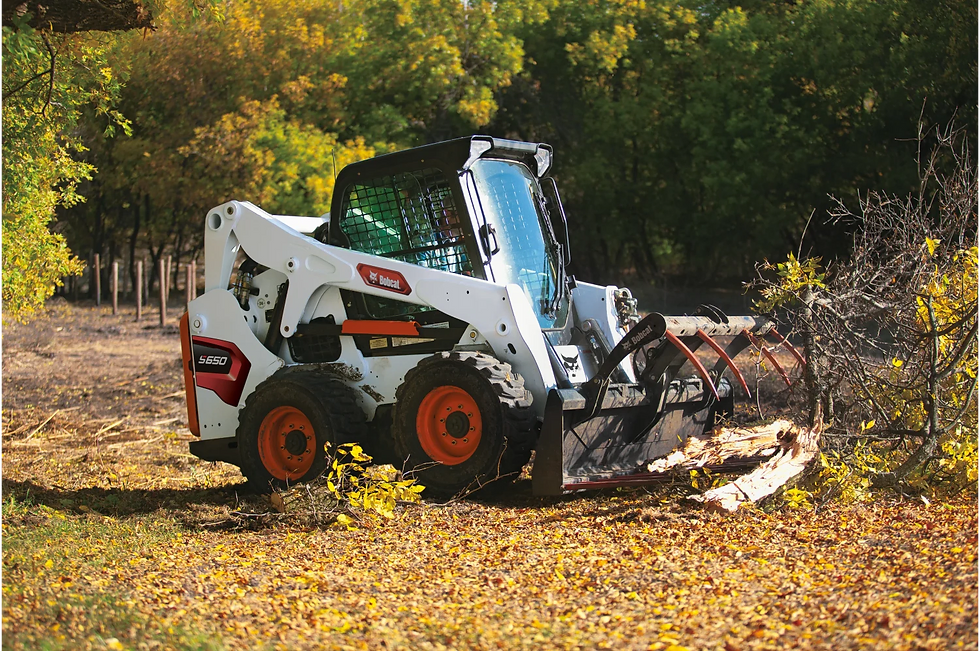
With a dirección de skid, the risks are closer to the ground. Because of its short wheelbase and high power, it can be prone to tipping forward if you stop too suddenly with a heavy load raised high. It can also roll over sideways on a steep slope. The biggest unique danger of a skid steer is the movement of the lift arms. It is absolutely essential that no one ever walks under raised arms and that operators use the safety bar and follow proper entry/exit procedures to avoid being crushed.
Both machine types should always be equipped with ROPS (Rollover Protective Structure) and FOPS (Falling Object Protective Structure) to protect the operator. Daily inspections, understanding the terrain, and never exceeding the machine’s rated capacity are universal rules that apply to both. Safety is not in the machine; it is in the hands of the operator.
Can you use telehandler attachments on a skid steer?
This is a practical question about saving money and increasing versatility. It’s tempting to think you can share attachments between these two powerful machines.
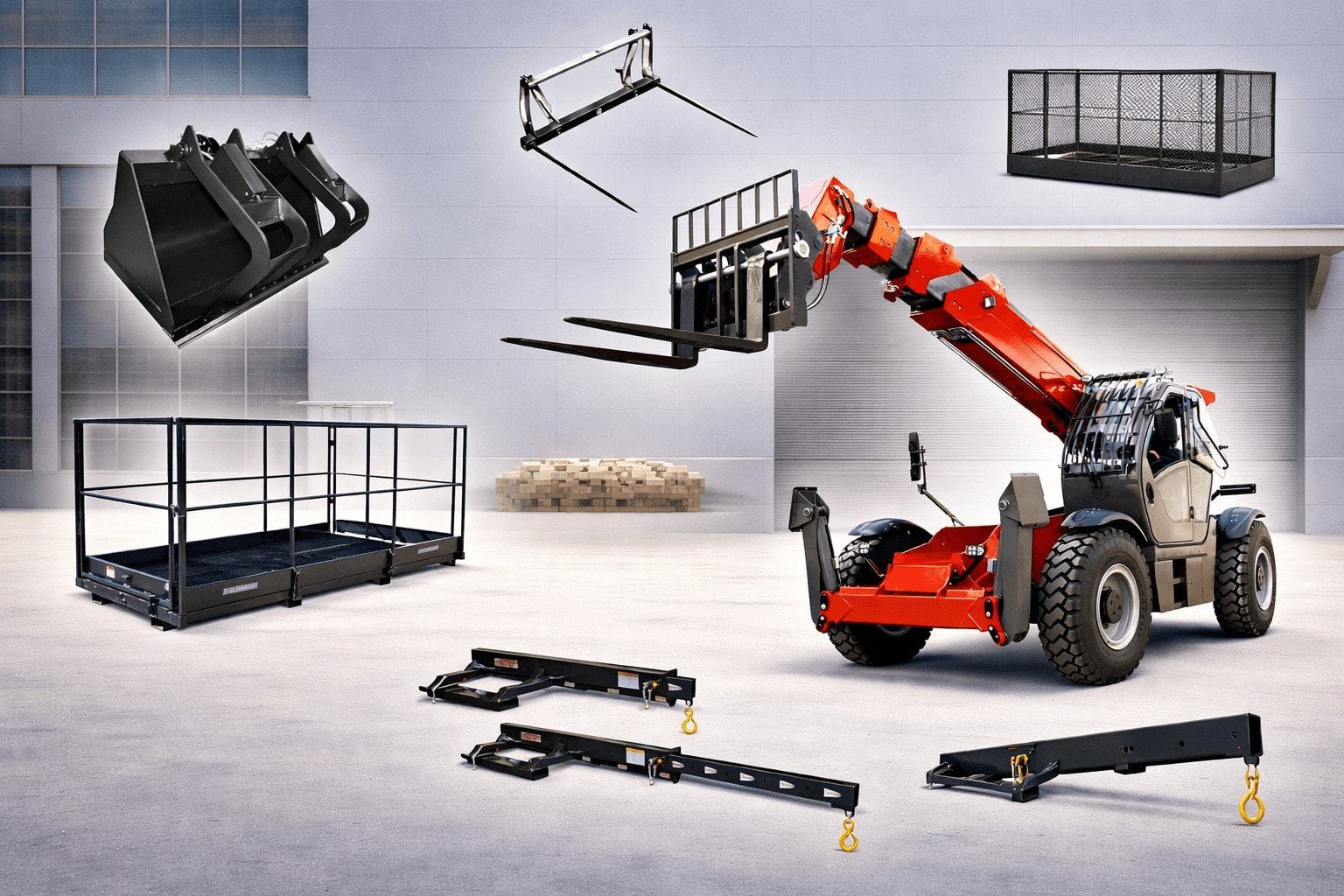
Generally, you cannot use telehandler attachments on a skid steer, or vice versa. They use different mounting systems (quick-attach plates), have different hydraulic power requirements, and are built to handle completely different types of stress.
Let me explain the “why” behind this. It’s not just that the manufacturers want you to buy more attachments; there are real engineering reasons for the incompatibility.
First is the mounting system. Most skid steers in North America and Europe use a “universal” quick-attach plate. This is a standardized design that allows attachments from many different brands to fit. Telehandlers, on the other hand, often use proprietary mounting systems specific to the manufacturer (like JCB, Manitou, or us at HIXEN). These mounts are typically larger and more robust to handle the different forces created by a long boom. There are adapters on the market, but they can add weight and change the machine’s operating dynamics, so you must be very careful.
Second is the sistema hidráulico. Attachments like augers, breakers, or mowers need hydraulic flow to operate. Skid steers are often designed with high-flow hydraulic options specifically to power these demanding attachments. Telehandler hydraulics are primarily designed for lifting, extending, and tilting the boom. While they can power some attachments, they may not provide the continuous flow needed for certain skid steer tools.
Third, and most important, is the design intent. A skid steer bucket is built for high-impact digging and scraping. It’s thick and heavy. A telehandler fork carriage is designed to handle palletized loads with precision. Using a skid steer bucket on a telehandler’s long boom would put immense and unsafe stress on the boom cylinders. Conversely, using a light telehandler attachment for heavy ground-engaging work with a skid steer would likely destroy the attachment. The tools are built for the machine’s specific purpose.
Which Machine Fits Your Jobsite — A Buyer’s Checklist?
You’ve learned the theory. Now it’s time to make a decision for your business. Don’t guess. Let’s walk through a practical checklist. I use this thought process when advising my own customers.
Stop comparing them as rivals. Instead, analyze your job requirements against this checklist. Your answers will clearly point to the telehandler, the skid steer, or the need for both in your fleet.
Before you spend a single dollar, go through these questions. Be honest and specific with your answers. This will save you from buying the wrong machine.
Your Jobsite Requirement Checklist:
- Primary Task Analysis: Height or Ground?
- Do my daily tasks involve lifting materials above the second story (over 6 meters)? (Points to Telehandler)
- Do my daily tasks involve digging, grading, or moving loose materials in tight spaces? (Points to Skid Steer)
- The Reach Question:
- Do I need to place materials over obstacles like fences, walls, or deep into the center of a flatbed truck? (Points to Telehandler)
- Is all my lifting straight up and down, right in front of the machine? (Points to Skid Steer)
- Site Access and Terrain:
- Is my job site mostly open with room to maneuver a larger machine? (Telehandler is fine)
- Do I work inside buildings, in tight alleys, or need to turn in a very small footprint? (Points to Skid Steer)
- Capacidad de carga:
- Do I need to lift single items weighing more than 2 tons? (Points to Telehandler)
- Are my typical loads pallets, buckets, or items under 1.5 tons? (Skid Steer may be sufficient)
- Fleet Strategy: Pairing Machines
- If you already own a skid steer, the most common next step is adding reach capability. For a fleet with 1-2 ton skid steers, a complementary machine is often a telehandler that can handle your next biggest challenge. For example, one of our HIXEN 7-meter or 9-meter telehandlers provides significant reach and lifting power (3-4 tons) without being excessive, perfectly complementing the ground-level work of your existing skid steers.
- Operating Cost and Attachments:
- Am I prepared for the maintenance of a more complex telescopic boom and hydraulic system? (Telehandler)
- Is my main priority a lower initial purchase price and a wider availability of universal attachments? (Skid Steer)
Answering these questions will guide you to the right investment. It’s not about finding one machine that does it all, but about building a fleet where every machine is the perfect tool for its specific job.
Conclusión
The debate isn’t about which machine is superior. It’s about matching the right machine to the right job. A telehandler provides irreplaceable height and reach, while a skid steer offers unmatched ground-level agility.
“`

