
Choosing the wrong telehandler configuration is rarely about the machine being “bad” — it’s about a mismatch between the spec sheet and the actual jobsite.
Telehandlers today are split across several overlapping categories — boom configuration, size class, power source, and application — and most buying mistakes come from optimizing for one category while ignoring the others. This guide breaks down each classification the way a procurement team should actually use it: not as a product catalog, but as a decision framework for matching machine type to load, site, and budget.
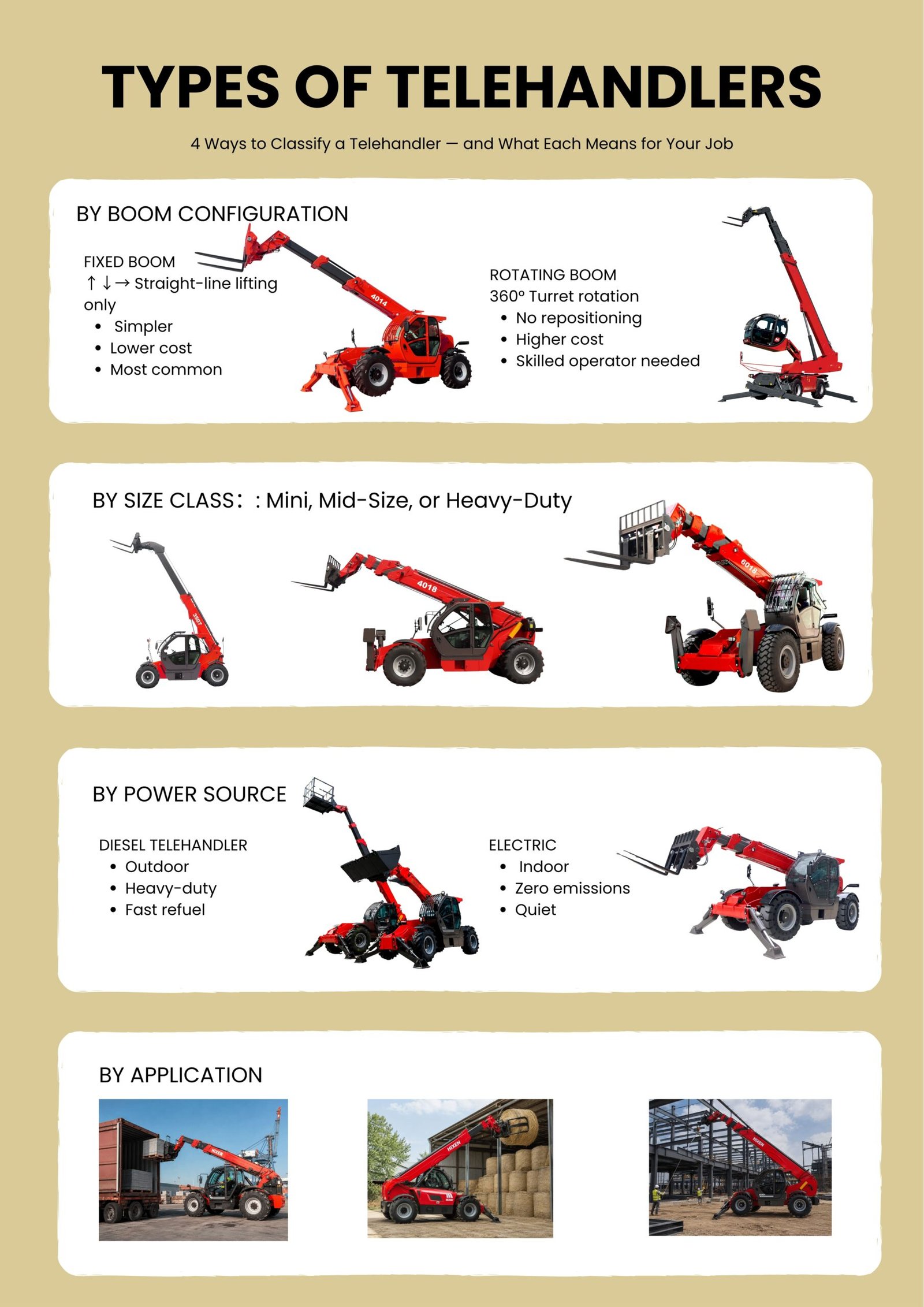
Let’s take a closer look at the various types of telehandlers so you can find the model best suited for your work.
¿Qué es un manipulador telescópico?
Confused about what makes a telehandler unique? Its blend of crane and forklift capabilities can seem complex. You need a simple definition to understand its value.
A telehandler is a multi-purpose machine featuring a long, extendable boom. This allows it to lift loads to heights and reaches that a standard forklift cannot, making it indispensable for construction, agriculture, and industrial tasks.
From our factory floor in Shandong, we see a telehandler as more than just a machine; it’s a solution to a logistical problem. Unlike a conventional forklift that only lifts vertically, a telehandler’s boom can telescope—extend, retract, and lift. This gives it the unique ability to place materials not just up high, but also deep into a structure or over obstacles. Think of it as a “Swiss Army knife” for material handling. It can be fitted with forks to move pallets, a bucket to scoop loose material, or a platform to lift workers. This incredible versatility is why it’s become a cornerstone piece of equipment across so many industries. Its robust chassis and off-road tires also mean it can operate on the rough, unprepared ground typical of a construction site or farm, a place where a standard forklift would be useless.
Types of Telehandlers by Boom Configuration: Fixed Boom vs Rotating Boom?
Choosing between a fixed or rotating boom is a key decision. A fixed boom is simpler, but a rotating boom offers more flexibility. Which one truly fits your workflow?
Fixed boom (non-rotating) telehandlers require the entire machine to be repositioned to move a load sideways. Rotating telehandlers have a turret that allows the boom to swing 360 degrees, placing loads without moving the chassis.
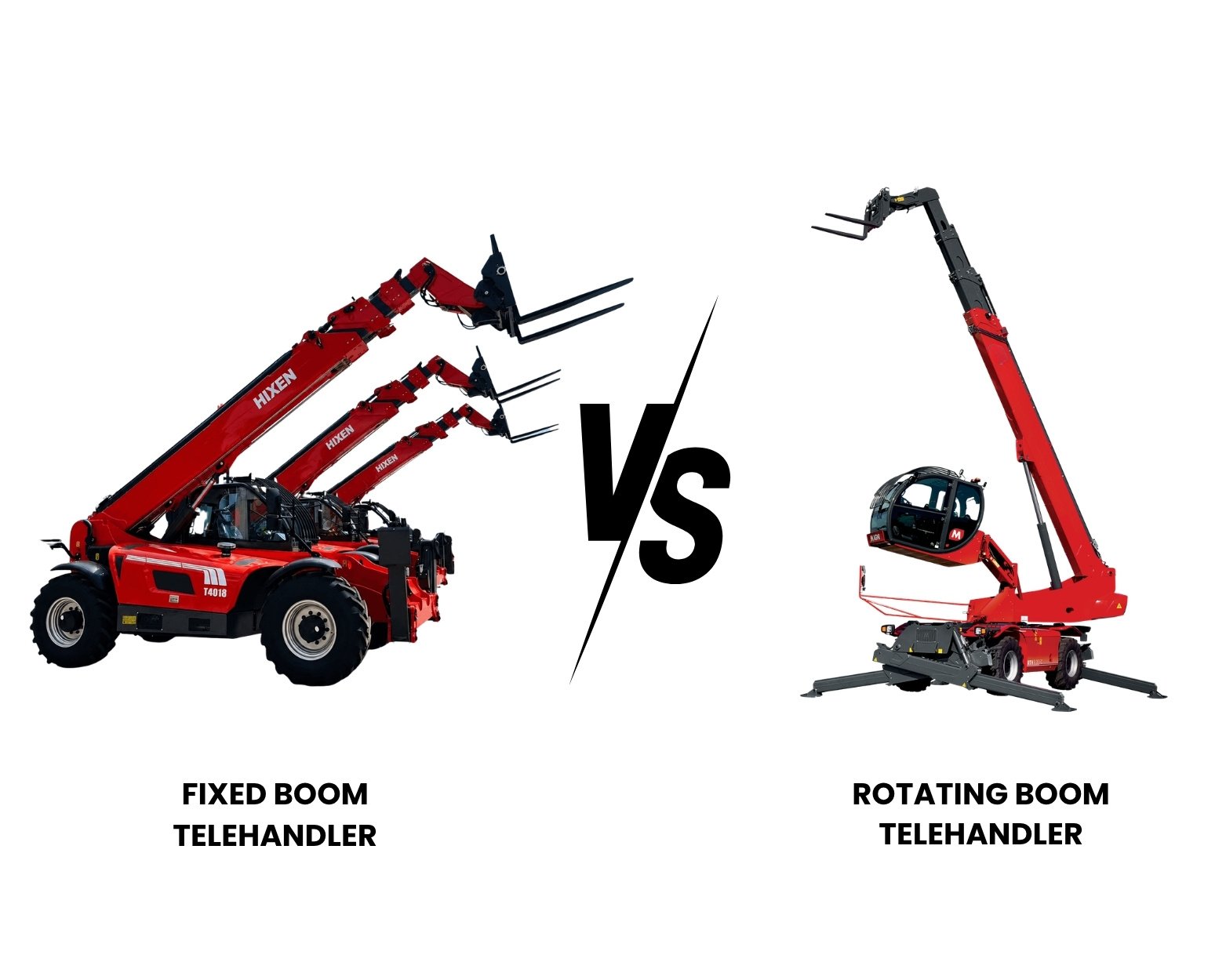
The choice between a fixed and rotating boom fundamentally changes how you work on site. From a manufacturer’s perspective, the engineering difference is significant, and so is the operational impact for the user. A fixed boom telehandler is the industry workhorse. It’s mechanically simpler, more robust, and generally less expensive to purchase and maintain. It excels at straightforward “pick and carry” tasks where you are moving materials from point A to point B in a relatively straight line.
A rotating telehandler, however, is a game-changer for complex, congested sites. It can be parked in one spot and service a wide circular area. This is invaluable in urban construction or on busy sites where repositioning a large machine is impractical or impossible. While they are more complex and carry a higher price tag, the productivity gains can be enormous.
Here’s a direct comparison from a procurement standpoint:
| Característica | Fixed Boom Telehandler | Manipulador telescópico giratorio |
|---|---|---|
| Uso primario | Straight-line lifting, pick and carry | 360-degree placement, congested sites |
| Maniobrabilidad | Requires whole vehicle movement | Boom rotates from a stable base |
| Complejidad | Simpler, fewer moving parts | More complex, requires skilled operator |
| Costo | Lower initial investment & maintenance | Higher initial investment & maintenance |
| Mejor para | Open sites, agriculture, general construction | Urban construction, tight spaces, crane-like tasks |
Telehandler Types by Size Class: Mini, Mid-Size, or Heavy-Duty?
Does your project need a compact machine for tight spaces or a heavy-lifter for massive loads? Selecting the wrong size can halt your project or waste your budget.
Telehandler sizes are categorized by their lift capacity and reach. Mini (compact) for small jobs, mid-size for general use, and heavy-duty for maximum height and weight, like lifting materials to the top floors of a building.

As a factory, we build telehandlers to meet a wide spectrum of demands, and size is the most fundamental specification. A mini or compact telehandler, typically lifting up to 2.5 tons, is perfect for landscaping, residential construction, or tasks inside buildings where space is at a premium. They are nimble and can navigate tight corners easily. Mid-size telehandlers are the all-rounders, with capacities from 2.5 to 4 tons and reaches around 10-14 meters. They are the most common type you’ll see because they balance capability with maneuverability for general construction and agricultural work.
Then you have the heavy-duty class. These are the machines we specialize in, like our HIXEN HX6018, which handles 6 tons and reaches up to 18 meters. These models are engineered for the most demanding jobs: large-scale commercial construction, infrastructure projects, and industrial yards. They are built with stronger chassis, more powerful engines, and a focus on stability at extreme heights and reaches.
| Size Class | Typical Lift Capacity | Typical Reach Height | Common Applications |
|---|---|---|---|
| Mini (Compact) | 2.0 – 2.5 tons | 4 – 7 meters | Landscaping, residential, interior work |
| Mid-Size | 2.5 – 4.0 tons | 7 – 14 meters | General construction, farming, rental yards |
| Heavy-Duty | 4.0 – 7.0+ tons | 14 – 18+ meters | Large construction, industrial, high-reach jobs |
Telehandler Types by Power Source: Diesel vs Electric?
The choice between diesel and electric power impacts your running costs, emissions, and job site suitability. Will you prioritize raw power or eco-friendly operation for indoor use?
Diesel telehandlers offer powerful performance and are ideal for outdoor, heavy-duty tasks. Electric models are quiet, produce zero emissions, and are perfect for indoor applications, sensitive environments, or areas with strict noise regulations.
The engine is the heart of the telehandler, and the choice between diesel and electric is becoming more important every year. For decades, diesel has been the undisputed king. It provides the raw torque and sustained power needed for heavy lifting and operating on rough terrain all day long. Diesel engines are proven, reliable, and can be refueled in minutes, minimizing downtime on demanding construction and agricultural sites. This is why the vast majority of mid-size and heavy-duty machines, which need that constant power, are diesel-powered.
However, the rise of electric telehandlers is undeniable. They are a response to the growing need for work in emission-sensitive areas. Think food processing plants, indoor construction, or urban zones with strict environmental laws. Electric models run silently and cleanly. While their current lift capacities and runtimes are generally lower than their diesel counterparts, and they require charging infrastructure, battery technology is improving rapidly. For specific niche applications, they are not just an alternative; they are the only viable option.
| Power Source | Mejor caso de uso | Pros | Cons |
|---|---|---|---|
| Diesel | Outdoor, heavy-duty, rough terrain | High power/torque, long runtime, fast refueling | Noisy, emissions, requires fuel storage |
| Electric | Indoor, quiet zones, light/medium duty | Zero emissions, quiet operation, lower running cost | Lower capacity, limited runtime, needs charging |
Telehandler Types by Application: Construction, Agriculture, or Industrial/Port?
Using a construction telehandler on a farm can be inefficient. Each industry has unique demands. How do you ensure your machine is built for your specific environment?
Construction telehandlers prioritize reach and ruggedness. Agricultural models focus on speed and attachment versatility. Industrial or port handlers are built for repetitive, heavy lifting in paved environments, often with specialized attachments.
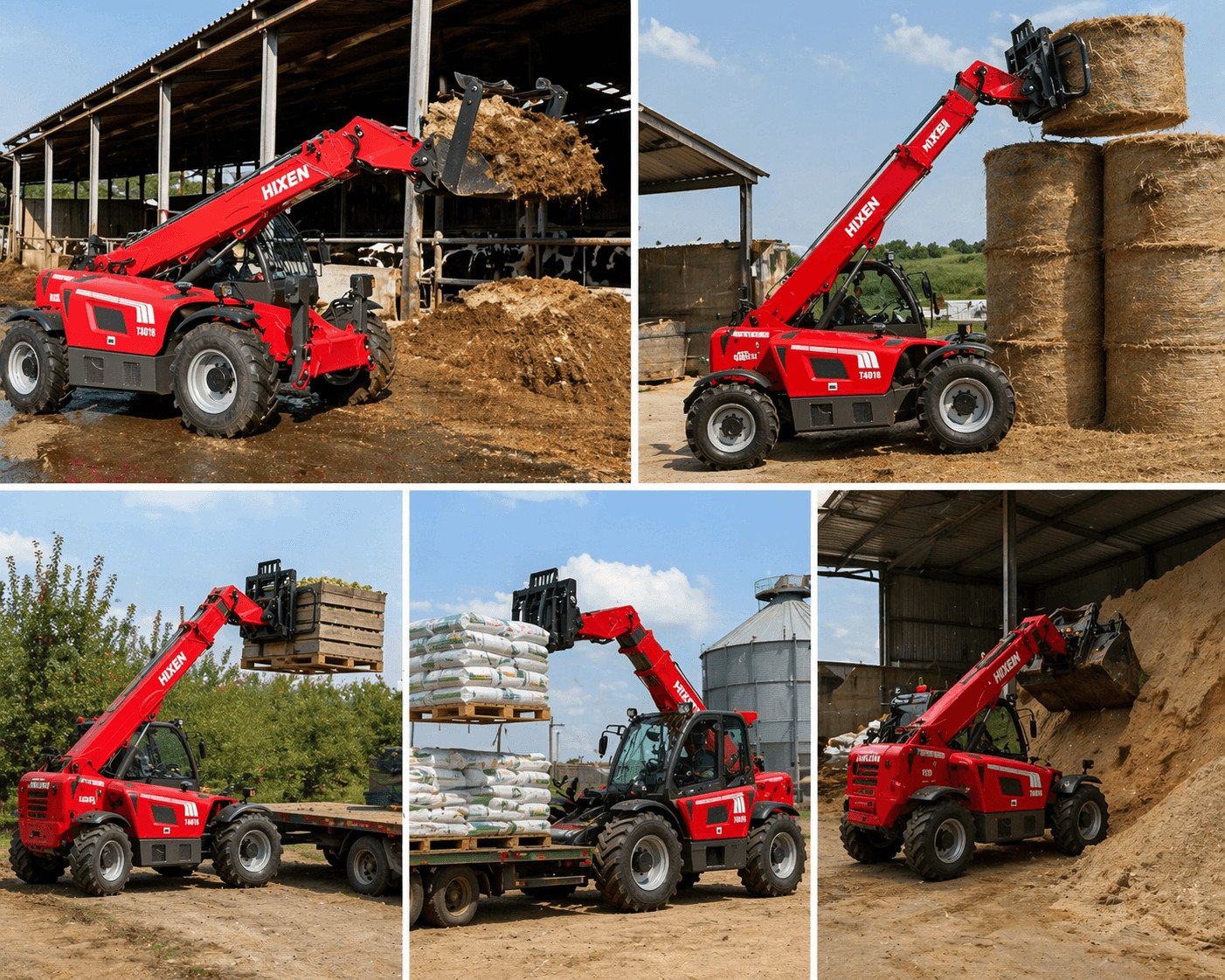
We engineer machines with specific industries in mind because the demands are so different. A telehandler for a construction site needs maximum lift height and forward reach. It’s all about placing materials like bricks, steel beams, and roofing supplies on multi-story buildings. That’s why our HIXEN 18-meter series is popular in this sector; it’s built for stability and precision at height on rugged, uneven ground. Durability and robust 4×4 capability are non-negotiable.
In agriculture, the machine is used more like a super-powered tractor. It needs to be faster for moving between barns, and the focus shifts to a wide variety of attachments: buckets for grain, bale spears for hay, and grapples for silage. Lift height is often less critical than cycle speed and hydraulic power for attachments.
Industrial and port applications are another world entirely. These machines often operate on smooth concrete, so rugged off-road tires may be swapped for solid industrial ones. The work involves repetitive lifting of heavy, uniform loads, like containers or large components. Durability and speed for quick loading/unloading cycles are the primary concerns.
| Solicitud | Key Requirement | Common Features | Typical Attachments |
|---|---|---|---|
| Construcción | Lift height, forward reach, stability | Robust chassis, 4×4, stabilizers | Forks, buckets, man-baskets |
| Agricultura | Speed, attachment versatility, power | Higher road speed, powerful hydraulics | Bale spears, grain buckets, grapples |
| Industrial/Port | Lift capacity, durability, cycle speed | Solid tires, reinforced chassis | Heavy-duty forks, container handlers |
How to Match Telehandler Type to Your Project?
You know the types, but how do you read between the lines of a spec sheet? A great-looking number on paper can be misleading on the job site, a costly mistake I’ve seen too often.
Look beyond the maximum lift capacity. The most critical factor is the machine’s load chart, which shows the actual safe lifting capacity at different boom extensions and angles. Always prioritize this real-world data.
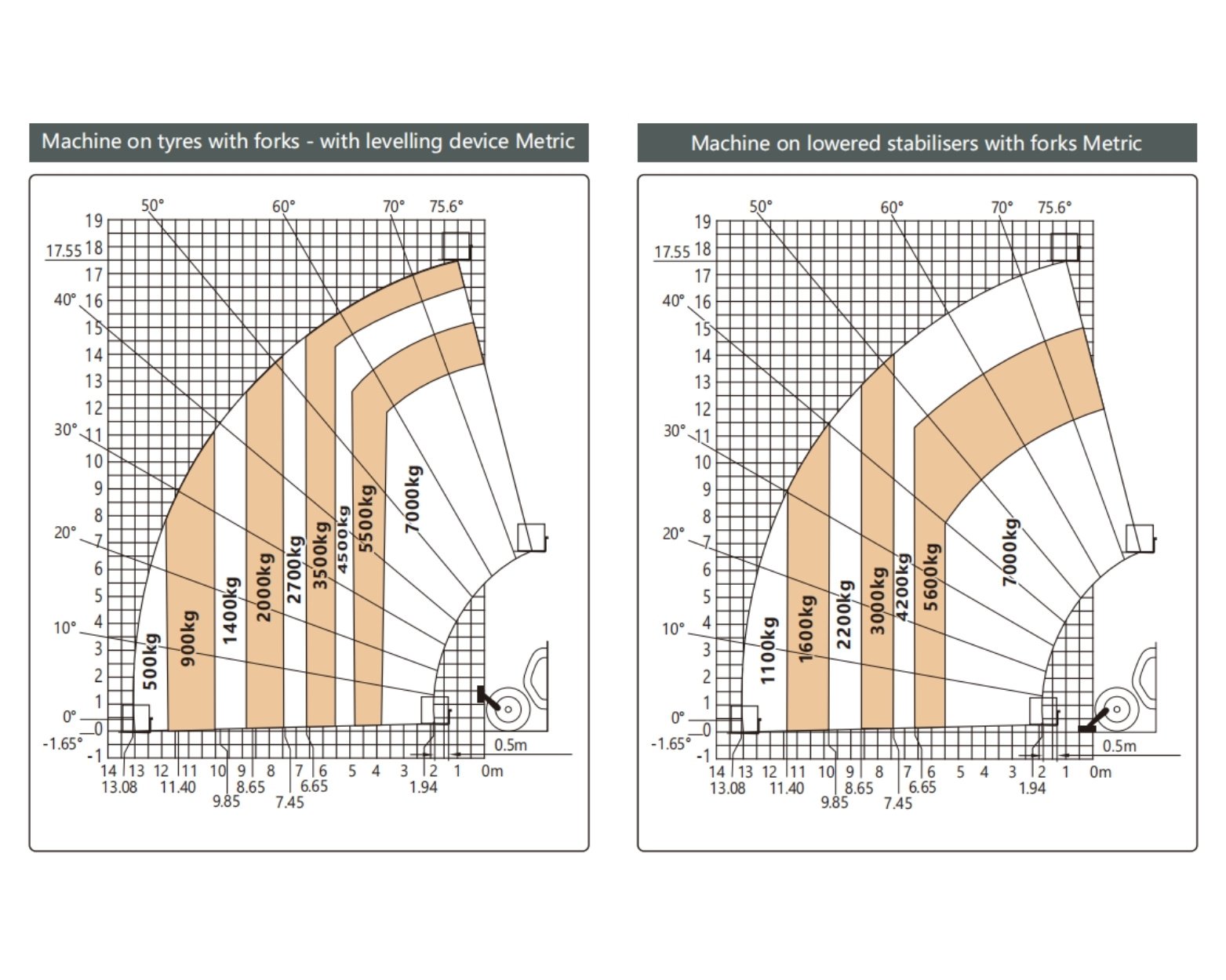
As a manufacturer, I want my clients to succeed. That means being honest about what the numbers mean. The biggest pitfall for buyers is confusing the “rated maximum load” with the “actual safe load at full extension.” A telehandler rated for 5 tons can likely only lift that weight close to the machine with the boom retracted. Once you extend that boom up and out, the laws of physics take over, and the safe capacity can drop dramatically—often by 50% or more. Always, always ask for and analyze the load chart. This chart is the true test of a machine’s capability for your specific task. It tells you exactly how much you can lift at the maximum height and reach your project requires.
Beyond the load chart, consider the terrain. Will you be on mud, gravel, or pavement? This dictates your choice of tires—pneumatic for versatility, foam-filled for puncture-proof reliability, or solid for hard surfaces. Ensure the machine has the 4×4 and steering modes (2-wheel, 4-wheel, crab steer) you need to navigate your site effectively. Finally, think about attachments. The telehandler is only a prime mover; its value comes from the work it does with attachments. Confirm that the machine you’re considering has the hydraulic flow and compatibility for the tools you need now and in the future.
Conclusión
Choosing the right telehandler involves matching its type, size, and power to your job’s specific demands. Always prioritize the load chart over simple capacity ratings to ensure safety and efficiency.
Final Procurement Checklist:
Before you sign any purchase order, run through these final checks:
- Load Chart: Have I verified the machine’s capacity at my project’s required height y reach?
- Dimensions: Will the machine’s width, height (with boom down), and turning radius fit my job site?
- Terrain & Tires: Are the tires and drivetrain (4×4) suitable for my ground conditions?
- Adjuntos: Is the telehandler compatible with all the attachments I need? Does it have the required hydraulic flow?
- Operator Skill: Is this a simple fixed-boom or a complex rotating model? Do I have a trained operator?

