
Choosing the right forklift isn’t just about lifting capacity — it’s about matching the machine to your terrain, your workspace, and the loads you handle every day. A forklift built for a warehouse aisle will struggle on a muddy job site, and a machine designed for rough terrain is often overkill for indoor pallet racking. Understanding the different types of forklifts on the market helps you avoid costly mismatches and choose equipment that actually fits your operation.
In this guide, we’ll walk through the main types of forklifts, explain how telehandlers fit into the picture (and where they differ), and give you a practical framework for choosing the right machine for your job.
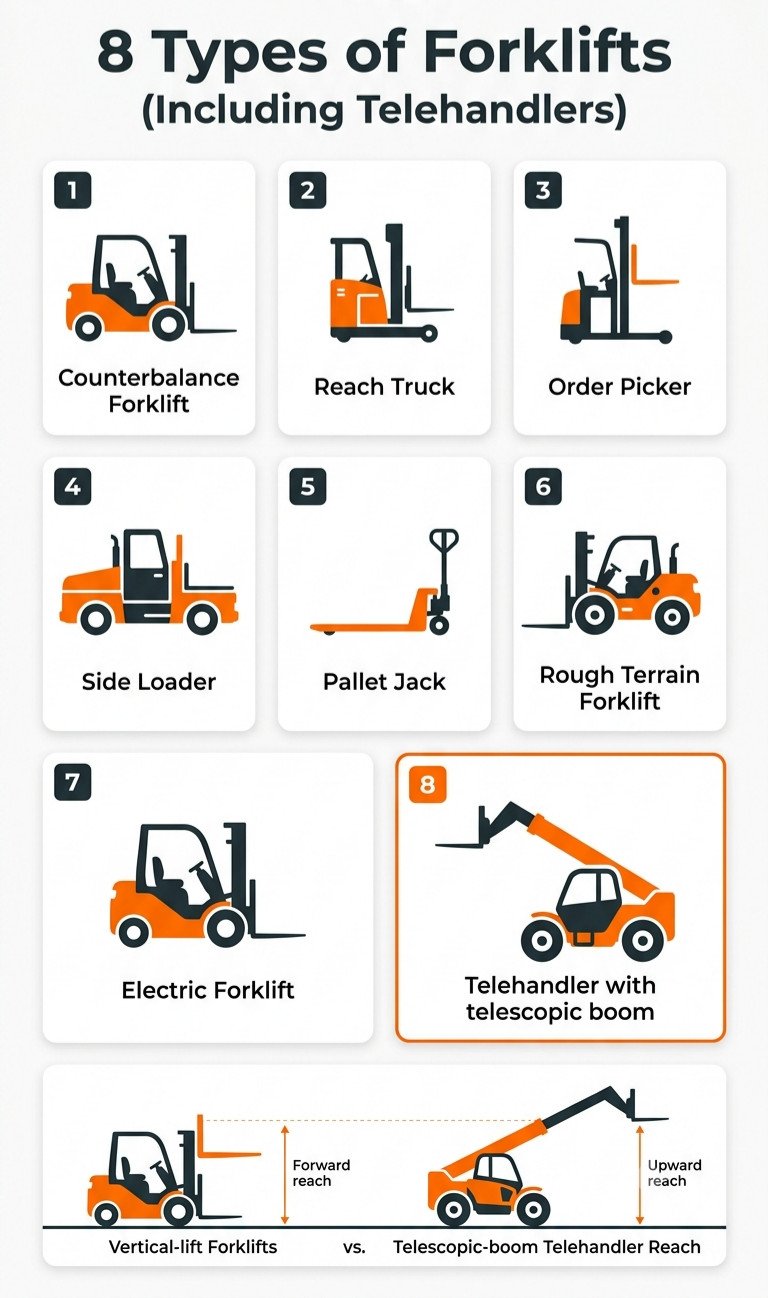
Types of Forklifts by Design and Function
1. Counterbalance Forklifts
The counterbalance forklift is the classic image most people picture when they hear “forklift.” It uses a heavy counterweight at the rear to offset the load on the forks, which sit at the very front of the machine with no outrigging arms needed. This design makes it highly maneuverable in warehouses, distribution centers, and manufacturing floors where loading docks and pallet racks are the norm. Counterbalance forklifts come in both internal combustion and electric versions, and typically handle loads from 1 to 5 tons.
2. Reach Forklifts
Reach trucks are built specifically for narrow-aisle warehouse work. Outrigger legs extend forward to stabilize the machine while the mast — and sometimes the entire carriage — reaches out to place or retrieve pallets deep in high-bay racking. Because they’re electric and compact, reach forklifts are a staple in cold storage and high-density distribution centers where maximizing vertical storage matters more than outdoor mobility.
3. Order Picker Forklifts
Unlike other forklift types, order pickers raise the operator along with the load, allowing them to manually select individual items from shelving rather than moving whole pallets. These are essential in e-commerce fulfillment and retail distribution centers where “each-picking” is part of the daily workflow.
4. Side Loader Forklifts
Side loaders lift loads from the side rather than the front, which makes them ideal for handling long, awkward materials like lumber, pipe, and steel bar stock. Operators drive alongside a narrow aisle instead of turning into it, saving significant aisle space in yards and warehouses that store long-format goods.
5. Pallet Jacks and Walkie Stackers
At the lighter-duty end of the spectrum, pallet jacks and walkie stackers are compact, low-cost machines for moving pallets short distances. Walkie stackers add vertical lift capability, making them useful for smaller businesses and low-volume racking without the investment of a full sit-down forklift.
6. Rough Terrain Forklifts
Rough terrain forklifts are built with large, heavily treaded tires and reinforced frames to operate on unpaved, uneven, or muddy ground — construction sites, lumber yards, and outdoor storage areas. They resemble counterbalance forklifts in layout but trade warehouse maneuverability for outdoor durability and traction.
7. Electric Forklifts
Electric forklifts span several of the categories above (counterbalance, reach, order picker) but deserve their own mention because of how fast this segment is growing. Battery-electric models produce zero emissions, run quieter, and cost less to maintain over time — making them the default choice for indoor operations and increasingly common in outdoor fleets as battery technology improves.
8. Telescopic Handler Forklifts
Telehandlers — also called telescopic handlers — are one of the most versatile machines in the material handling world, and they’re often grouped with forklifts because of one shared feature: forks. But a telehandler is built around fundamentally different engineering, and it’s worth understanding why.
Instead of a vertical mast, a telehandler uses a telescopic boom that extends both upward and outward, similar to a crane. This lets it lift materials to heights of 7 to 18 meters and reach over obstacles — placing loads on rooftops, scaffolding, or upper floors that a standard forklift simply cannot access. Combined with four-wheel drive and rough terrain tires, telehandlers are engineered to work confidently on the uneven, muddy, and unpredictable ground found on construction sites and farms, not the flat concrete floors forklifts are designed for.
Is a telehandler considered a forklift?
Technically, no — a telehandler and a forklift are different classes of equipment. A forklift lifts straight up along a fixed vertical mast, while a telehandler’s boom extends outward as well as upward, giving it far greater reach and height. However, because telehandlers commonly use fork attachments and perform many of the same load-lifting tasks, they’re frequently discussed alongside forklifts and are sometimes marketed as “telehandler forklifts.” The key distinction: a telehandler behaves like a hybrid between a forklift and a crane, offering reach and rough-terrain capability that a traditional forklift can’t match.
This hybrid design is exactly why telehandlers have become the go-to machine for construction, agriculture, and logistics applications:
- Extended reach and height — telescopic booms lift materials to elevated work areas that forklifts and standard loaders can’t reach
- Rough terrain performance — four-wheel drive and off-road tires handle muddy, uneven, or sloped ground
- Attachment versatility — pallet forks, buckets, grapples, winches, and work platforms let one machine replace two or three pieces of separate equipment
- Load capacity — typical models handle 3 to 6 tons, with lifting heights scaling from 7m up to 18m depending on the configuration
For operations that need both the lifting precision of a forklift and the reach of a crane — especially outdoors — a telehandler is usually the more capable investment. HIXEN’s construction telehandler lineup covers 3–6 ton capacities with boom heights from 7m to 18m, purpose-built for job sites where standard forklifts fall short.

Forklift Classification by OSHA Class (I–VII)
For buyers in the U.S. and other markets that follow OSHA-style classification, forklifts are grouped into seven official classes based on power source and design:
| Class | Type | Power Source |
|---|---|---|
| I | Electric motor rider trucks | Electric |
| II | Electric motor narrow-aisle trucks | Electric |
| III | Electric motor hand trucks / walkie stackers | Electric |
| IV | Internal combustion, cushion tires | Gas/Diesel/LPG |
| V | Internal combustion, pneumatic tires | Gas/Diesel/LPG |
| VI | Electric and IC tractors | Electric/Gas/Diesel |
| VII | Rough terrain forklifts (including many telehandlers) | Diesel |
This classification is primarily used for operator certification and safety training purposes, so it’s a useful reference if your business needs to standardize training across a mixed equipment fleet.
How to Choose the Right Forklift for Your Job
The right forklift type comes down to three questions: where will it operate, what will it lift, and how high does it need to reach?
- Flat, indoor warehouse floors, standard pallet loads → Counterbalance or reach forklift
- Narrow aisles, high-bay racking → Reach forklift or order picker
- Long or oversized materials (lumber, pipe) → Side loader
- Low-volume, short-distance moves → Pallet jack or walkie stacker
- Outdoor yards, construction sites, uneven ground → Rough terrain forklift or telehandler
- Need to lift materials to height, over obstacles, or across rough terrain → Telehandler
If your work is confined to a warehouse floor, a traditional forklift is almost always the simpler and more cost-effective choice. But if your operation involves construction, agriculture, ports, or any environment where you need height, reach, and rough-terrain mobility in one machine, a telehandler typically delivers better return on investment than running separate forklifts and cranes side by side.
.jpg)
FAQ
What is the most common type of forklift? The counterbalance forklift is the most widely used type worldwide, thanks to its simple design and versatility across warehouses, manufacturing plants, and distribution centers.
What’s the difference between a forklift and a telehandler? A forklift lifts loads vertically along a fixed mast, while a telehandler uses a telescopic boom that extends both up and outward — giving it greater reach, lifting height, and rough-terrain capability than a standard forklift.
Can a telehandler replace a forklift? In many outdoor and construction settings, yes. A telehandler can perform most forklift tasks while also reaching heights and handling terrain that a standard forklift cannot, though indoor warehouse work is usually still better suited to a traditional forklift.
What size telehandler do I need? It depends on your load weight and required lift height. Telehandlers generally range from 3 to 6 tons in capacity with booms extending from 7m to 18m — matching the right combination to your job site avoids paying for capacity you won’t use.
Conclusion
From compact pallet jacks to long-reach telehandlers, “forklift” covers a wide range of machines built for very different jobs. Warehouses generally need the precision and efficiency of counterbalance, reach, or electric forklifts, while construction sites, farms, and outdoor material handling operations get more value from the reach, height, and rough-terrain performance of a telehandler.
If your work involves lifting materials to height, across rough ground, or into hard-to-reach spaces, explore HIXEN’s telehandler range — factory-direct pricing, 3 to 6 ton capacities, and boom heights up to 18m, built for real job site conditions.

